
Welcome:
Login
|
Sign Up
|
About CircleID
Follow:
|
|


|
||
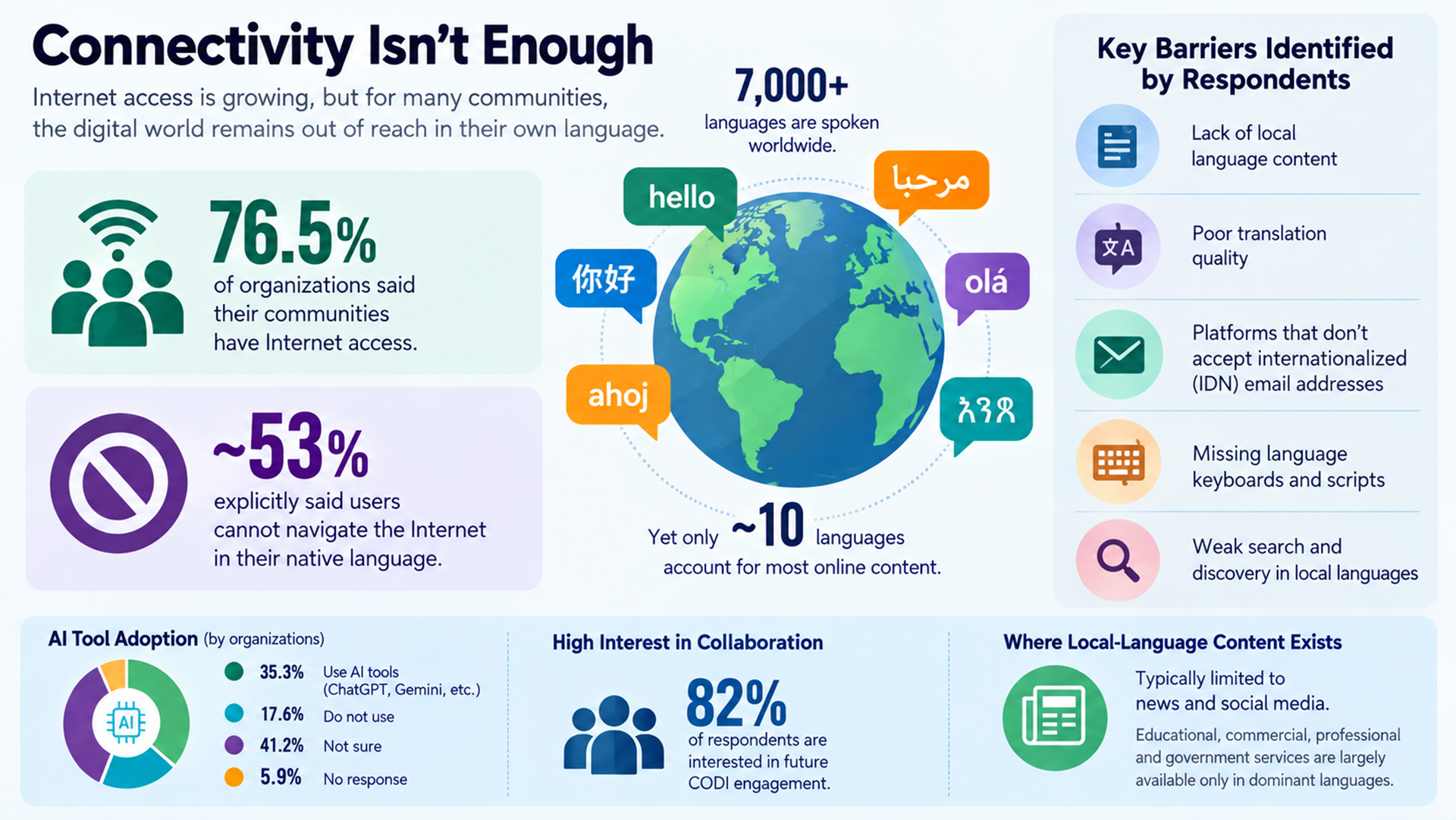
The Coalition on Digital Impact (CODI) has published its first State of Digital Access report, finding that Internet connectivity alone does not translate into meaningful digital participation when users cannot navigate services, find content or complete transactions in their own languages.
The report, Global Web: The State of Digital Access, 2026, examines what CODI describes as a mismatch between demand from underserved language communities and the programs, policies and technologies intended to expand digital participation. More than 7,000 languages are spoken worldwide, while approximately 10 account for most online content, according to the report.
More than half of surveyed organizations reported a native-language access problem. CODI surveyed organizations working directly with underserved language communities between December 2025 and February 2026, with respondents operating across Africa, Asia, Australia, North America and Europe.
The accompanying survey summary says 76.5% reported that their communities had Internet access, but roughly 53% said users could not navigate the Internet in their native language. Respondents identified missing local-language content, poor translation, rejection of internationalized email addresses, missing keyboards and scripts, and weak local-language search and discovery among recurring barriers.
The report says local-language material, where available, is often concentrated in news and social media, while educational, commercial, professional and government services remain predominantly available in dominant languages. It also documents problems including limited search indexing, poor support for non-Latin scripts and online forms that reject Internationalized Domain Name email addresses.
Universal Acceptance addresses only part of the problem. CODI describes Universal Acceptance—ensuring that domain names, internationalized email addresses and scripts are correctly accepted and processed across Internet-enabled systems—as an essential technical foundation for multilingual participation. But the report argues that users also require searchable content, usable services, appropriate input tools and trustworthy information in their languages.
The supply side presents a different problem. CODI reviewed digital-development programs and policies from governments, multilateral bodies and technology organizations and found substantial investment in infrastructure, digital skills, governance and innovation. It says linguistic inclusion, however, is rarely treated as a foundational design requirement; language support is more commonly introduced through translation or localization after systems have been developed.
AI could amplify the existing imbalance. The report notes investments in low-resource and multilingual language models, including Meta’s No Language Left Behind work and initiatives from Google, but says most AI language projects still cover only a subset of the world’s languages. Commercial investment also tends to follow market size, leaving many underrepresented languages outside the strongest areas of development.
CODI also identifies a coordination gap: community organizations seeking localized content, multilingual technology, funding and policy support often operate separately from the governments, funders and technology providers investing in digital development. The organization plans to build on the baseline with research partnerships, crowdsourced contributions and a searchable catalog of digital-access resources.
Sponsored byVerisign

Sponsored byIPv4.Global

Sponsored byRadix

Sponsored byWhoisXML API

Sponsored byVerisign

Sponsored byDNIB.com

Sponsored byCSC


A World-Renowned Source for Internet Developments. Serving Since 2002.