
Welcome:
Login
|
Sign Up
|
About CircleID
Follow:
|
|



|
||
|
||
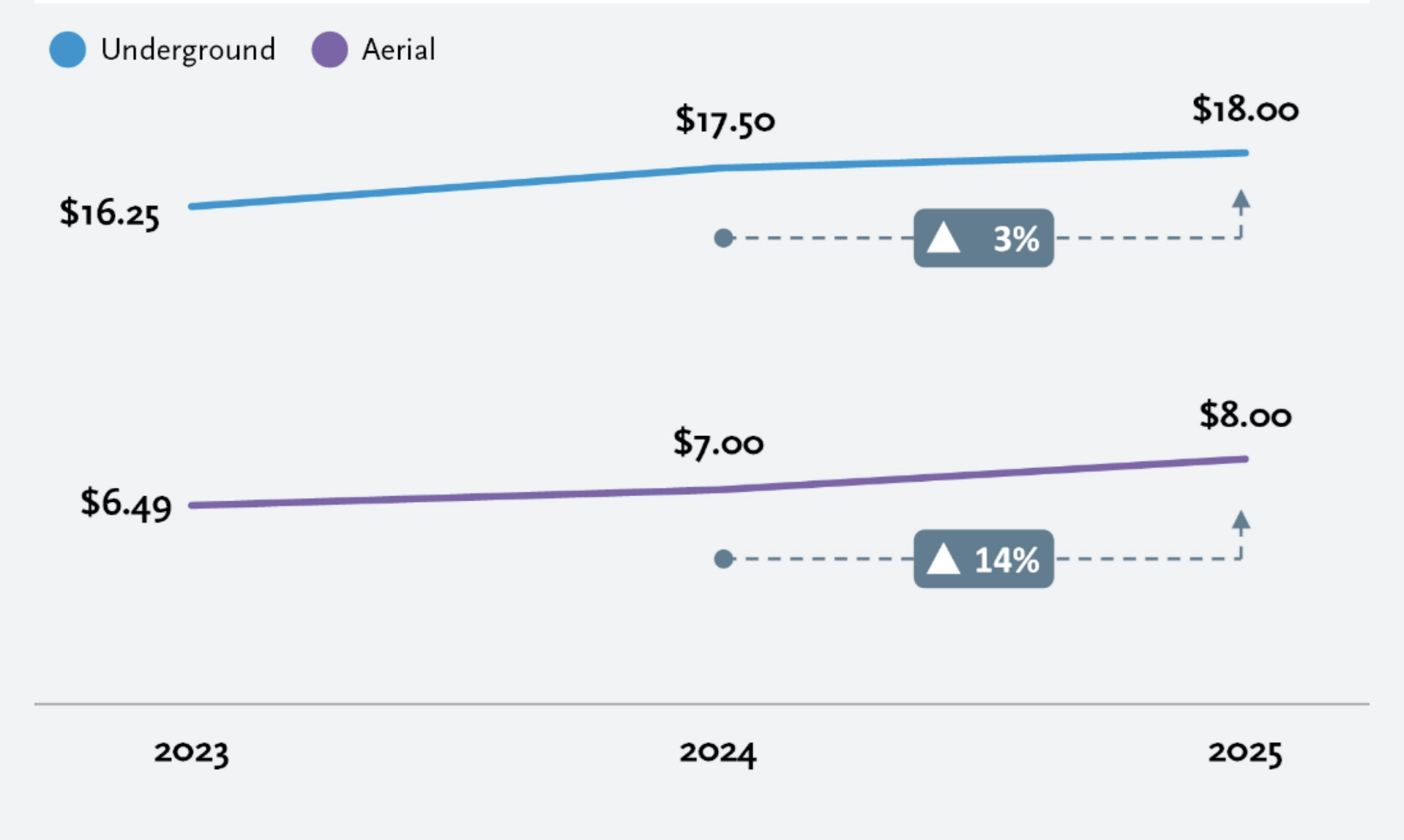
The Fiber Broadband Association, along with its consultant, Cartesian, published its annual report on the cost of fiber deployment in the United States. The report was compiled from online surveys and phone interviews conducted in September and October 2025.
The report includes a lot of interesting statistics and trends for anyone preparing to build fiber.
The most relevant news from the report is that 88% of the respondents expect a cost increase for construction in 2026. 62% of respondents expect a ‘slight’ cost increase of less than 10%. 26% expect a cost increase of more than 10%. 9% expect costs to stay the same, and 3% expect costs to decrease by less than 10%.
Nearly two-thirds (62%) of respondents said they expect fiber deployment costs to rise “slightly” (less than 10%) compared to 26% who expect a “significant” increase of 10% or more. About 9% expect costs to stay the same, and 3% expect costs to decrease by 10% or less. Considering all responses, 88% of respondents expect costs to increase again in 2026.
Note that the cost increases experienced in 2025 and the expected increases expected for 2026 are national averages. Responses to the survey came from 38 different states, and there was a fairly even split between urban, suburban, and rural fiber builders. National averages blur the significant differences in the cost of labor in different parts of the country. National averages also even out the differences between the big fiber builders who build huge numbers of miles of fibers, and smaller ISPs building smaller projects. The labor costs in a national survey also include projects built with prevailing wages, projects built at union wages, and projects built at market non-union wages. The averages also blend the costs from ISPs that build with employees versus those that use contractors.
I have to wonder if all of the folks who plan to build fiber with BEAD grants have built in a possible cost increase for fiber construction of 10% per year. That would mean that fiber built in the fourth year might be 33% more expensive than what was built in the first year.
The report is well worth reading for anyone planning to build fiber, as it’s full of interesting statistics. For example, an interesting statistic is that a buried construction crew of 3 can build around 1,000 feet per day, while a crew of 7 can build 1,585 feet per day. A crew of 3 can build 1,800 feet of aerial fiber per day, while a crew of 6 can build 4,000 feet per day. These statistics show there isn’t a big benefit from using large crews compared to using multiple smaller crews.
Another interesting statistic was drop costs. The average cost for a buried drop under 100 feet was $556, while the cost for a 500+ foot drop was $675. The average cost for an aerial drop under 100 feet was $338, while the cost for a 500+ foot drop was $400. These numbers also blend the cost of ISPs that build drops using in-house staff versus those that use all contract labor.
Sponsored byCSC

Sponsored byDNIB.com

Sponsored byVerisign

Sponsored byRadix

Sponsored byIPv4.Global

Sponsored byWhoisXML API

Sponsored byVerisign


A World-Renowned Source for Internet Developments. Serving Since 2002.