
Welcome:
Login
|
Sign Up
|
About CircleID
Follow:
|
|


|
||
France Telecom has reported today that 3 major underwater cables were cut: “Sea Me We 4” at 7:28am, “Sea Me We3” at 7:33am and FLAG at 8:06am. The causes of the cut, which is located in the Mediterranean between Sicily and Tunisia, on sections linking Sicily to Egypt, remain unclear.
Most of the B to B traffic between Europe and Asia is rerouted through the USA. Traffic from Europe to Algeria and Tunisia is not affected, but traffic from Europe to the Near East and Asia is interrupted to a greater or lesser extent (see country list below).
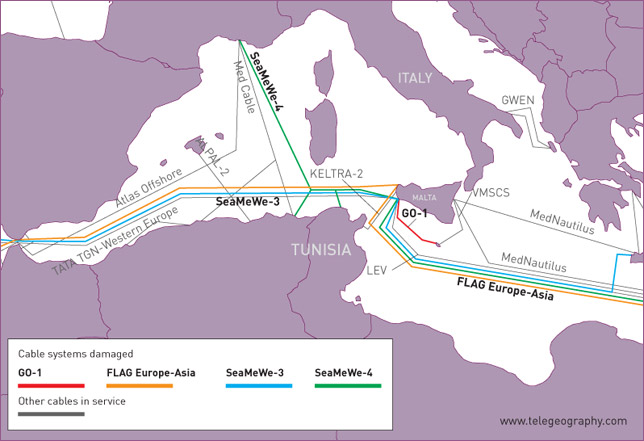 Three undersea cables – Sea Me We3 partly, Sea Me We4 and FLAG – cut in the morning hours of December 19, 2008, causing significant Internet access disruptions between Europe and Asia/Near East zone. Map by TeleGeography
Part of the internet traffic towards Réunion is affected as well as 50% towards Jordan. A first appraisal at 7:44 am UTC gave an estimate of the following impact on the voice traffic (in percentage of out of service capacity):
[Editor’s Note - Dec 21, 2008: The SeaMeWe-4 cable connects 12 countries: Pakistan, Indonesia, Singapore, Malaysia, Bangladesh, India, Sri Lanka, United Arab Emirates, Saudi Arabia, Egypt, Italy and France.]
France Telecom says that it immediately alerted one of the two maintenance boats based in the Mediterranean area, the “Raymond Croze”. This France Telecom Marine cable ship based at Seyne-sur-Mer has received its mobilization order early this afternoon and will cast off tonight at 3:00 am with 20 kilometers spare cable on board. It should be on location on Monday morning for a relief mission.
Priority will be given to the recovery of the Sea Me We4 cable, then on the Sea Me We3. By December 25th, Sea Me We4 could be operating. By December 31st, the situation should be back to normal.
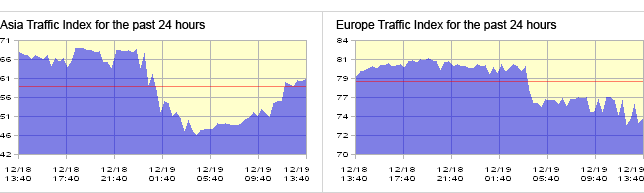 The “traffic index” is a score from 0 to 100 where 0 is “slow” and 100 is “fast”. It is determined by comparing the current response of a ping echo to all previous responses from the same router over the past 7 days. A score of 0 to 100 is then assigned to the current response depending on if this response is better or worse than all previous responses from that router. Source: Internet Traffic Report - December 19, 2008
Sponsored byDNIB.com

Sponsored byWhoisXML API

Sponsored byCSC

Sponsored byVerisign

Sponsored byIPv4.Global

Sponsored byVerisign

Sponsored byRadix


A World-Renowned Source for Internet Developments. Serving Since 2002.