
Welcome:
Login
|
Sign Up
|
About CircleID
Follow:
|
|


|
||
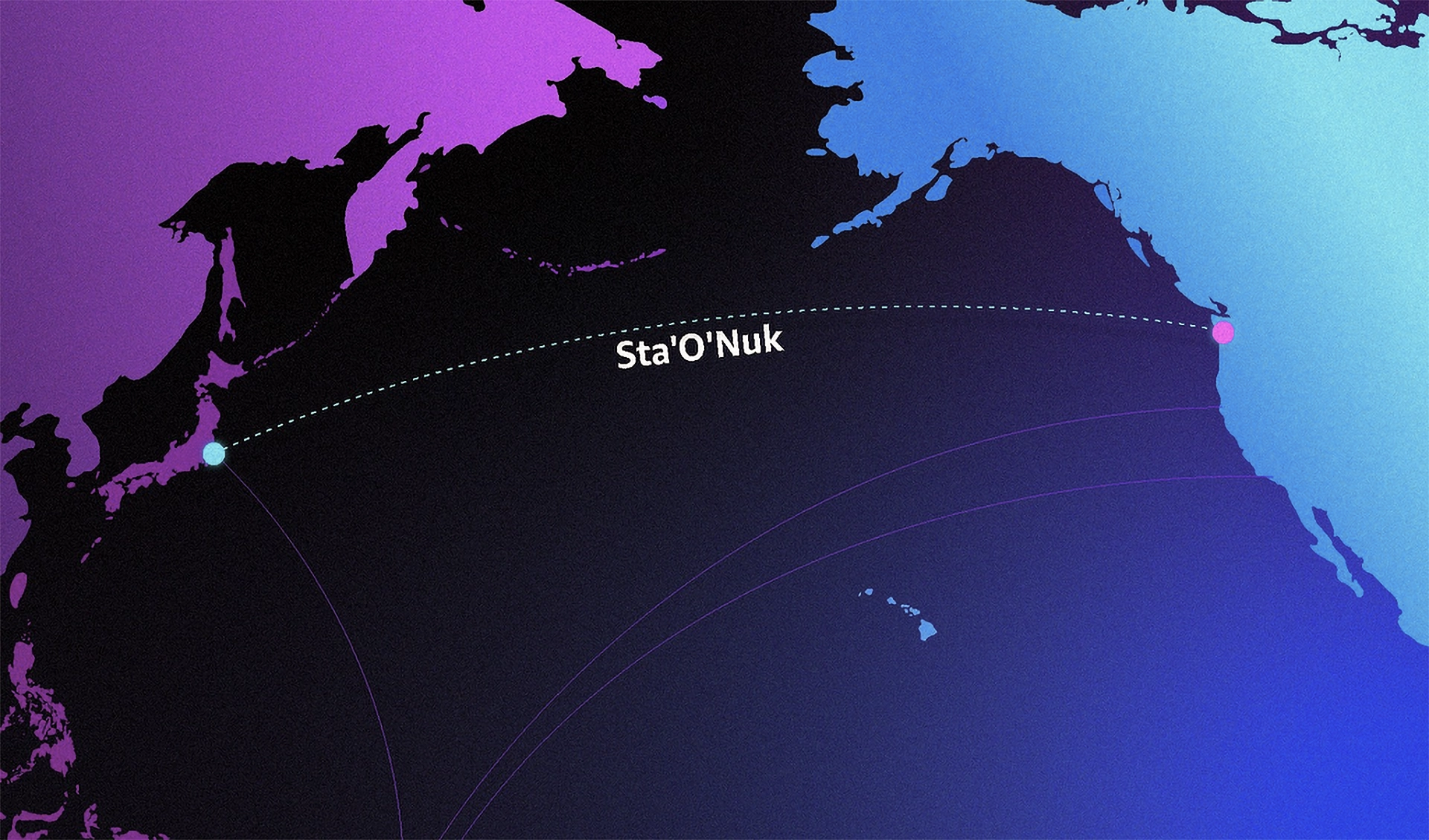
Amazon Web Services plans to build a new transpacific subsea cable between the United States and Japan, adding a geographically distinct route to its global network and 420 terabits per second of designed capacity when the system enters service in 2029.
The cable, called Sta’O'Nuk, will use 20 fiber pairs and connect new or less-concentrated landing locations on both sides of the Pacific, according to AWS's announcement. The company says the U.S. endpoint will make Sta’O'Nuk the first international subsea cable system to land in Washington state in almost 30 years.
The route is intended to reduce dependence on established transpacific cable corridors. AWS says most of the more than 30 existing transpacific systems use concentrated gateways, particularly California and Oregon in the United States and Shima and the Chiba Peninsula in Japan. Geographic concentration can expose multiple cables to the same earthquakes, fishing and anchoring damage, or other disruptions.
Sta’O'Nuk will connect to the AWS Global Network, giving the cloud provider another path for moving traffic between North America and Asia-Pacific. AWS expects the additional capacity to support workloads ranging from financial transactions and video delivery to distributed AI training, although the stated performance and 2029 completion date remain plans rather than operational results.
AWS plans multiple layers of protection for traffic carried over the system. Its design calls for optical encryption at Layer 1 described by AWS as quantum-safe, MACsec at Layer 2, and higher-layer TLS/SSL or QUIC protection. Near shore, the cable is expected to be armored and buried at water depths of up to 1,500 meters.
The Washington landing involves the Quinault Indian Nation and Toptana, its Indigenous-owned subsea cable landing-station and backhaul venture. The Nation authorized AWS to use the Quinault name Sta’O'Nuk, translated by the company as “lightning serpent,” for the system.
The project arrives as hyperscale cloud and technology companies increasingly invest directly in the physical infrastructure carrying international Internet traffic. New systems are adding both capacity and alternative routes: the 10,500-kilometer SJC2 cable, for example, entered service in Asia in July 2025 with more than 126 Tbps of capacity, while the 8,000-kilometer Candle system connecting Japan with Southeast Asia is scheduled for service in 2028.
Sta’O'Nuk will also proceed under a changing U.S. regulatory regime. The Federal Communications Commission adopted revised submarine-cable licensing rules this year aimed at addressing national-security risks while promoting cable deployment; parts of the new framework take effect September 25.
Sponsored byDNIB.com

Sponsored byIPv4.Global

Sponsored byCSC

Sponsored byRadix

Sponsored byVerisign

Sponsored byVerisign

Sponsored byWhoisXML API


A World-Renowned Source for Internet Developments. Serving Since 2002.