
Welcome:
Login
|
Sign Up
|
About CircleID
Follow:
|
|


|
||
|
||
The most recent North American Network Operators Group (NANOG) meeting was held in mid-October 2026 in Miami. The opening keynote presentation was by TeleGeography’s Paul Brodsky on the topic of global Internet infrastructure.
Brodsky’s account points to a structural shift in global Internet infrastructure: traffic continues to grow, but investment and operational control are concentrating in a small number of hyperscalers. Submarine cables remain the high-capacity core of the global network, while low Earth orbit (LEO) systems extend broadband access into locations that terrestrial networks serve poorly. The important policy question is therefore not whether one platform will replace the other, but who will own, operate, and secure the increasingly complementary systems on which international connectivity depends, and to what extent the concentrated ownership profile represents a source of sovereign risk to many national communities.
The big picture story of the Internet’s infrastructure since its inception has been one of unrelenting demand growth. Growth rates were exceptionally high in the early 1990s as the core NSFNET in the United States transitioned into a mixed infrastructure with commercial providers established in parallel to the existing academic and research infrastructure. We experienced 100% annual growth rates in all parts of the network. Such massive demand growth rates are exceptionally challenging to manage over extended periods, as they call for a constant refresh of the underlying infrastructure and, from time to time, a comprehensive change in the internal architecture of the platform and a continual injection of capital. Although overall growth rates have slackened off from this unsustainable peak, the growth has remained to the present day, and the escalating demands we are placing on the network infrastructure have persisted. We’ve just completed a major architectural shift through the large-scale adoption of replicated service points and an overlay of content distribution networks as a means of pre-provisioning content and services closer to where users are located and where they demand access to content and services. The motivation for this architectural change was that it was intended to push the network’s growth pressures and associated infrastructure investment costs out to the network’s edge, relieving the acute manifestation of various growth pressures that were being experienced by the set of operators of the inner core of the network’s infrastructure.
To some extent, this redesign of the network platform has been effective in managing growth, insofar as when we look at the growth in demand for international bandwidth over the past 15 years, annual growth levels appear to be falling year by year. However, today’s 30% annual growth level still represents a significant impetus for increases in the total capacity of international bandwidth, as a figure in TeleGeography’s presentation illustrates (Figure 1). So it appears that this has not been as successful as was originally anticipated, in that while more user transactions have been pushed to edge transactions between data centers and users, the pressures on infrastructure resulting from the movement of increasingly large volumes of data across the core remain.
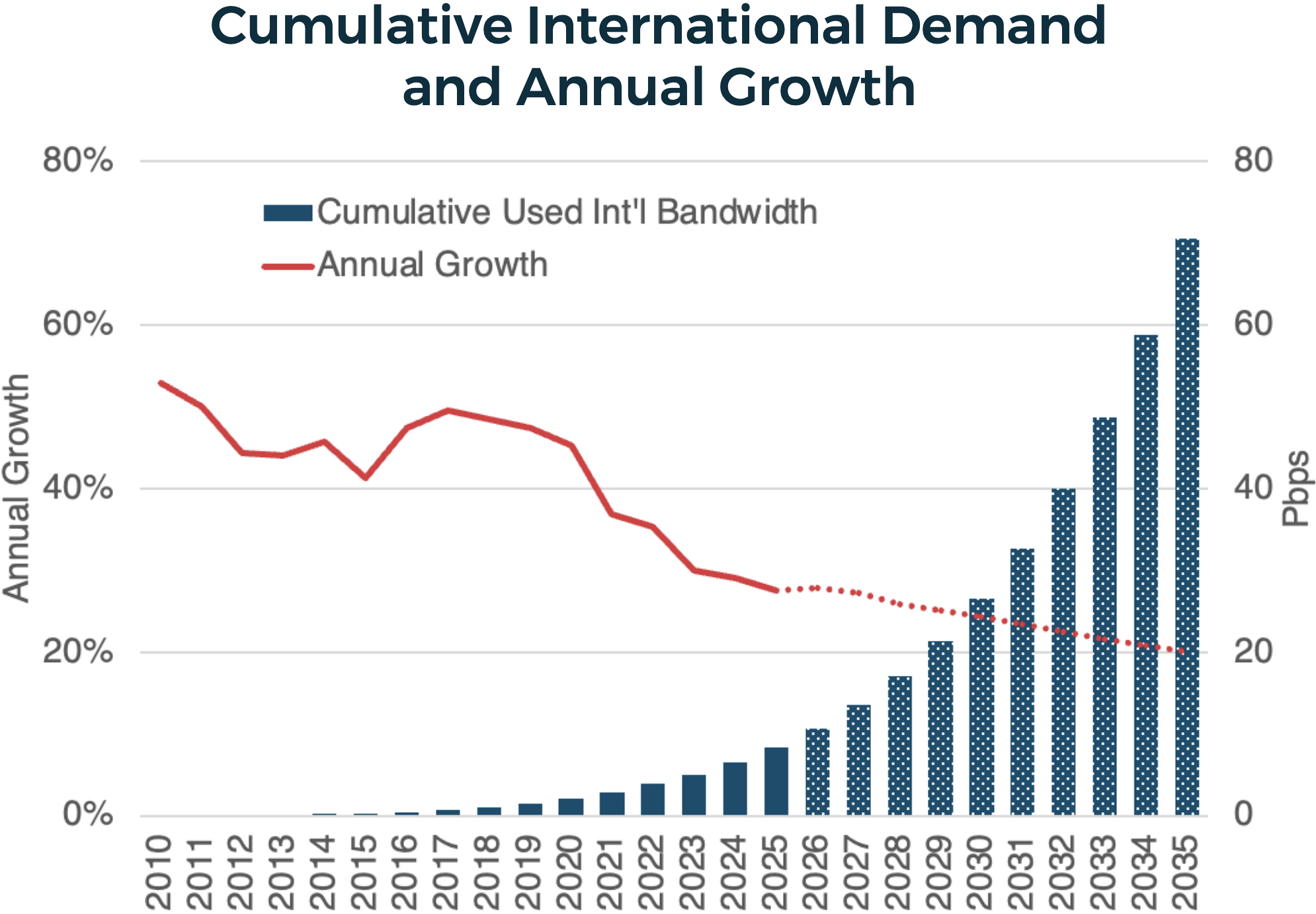
In such a constantly growing space, each annual increment in demand represents a constantly growing demand for additional in-service capacity, which is now some 2 Pbps per year, and will rise to more than 10 Pbps per year of additional global capacity in 2035.
We also need to factor in the service life of subsea cable infrastructure of some 25 years, which means that the large-scale increment of international cable capacity that was installed at the turn of the century is now demanding replacement. Approximately a quarter of the world’s current subsea cable kilometers are expected to be decommissioned and retired by 2030.
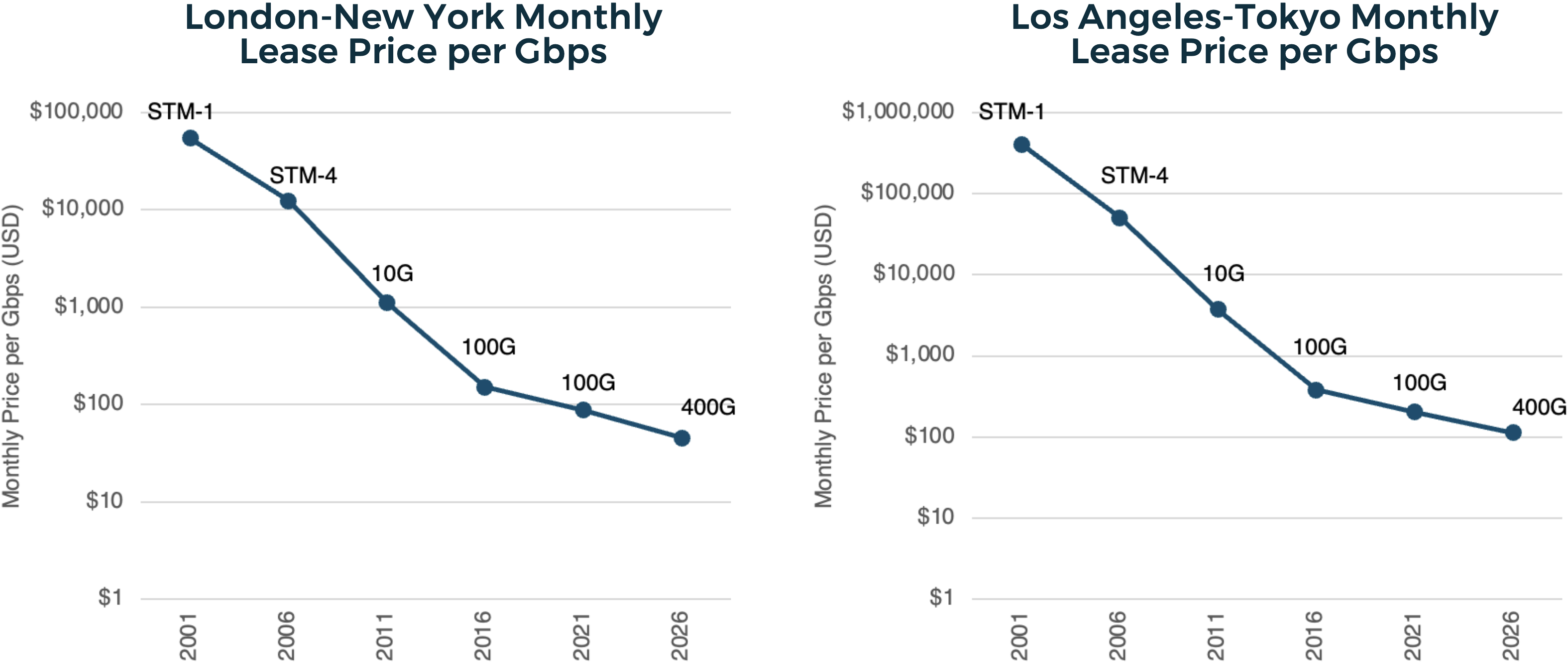
At the same time, there is a continuing improvement in cable capacity for these submarine cables, with more fiber pairs in a single physical cable, expanding the optical transmission capacity by using L- and C-band optics and now using two-core fiber strands instead of single-core fiber. The outcome has been a continuing improvement in the unit cost of capacity, and that is reflected in the market price of leased capacity on the major transatlantic and transpacific routes (Figure 2). This is a very critical factor in terms of demand trends. Falling unit costs expose additional tranches of price-sensitive demand, which then drives further increases in capacity. These higher-capacity systems can operate at higher levels of efficiency, which results in further falls in unit cost of new cable systems.
These two factors, an aging international submarine cable inventory and increased efficiency of new cable systems, are coupled with growing demand and a desire to improve resilience through route diversity. Together, these factors are driving ongoing investment in new cable systems. Current announcements of new cable projects entail annual investment in new cable systems of some USD 5—7B over the coming 2026—2029 period.
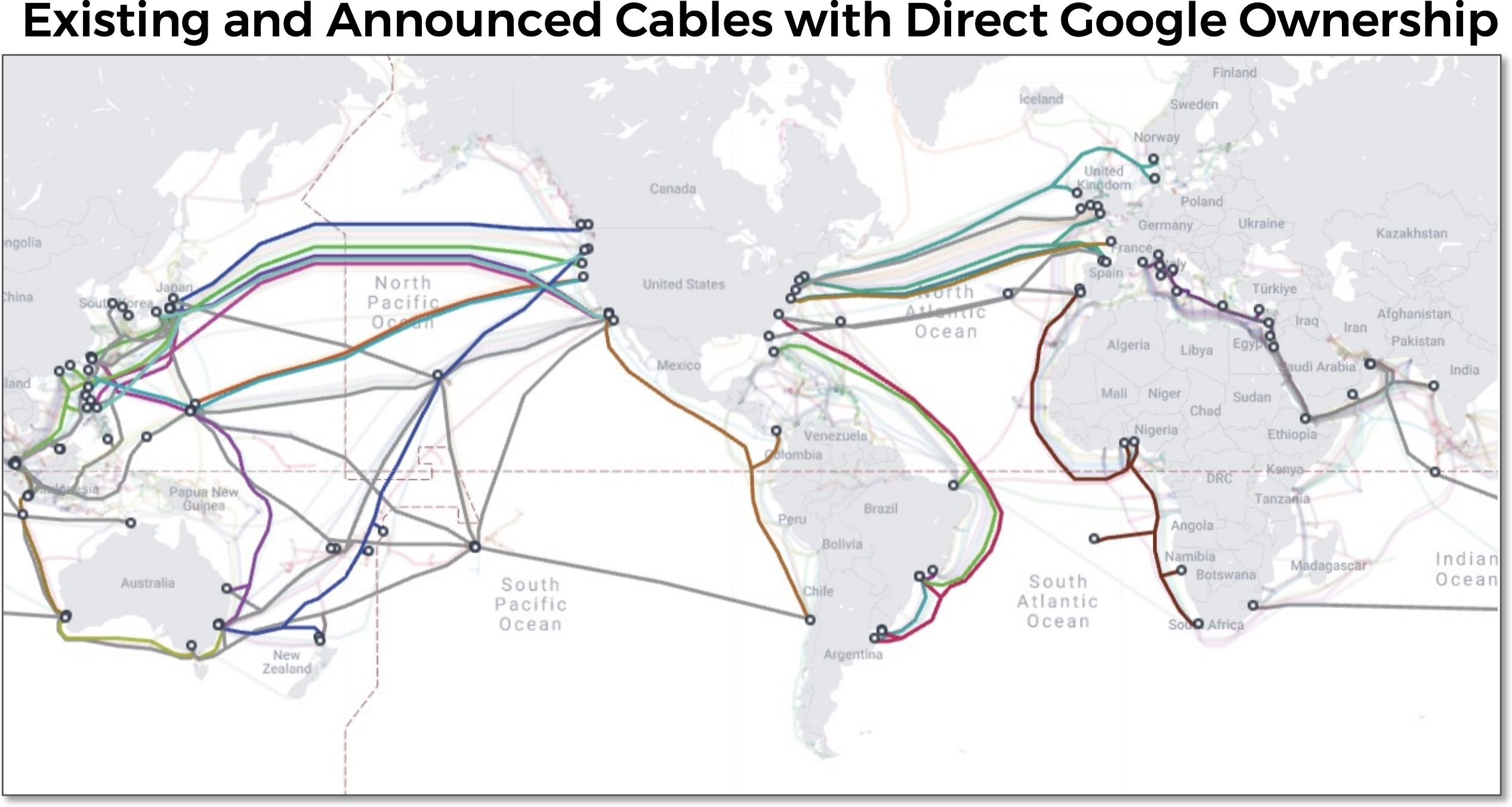
So, where’s all this money coming from? The four incumbent digital behemoths—Google, Meta, Microsoft, and Amazon—have lifted their level of involvement in cable projects significantly over the past decade. These days, some 38% of cable investments are made by these four hyperscalers for cable services that are operated as a private service for the exclusive use of the funding entity. They are also investors in consortium arrangements for a further 25% of cable investments. The remaining 37% of cable investments have no hyperscaler involvement. This investment profile varies at a regional level. The cables on the transatlantic route are now 85% private hyperscaler-funded, which is the most extreme case of the rise of privately owned and operated subsea infrastructure. Google and Meta are the most active in this space, and their portfolios of owned cables are shown in Figures 3 and 4.
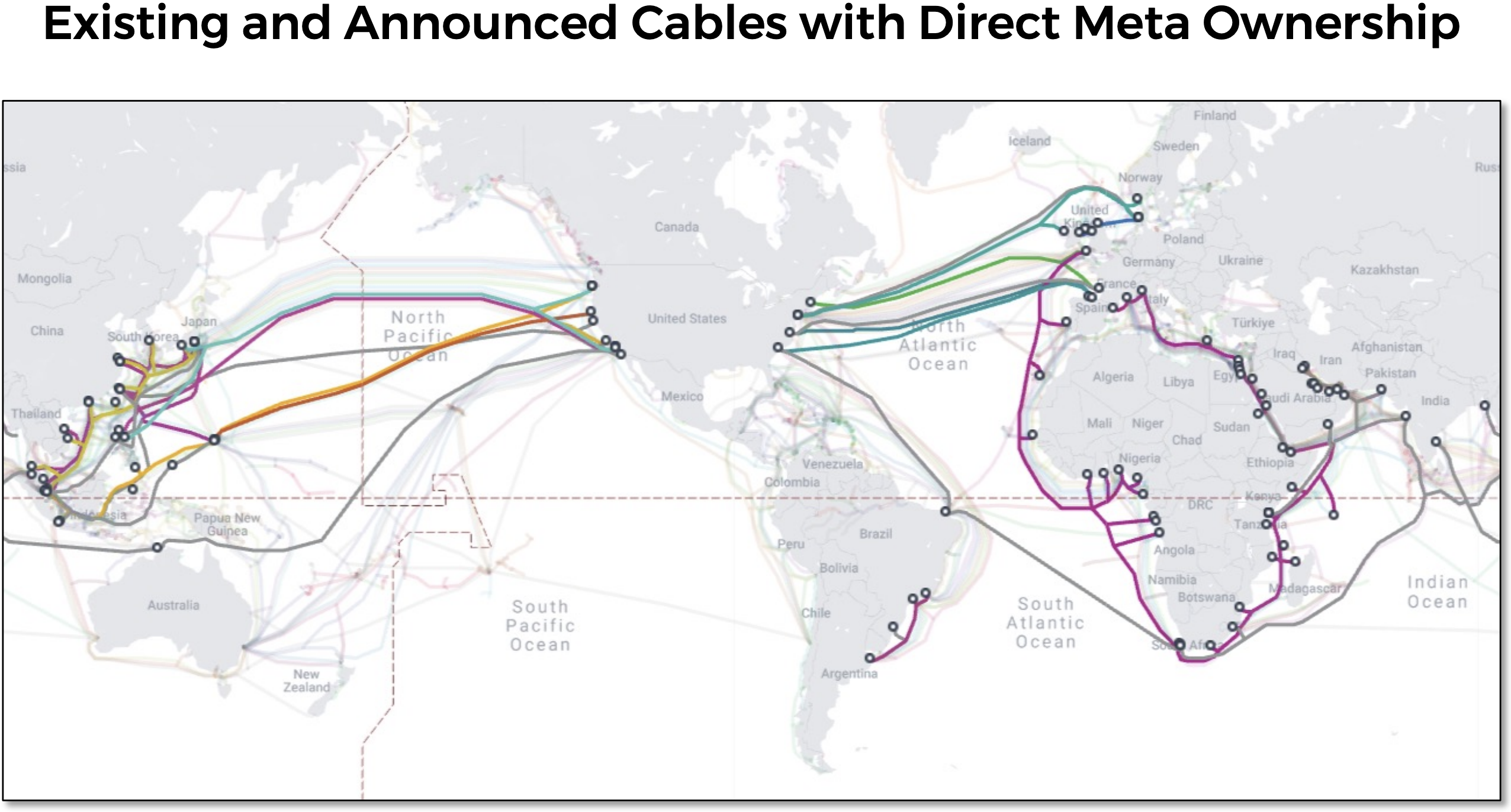
The reason for this trend to private cable infrastructure lies in the high level of concentration in the Internet market. This market concentration has allowed the hyperscalers to accumulate large capital reserves, and by using this capital to own and operate a collection of private cable systems, they have complete control over the delivery of their service and are not dependent on third parties. At the same time, a consortium model made little sense when a single major capacity leaseholder controlled a massive proportion of the cable’s leases. If this single dominant lessee decided to leave the consortium, then the cable would quickly become insolvent if there was no other bidder for the vacated capacity and the consortium that owns the cable would be left with a stranded asset. The rise of the private cable model was a natural outcome of these considerations of extreme imbalance between the various actors in the cable market.
The growing concentration of submarine cable investment among four US hyperscalers raises concerns about national sovereignty. In many countries, critical international communications infrastructure is increasingly owned and operated by foreign private entities, raising questions about national control, accountability, and infrastructure resilience. This situation also raises the question of sovereign control over the associated submarine repair vessel fleet and the existing maintenance pooling arrangements through submarine cable maintenance zones. While many national communities would regard these international cable systems as a critical infrastructure asset, and their disruption would have severe consequences for the nation that is served by the cable, to have these essential communication platforms owned and operated by a foreign private entity with no direct accountability or responsibility to that nation leads to a discomforting position of vulnerability at a national level.
Today’s fiber optic cable system replaced a prior reliance on satellite communications. The satellite systems in geostationary orbit were used to support all forms of international communication from the 1960s. However, this geostationary orbital plane is a limited resource, with just 569 active spacecraft parked in this geostationary orbit at present. In addition, their use involves extended delays when bouncing data packets off a spacecraft that is some 36,000 km away. When undersea fiber systems were introduced, the major users shifted many of their international communication requirements to a cable-based platform as quickly as they could in those parts of the world that were served by these cables.
What largely remained on geostationary spacecraft were services to remote and otherwise unreachable destinations and broadcast television services. But this was by no means the end of the use of satellites for communications infrastructure. Continual refinements in computing technology, particularly in signal processing capabilities, and the development of reusable rocketry, supported a new generation of physically small spacecraft placed into low earth orbit at an unprecedentedly low cost per kilo of payload. To put it simply, LEO satellites can be small and cheap!
To compensate for the small service footprint of a satellite in a low earth orbit, these LEO systems require the use of many thousands of satellites, where a user’s communication is regularly switched from satellite to satellite every few seconds. The result is a system capable of sustaining data throughput for individual users at hundreds of Mbps. The use of laser links between spacecraft also means that packets can be relayed across the LEO spacecraft constellation, so that large areas, such as oceans, can be covered with a sparse set of ground stations. In terms of a service delivered to a user with an antenna, the capacity and delay of LEO service are comparable to that delivered via terrestrial broadband infrastructure.
In terms of capital investment, SpaceX has spent over USD 20B on its Starlink platform, and Amazon’s LEO platform has been reported to cost the company some USD 20B as well. In comparison, in the period 2026—2029 all new submarine cable systems will cost a total of some USD 22B.
But as a financier might tell you, what really matters is the return on that invested capital and the assessment of risk associated with that return. In Q3 of 2026, Starlink reported quarterly revenue of USD 5.25B and a net profit of USD 2.4B. That’s an annual profit of USD 9.6B on an estimated total outlay of USD 20B, or an annual rate of return on capital of 48%. In comparison, institutional investors in consortium submarine cables look for a 12% to 14% rate of return, while terrestrial broadband infrastructure has a typical rate of return between 5.5% and 9%.
The major financial difference between submarine cables and these LEO satellite platforms lies in their positioning within the market. Starlink is positioned as a last-mile access system, servicing through a direct retail model a class of users who have specialized requirements in remote locations or in other locations that are poorly served by terrestrial wired and wireless platforms. As a retail provider of last resort with an effective monopoly in this sector, Starlink can currently charge a monopoly premium for its services, and as a retail provider it does not have to share this revenue with a collection of retailers. The capital barrier to effective competitive entry in the LEO sector is around USD 20B, which is of a size that eliminates many potential competitive interests. The Amazon LEO service has the potential to disrupt Starlink’s effective monopoly, but it remains to be seen what Amazon will do in terms of positioning its service in markets. It is a possible outcome that these two LEO operators choose to sustain the current prices and margins and operate as an effective duopoly and set pricing to sustain profitability of this sector.
A submarine cable system has a somewhat lower barrier to entry, as the cost of a submarine cable project is some USD 100—400M, and the lower rates of return reflect this higher likelihood of competitive services were the price to be set at an excessively high level.
It’s apparent that LEO systems and submarine cables therefore serve distinct but complementary markets. LEO constellations provide last-mile access in remote, mobile, and otherwise difficult locations, while submarine cables provide the high-volume, comparatively low-risk capacity required to move bulk data between distributed data platforms. Their economic models, customers, and operating constraints differ, so direct competition between them is likely to remain limited. The more consequential development is that both layers are attracting very large private investments, increasing the influence of a small number of platform operators over global connectivity.
Paul’s NANOG 98 presentation on Global Infrastructure can be found here.
Sponsored byWhoisXML API

Sponsored byDNIB.com

Sponsored byVerisign

Sponsored byIPv4.Global

Sponsored byRadix

Sponsored byCSC
Sponsored byVerisign

A World-Renowned Source for Internet Developments. Serving Since 2002.