
Welcome:
Login
|
Sign Up
|
About CircleID
Follow:
|
|



|
||
|
||
Last week I wrote about what happens when you win an accountability ruling and still walk away empty-handed. The IRP merry-go-round keeps spinning, and the applicant keeps paying to ride it. That piece is here: Accountability Without Remedy Is Just Documentation. This article is about why the system is built that way.
I contributed to building this program. I was excited about it. I genuinely believed it would benefit the global internet community. It has not. It has been a heartache and a disappointment for many. There are few winners and more losers. Here is why.
Fourteen years after the last gTLD round, the domain industry is still debating what went wrong. We are told we learned the wrong lessons. We are told the real question is relevance, not volume. We are told to be patient, to wait for namespaces to find their meaning.
Meanwhile, the 2026 round is open. Applicants are preparing to spend millions. And the evidence from the last round tells a very different story than the one sold to the global internet community.
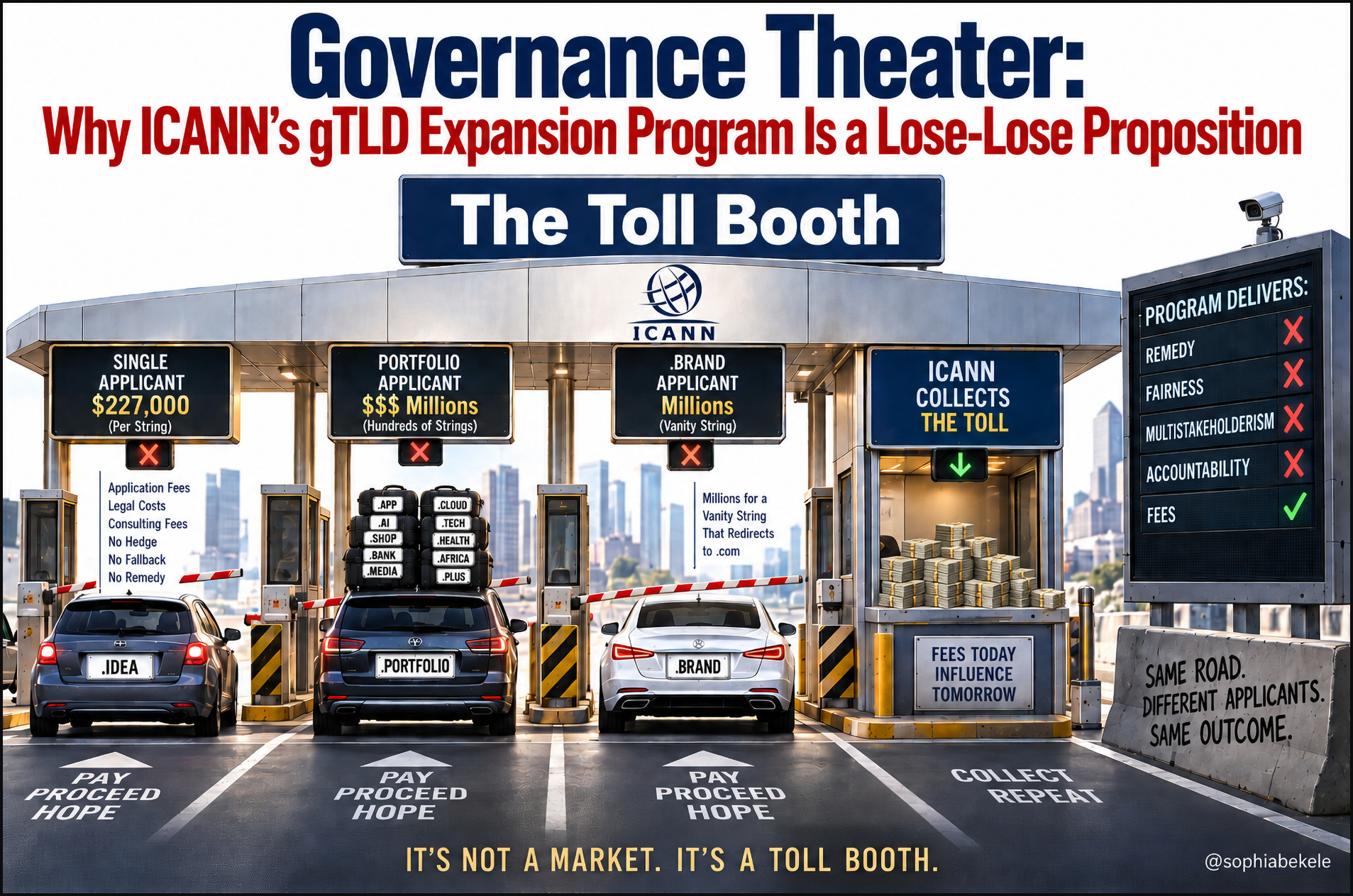
The truth is this: the gTLD expansion program is not a market. It is a toll booth. And it is a lose-lose proposition for almost everyone who passes through.
When ICANN opened the 2012 round, one of the great promises was the .brand TLD. Companies would apply for their own name, .google, .apple, .amazon, and use it to control their digital identity, build direct relationships with customers, and escape the constraints of .com.
Companies spent millions. Application fees alone were $185,000 per string. Legal costs, consulting fees, and ongoing operating expenses pushed the total far higher.
What did they get?
The 2012 round produced more than 600 .brand applications. 56 were withdrawn before the program concluded:
The ones that stayed and did nothing are equally instructive. Google and Amazon parked their strings, paid $25,000 in annual fees every year, and built no public-facing ecosystem. ICANN deleted several dormant applications in 2025 after more than a decade of inactivity.
The data tells the same story:
A program sold as a tool for brand identity became, for many, an expensive trademark protection filing with an annual fee attached and no meaningful namespace built beneath it.
Post-close reporting on the 2026 round confirmed the pattern. Barely any major brand publicly disclosed a .brand application. Salesforce surfaced only through a board conflict-of-interest disclosure, not a press announcement.
The 2026 round reflects that lesson. Fewer brands are applying. Those who are know the math is difficult.
The largest applicants in the 2012 round were not communities or brands. They were portfolio players, companies that applied for hundreds of strings at once, betting that a few winners would cover the many losers.
Donuts was the biggest. It applied for 307 strings, the largest portfolio in the round. It raised over $150 million in total funding. It was seen as the future of the registry business.
The Donuts case is not about a price. It is about who moved where.
Abry Partners acquired Donuts in September 2018. Terms were not disclosed. Fadi Chehadé, ICANN’s former CEO, was a partner at Abry when the deal closed. One month later, Akram Atallah, the ICANN executive who had overseen the entire new gTLD program as President of the Global Domains Division, was named Donuts CEO. The two had worked together previously at CoreObjects Software before joining ICANN.
In 2021, Ethos Capital acquired a controlling interest in Donuts from Abry. Chehadé was co-CEO of Ethos Capital. Atallah remained Donuts CEO. In 2022, Donuts and Afilias were merged under Identity Digital.
This is not a market. It is a pipeline. The people who ran the program moved to the firms that profited from it. The applicants paid the toll. The insiders collected the rent.
This is not a criticism of Donuts or its founders. Paul Stahura is a pure businessman who built from the ground up, played the game ICANN designed, stayed in his lane, made no false promises about community purpose, and executed cleanly. The criticism belongs to a program that created those incentives in the first place while simultaneously selling community applicants a different story. Unlike some new generation portfolio applicants who want to play both sides, Donuts never confused the two.
Portfolio strings may survive as commercial registries under new ownership. But the original promise, that these namespaces would carry meaning and identity for those who held them, gets replaced by a consolidation play. The string becomes inventory. The namespace becomes a product line. And the founders collect their exit while ICANN collects the annual fee regardless of who owns the registry or how many domains resolve.
Chehadé now leads Ethos Capital as Co-Founder and Co-CEO, alongside Erik Brooks, formerly of Abry Partners. The 2026 round has introduced 1,600 new applicants. The advisory and investment infrastructure built around the first cycle is ready for the second.
Now Vaughn Liley has applied for more than 300 strings, including .kek, .omg, .lfg, .btc, .nft, and .mall. At $227,000 per string, that is tens of millions of dollars in application fees alone, confirmed in post-close reporting. The largest single portfolio submission in the history of the program.
In a recent CircleID article, Mr. Liley argued that the wrong lesson from 2012 was chasing registration volume. The right question, he said, is whether a namespace develops genuine meaning for the communities and identities that choose it.
I asked him a simple question: by your own argument, does your portfolio not disqualify itself? Those are not communities seeking digital identity. They are inventory bets on internet slang and trend cycles.
He did not answer.
The question worth asking is whether Link Freedom Group is planning to repeat the Donuts cycle. File at scale, build the portfolio, attract private equity, consolidate, exit. The math only works if enough strings gain traction. The model does not require every string to succeed. It requires enough to make the portfolio attractive to the next buyer. ICANN collects its fees regardless of which cycle this is.
Two applicants. Two IRP wins. Two routes tested. Neither delivered the string.
DCA proved in 2015 that ICANN violated its own Bylaws over .africa. The string went elsewhere. Afilias proved in 2020 that ICANN violated its own rules over .web. The string went nowhere. Altanovo tried a second IRP in 2026 and walked away before it concluded.
The courthouse did not work. The IRP did not work. Going back a second time did not work.
At some point the question stops being about which door to try. It becomes about whether the building has an exit at all.
Since 2012, more than a dozen IRPs have been filed against ICANN:
The well-resourced can afford to ride the merry-go-round. For the single-string applicant and the community applicant, one trip is often all they can sustain. The process does not distinguish between them. The fee is the same. The waiver is the same. The outcome is the same.
A selection of these cases and their outcomes is examined here: The IRP Docket Speaks Louder Than Theory.
The .brand experiment failed. The portfolio model failed. Most of all, the remedy mechanism failed.
What connects these failures?
A system structured so that fees are collected regardless of outcomes. A process that claims accountability, fairness, and multistakeholderism but produces no remedy when things go wrong. A stage where the performance is the point, and the applicants are the audience.
It is all a governance theater.
This is where the 2026 model begins to look less like process reform and more like rent-seeking. When a regulatory system removes activities participants once performed themselves while leaving the underlying need intact, middlemen emerge to sell the solution back to them.
I first heard the term “rent-seeking” years ago from the late Ethiopian Prime Minister Meles Zenawi, who frequently spoke about eliminating rent-seeking behavior as an obstacle to productive industrial growth. The term stayed with me. Looking at the ecosystem developing around the 2026 round, it comes back to mind.
The 2026 round is developing its own form of carpetbag capitalism: wherever ICANN creates a procedural gap, a commercial service seems ready to occupy it.
In 2012, applicants who found themselves in a contention set could negotiate directly with competing applicants to resolve the dispute privately. That option no longer exists. Section 5.2.3 of the 2026 Applicant Guidebook prohibits private resolution of contention sets. ICANN banned the solution but did not solve the problem. What filled the gap was a private market selling applicants back the intelligence and navigation they once handled themselves.
And the pattern goes well beyond contention resolution. ICANN establishes the rules and collects the application fees, while key functions across the round are handled by outside providers. Dispute resolution goes to institutions such as WIPO and ICC. Auctions, background screening, name collision reviews and geographic-name evaluations rely on external providers and evaluators. Around that formal machinery sits another economy of lawyers, consultants, registry providers and technical advisers helping applicants navigate it.
Outsourcing expertise is normal. But creating complexity, outsourcing the work, and then requiring applicants to hire another layer of experts to navigate the outsourced system is something else. At some point, ICANN staff cease to be the people performing much of the substantive work and become managers of the vendors who do. That raises a question rarely asked in discussions about the new round: when so much institutional capability resides outside the institution, where does ICANN’s own operational expertise reside?
The 2026 Applicant Guidebook makes the constraint explicit. Appendix 10, Terms and Conditions, Section 6 states:
“APPLICANT AGREES NOT TO CHALLENGE, IN COURT OR IN ANY OTHER JUDICIAL FORA, ANY DECISION MADE BY ICANN WITH RESPECT TO THIS APPLICATION, AND IRREVOCABLY WAIVES ANY RIGHT TO SUE OR PROCEED IN COURT OR ANY OTHER JUDICIAL FORA ON THE BASIS OF ANY OTHER LEGAL CLAIM AGAINST ICANN AND ICANN AFFILIATED PARTIES WITH RESPECT TO THE APPLICATION.”
This covenant existed in 2012 as well. What changed is one word. The 2012 guidebook said “any final decision.” The 2026 guidebook says “any decision.” The constraint is now broader.
This applies even when ICANN is the party that got it wrong.
Section 12 of the Terms and Conditions requires applicants to execute waivers permitting law and consulting firms retained by ICANN to represent ICANN adverse to the applicant in the same matter. In 2012 this clause named Jones Day specifically. The 2026 version removed the name entirely and replaced it with:
“law and consulting firms retained by ICANN in connection with the review and evaluation of this Application.”
ICANN is no longer limited to one firm. The applicant has pre-waived conflicts for any firm ICANN chooses to bring in, before knowing who will be used against them. If an applicant retains the best legal counsel available, ICANN can simply retain the same firm for a different matter, triggering the conflict waiver the applicant already signed.
The playing field is not level. It is contractually tilted before the game begins.
I have seen how this works in practice. In my own case, ICANN’s General Counsel would not appear as a witness at the IRP where he was called to explain a written statement he made to DCA that “GAC is a policy issue and can’t be reversed.” That statement led directly to the IRP that DCA won. He did not show up to defend it under oath, and when DCA won, it was the same person who pushed the application to extended evaluation. ICANN retained outside counsel to defend the institution in both instances. When DCA responded publicly to his post-IRP blog, where he attempted to control the narrative around a ruling he had lost, it had to do so on CircleID because his own blog did not allow comments. The pattern is documented. Section 12 makes that arrangement a contractual condition of applying.
So now you understand the level of ICANN staff involvement in your application. CEO. General Counsel. Board. Not a lower level staff member. Not a contractor.
This is not a minor procedural detail. It is baked into the application itself. And it means that before a dispute even arises, applicants have narrowed their access to the courthouse and accepted limitations on their ability to seek remedy before they know what remedy they might need.
This is not fairness. This is risk transfer. The applicant bears the risk. ICANN collects the fee.
So by their operation, ICANN has become a toll booth. They are not a market.
ICANN does not need to win or lose. It does not need the bets to pay off. It just needs applicants to pass through, single strings, portfolios, .brands, and pay the toll on the way.
The program does not deliver remedy. It does not deliver fairness. It does not deliver multistakeholderism. It does not deliver accountability. It delivers fees.
For the single applicant, the math is brutal. One string. One shot. $227,000 in application fees, plus legal and consulting costs. No hedge. No fallback. No remedy when the process fails.
For the portfolio player, the math requires scale, patience, and an exit. Most strings will not deliver. At least one portfolio applicant in 2026 has already said as much in public. They learned that lesson from 2012 and entered this round knowing the outcome. ICANN collects the toll regardless.
For the .brand applicant, the math is unforgiving. Millions for a vanity string that redirects to .com.
Few strings succeeded. Most did not. ICANN collected the toll either way.
Before you spend money on ICANN’s program, ask the question applicants rarely knew to ask in 2012:
If I prove ICANN got it wrong, what exactly can I win?
That question takes us back to what I asked and answered here: Accountability Without Remedy Is Just Documentation.
The program does not serve applicants, communities, or the global internet. It collects fees. And it has done exactly that.
The house always wins. And the house is ICANN.
Like a toll booth on a road to nowhere, the gTLD expansion program is structured so that the house profits regardless of who wins or loses at the table. Applicants place their bets, single strings, portfolios, .brands, and ICANN collects the fees whether those bets pay off or not.
If nothing changes, the 2026 round will produce the same casualties as 2012. Single applicants will lose. Portfolio players will hedge. Brands will wonder why they bothered.
And ICANN will collect the toll.
The house always wins. But ICANN is not even the house. It is the toll booth.
Sponsored byVerisign

Sponsored byVerisign

Sponsored byRadix

Sponsored byCSC

Sponsored byWhoisXML API

Sponsored byDNIB.com

Sponsored byIPv4.Global

A World-Renowned Source for Internet Developments. Serving Since 2002.
You should get an agent and write a book, you have quite a story to share with the world. I’ve observed many whose hopes and dreams were shattered by their encounters with ICANN, most just quietly fade away. But hope springs eternal, hence a new generation of applicants apparently eager to hand over their money to ICANN. Yes, definitely a rentier economy at work within ICANN, today’s ICANN is definitely NOT what Jon Postel envisioned. Your mention of former ICANN President Fadi Chehadé prompted me to look up his early resignation announcement— Chehadé Announces Intention to End His Tenure as ICANN President & CEO in March 2016, 21 May 2015. “The Internet Corporation for Assigned Names and Numbers (ICANN) today announced that President and CEO Fadi Chehadé has informed the Board he will be concluding his tenure in March 2016 to move into a new career in the private sector (outside the Domain Name Industry) ....” https://www.icann.org/en/announcements/details/chehad-announces-intention-to-end-his-tenure-as-icann-president—ceo-in-march-2016-21-5-2015-en —he must have changed his mind after he left ICANN?
John, thank you. Your opening line made me smile because the book is actually coming.
The story has finally been written. It is not a memoir. It is called “Counter-Playbook for Governance Warfare: Surviving Power, Process, People and Institutional Failure in the Internet Domain Name Expansion Battle,” publishing in the coming months. Hope you will enjoy the read;)
Your observation about those whose hopes and dreams were shattered through their encounters with ICANN, only to quietly fade away, particularly resonated with me. That history is rarely captured when we talk about the success of the new gTLD program.
And thank you for digging up the 2015 announcement about Fadi Chehadé leaving for a career outside the Domain Name Industry. That language tells its own story in hindsight. He later became a partner at Abry Partners, where he led the acquisition of Donuts, the world’s largest TLD portfolio registry. He then co-founded Ethos Capital which acquired Donuts from Abry in 2021. You have just handed me a piece of historical evidence that belongs in the book, and it is going in before it publishes.
Your point about Jon Postel and the distance between the stewardship he envisioned and the rentier economy we see today goes directly to the heart of my argument.
Thank you for reading so closely, and for having followed this history for so many years!!