
Welcome:
Login
|
Sign Up
|
About CircleID
Follow:
|
|


|
||
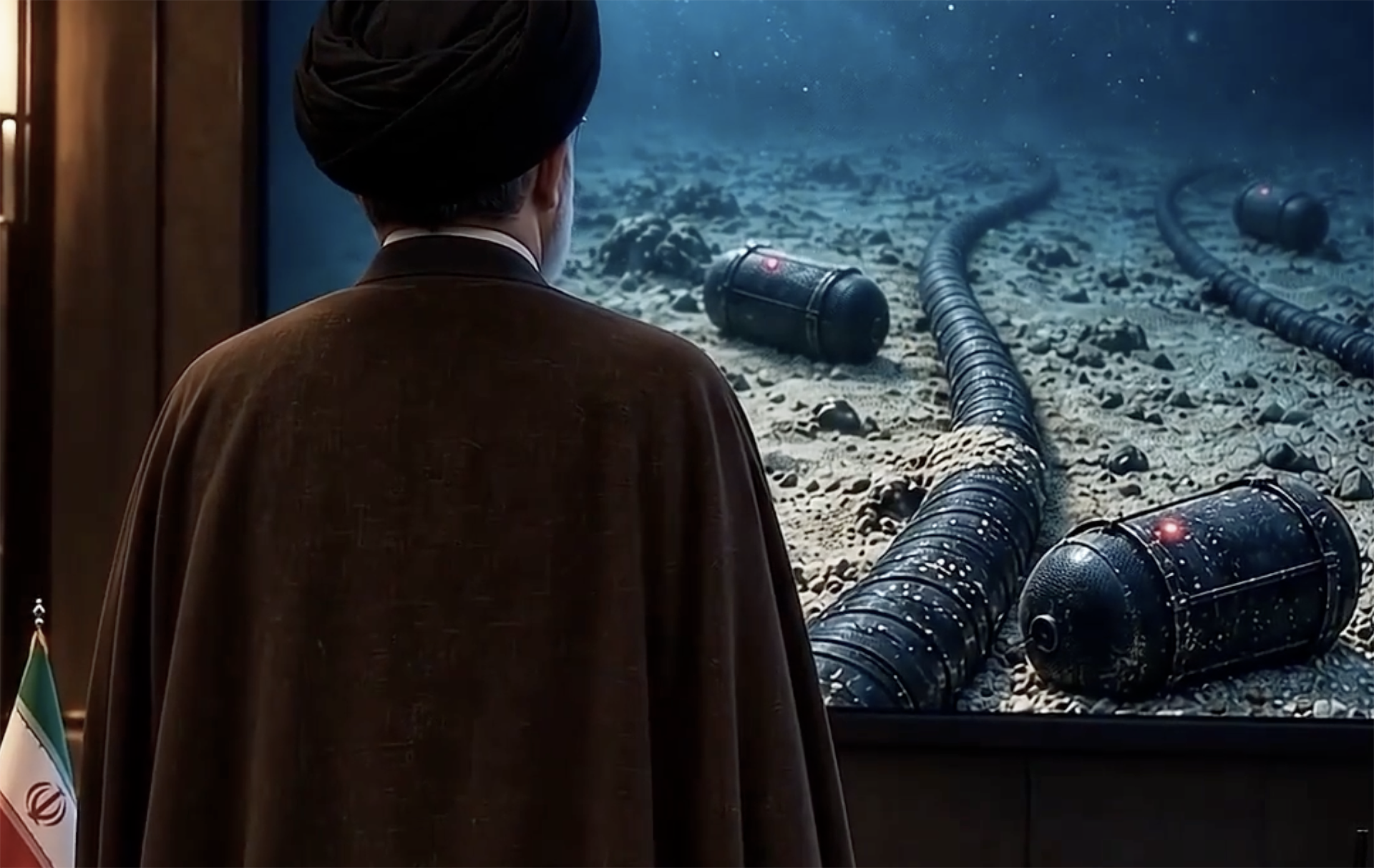
Iranian-linked propaganda accounts have circulated an AI-generated video depicting attacks on undersea internet cables in the Persian Gulf, following warnings from Iranian officials that the infrastructure could be targeted if conflict with the United States and Israel resumes. The video, reported on October 28, portrays cable strikes triggering widespread failures in banking and communications networks across Gulf states.
The footage, described in reports by MEMRI and JFeed, follows increasingly specific threats against the region’s digital infrastructure. The simulated destruction is not evidence of an actual cable attack, and the video’s precise origin and authorization have not been independently established.
Iranian officials have described plans to strike cables and obstruct repairs. On October 21, Yadollah Javani, deputy head of political affairs for Iran’s Islamic Revolutionary Guard Corps (IRGC), warned that seven major internet cables beneath the Strait of Hormuz could be targeted if Iranian infrastructure came under attack.
Two days later, two senior Iranian security officials told Reuters that Tehran had developed detailed plans for such attacks in the event of renewed U.S. and Israeli strikes. One official said Iran would also seek to prevent repairs, extending disruptions to internet connectivity and other communications services. Neither disclosed specific targets or operational methods.
Four Gulf states are particularly exposed. According to an October 26 assessment by maritime intelligence firm Windward, Iraq, Kuwait, Bahrain and Qatar have no submarine cable route to the outside world that avoids the Strait of Hormuz. Windward identifies six operational cable systems crossing the waterway, including 2Africa, AAE-1, FALCON, Gulf Bridge International, Tata TGN-Gulf and OMRAN/EPEG.
The countries’ dependence on those routes does not mean they would lose all connectivity. Terrestrial connections offer alternatives, particularly for Bahrain, Qatar and Kuwait, but their available capacity may be insufficient to accommodate traffic displaced by multiple simultaneous cable failures.
The greatest consequences would likely be regional rather than global. Although submarine cables carry approximately 99% of international data traffic, less than 1% of international bandwidth passes through the Strait of Hormuz, according to Alan Mauldin, research director at TeleGeography. Multiple cuts could nevertheless disrupt financial transactions, cloud services, e-commerce and internet access across affected Gulf markets.
Restoration could prove especially difficult during armed conflict. Cable repair ships require access to the damaged infrastructure, potentially complicated by maritime security restrictions, insurance costs and permissions to operate in territorial waters. Preventing repairs could therefore extend disruptions well beyond the initial damage.
The threatened infrastructure also serves Iran itself. Windward notes that the FALCON and Gulf Bridge International systems land in Iran, while OMRAN/EPEG connects Iran and Oman. Damage to those systems could consequently impair Iranian connectivity alongside that of neighboring countries.
Sponsored byWhoisXML API

Sponsored byDNIB.com

Sponsored byVerisign

Sponsored byRadix

Sponsored byVerisign

Sponsored byCSC
Sponsored byIPv4.Global


A World-Renowned Source for Internet Developments. Serving Since 2002.