
Welcome:
Login
|
Sign Up
|
About CircleID
Follow:
|
|


|
||
The RIPE Network Coordination Centre (RIPE NCC) has frozen Internet number resources held by five members and 23 End Users newly identified as subject to applicable European Union sanctions. The actions, disclosed October 23 in its latest quarterly transparency report, restrict changes to resource registrations without preventing the affected networks from continuing to use their existing IP addresses and autonomous system numbers.
According to the Q4 2026 sanctions transparency report, the registry also placed four members on hold because their sanctions status could not be conclusively established. One of those members additionally holds resources as an End User.
A resource freeze does not disconnect a network. Under RIPE NCC’s sanctions procedure, affected organizations cannot obtain additional Internet number resources or transfer existing allocations and assignments. Their registered resources remain in the RIPE Database, however, and the registry does not revoke those registrations or terminate membership agreements solely because of the sanctions.
This distinction separates administrative control over Internet number resources from their operational use. A frozen IPv4 or IPv6 allocation can continue to be used, and the freeze does not itself withdraw Border Gateway Protocol (BGP) route announcements or prevent an autonomous system from participating in Internet routing. Actual network reachability remains dependent on routing arrangements and decisions made by network operators.
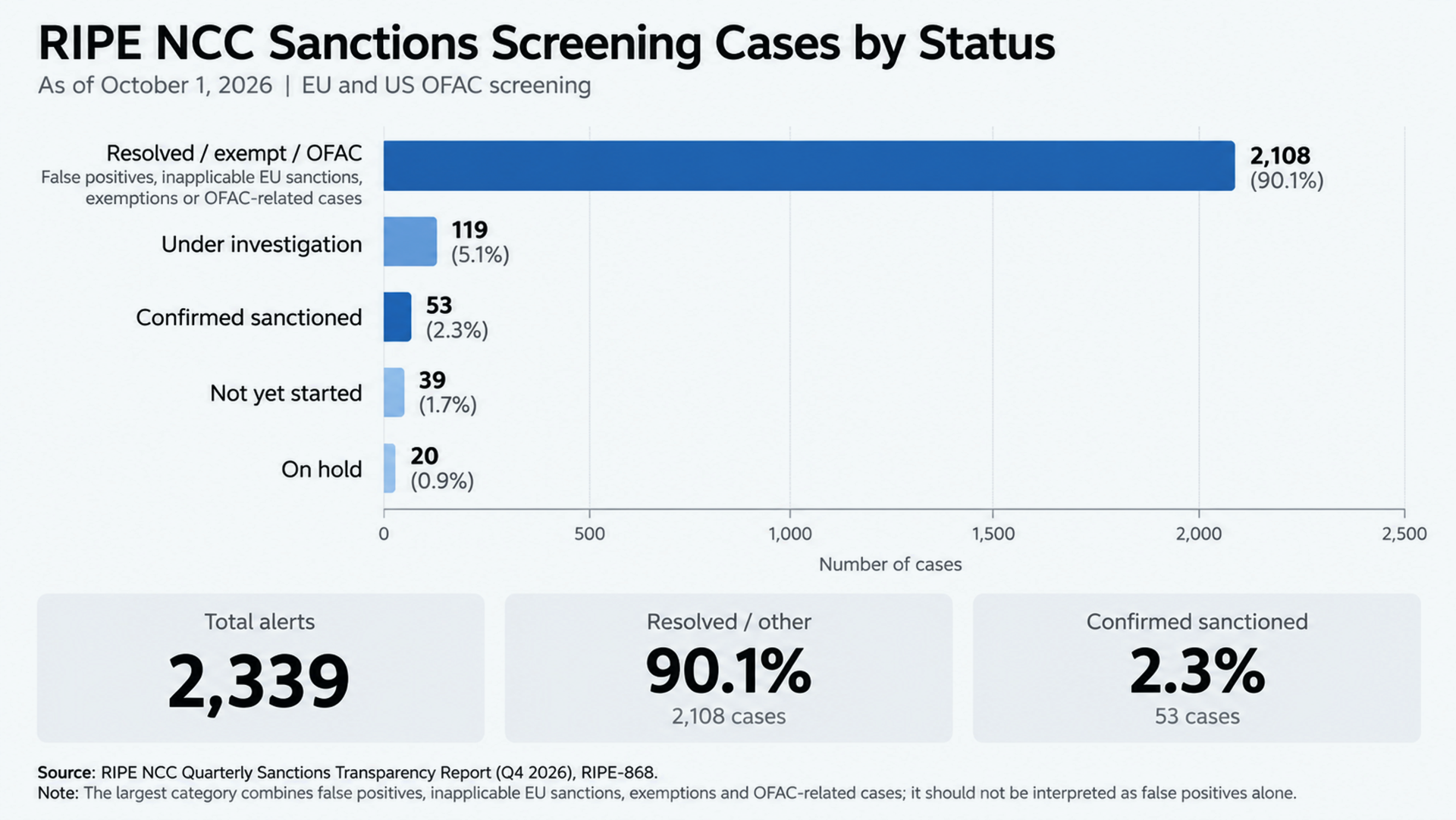
The registry reports 53 confirmed sanctions cases. As of October 1, RIPE NCC’s cumulative screening records showed 2,339 alerts involving EU and U.S. sanctions checks. Of these, 2,108 had been resolved as false positives, inapplicable sanctions, exemptions or cases involving U.S. sanctions, while 119 remained under investigation and 39 had not yet been examined. Another 20 were classified as on hold.
The report’s resource inventory lists 4,850,688 IPv4 addresses, 29 IPv6 allocations and 82 autonomous system numbers associated with frozen or on-hold registrations. These figures describe the resources covered by the registry’s administrative restrictions, not addresses or networks removed from service.
EU sanctions govern the registry’s response. RIPE NCC, headquartered in the Netherlands, must comply with EU restrictions applicable to its services. It also screens against sanctions maintained by the U.S. Office of Foreign Assets Control, although those measures do not automatically impose the same legal obligations on the organization. U.S. sanctions can nevertheless affect banking relationships and its ability to collect membership payments.
Potential sanctions matches can also temporarily prevent resource transactions. RIPE NCC says most investigations ultimately establish that restrictions do not apply, but it cannot process requests for new resources or transfers while relevant cases remain unresolved.
The latest figures illustrate how sanctions compliance affects the administration of Internet addressing resources without necessarily changing their use in the global routing system.
Sponsored byIPv4.Global

Sponsored byCSC

Sponsored byVerisign

Sponsored byWhoisXML API

Sponsored byRadix

Sponsored byVerisign

Sponsored byDNIB.com


A World-Renowned Source for Internet Developments. Serving Since 2002.