
Welcome:
Login
|
Sign Up
|
About CircleID
Follow:
|
|


|
||
|
||
A previous blog in this series, “From Verification to Trust,” discussed the role that digital signatures and other evidence can play in enabling trust decisions. The accompanying technical report “Origin Verification is Not Enough” further elaborated on the foundational difference between origin authentication and long-lived protections such as those provided by object security protocols.
Those discussions illustrated the importance of measurable trust and highly available, current security status information.
This blog and the new Verisign Labs Technical Report “Security is Priceless, but Exposure Costs Must be Quantified,” by Verisign Distinguished Scientist Eric Osterweil, explore a critical aspect of deriving trust from security status: time.
The technical report provides a formal mathematical foundation for the time dimension of security status called vulnerability windows. It also proposes calculations of the impact of these windows, called exposure cost. Organizations can use these concepts to quantify the risk levels in their deployments of certificate-based security, and how different status mechanisms can reduce those risks.
As an example of identifying vulnerability windows and exposure cost, consider that many secure email applications today follow the Secure/Multipurpose Internet Mail Extensions (S/MIME) protocol, which is based on the Cryptographic Message Syntax (CMS). Following the framework discussed in the blog “From Verification to Trust,” an S/MIME recipient considers at least three types of evidence when validating a secure email:
All three types of evidence have been included in the CMS SignedData syntax since it was first published as RFC 2630. They also appeared in CMS’s precursor, PKCS #7 v1.5.
The SignedData syntax originally supported one type of status information, Certificate Revocation Lists (CRLs). RFC 3852 made the status information types extensible and RFC 5940 formally added Online Certificate Status Protocol (OCSP) responses.
A benefit of “stapling” the status information in a SignedData syntax is that the email recipient doesn’t need to look up the certificate status itself; the SignedData object provides it directly.
In addition to stapling, applications can take other architectural approaches for obtaining status. For example, an application could look up status information based on the AuthorityInformationAccess extension in the certificate. Or, an application could obtain status information in the background, as web browsers now typically do, as discussed in the previous blog post.
Regardless of whether status information is stapled in, looked up, or pushed out in the background, an important question remains: how does the freshness (or staleness) of the status information affect the risks of an application’s security decisions?
As noted earlier, Verisign’s new technical report introduces a formal evaluation framework for answering the question. The framework is based on two key concepts:
The secure email use case, one of several considered in the technical report, provides a good illustration of the framework.
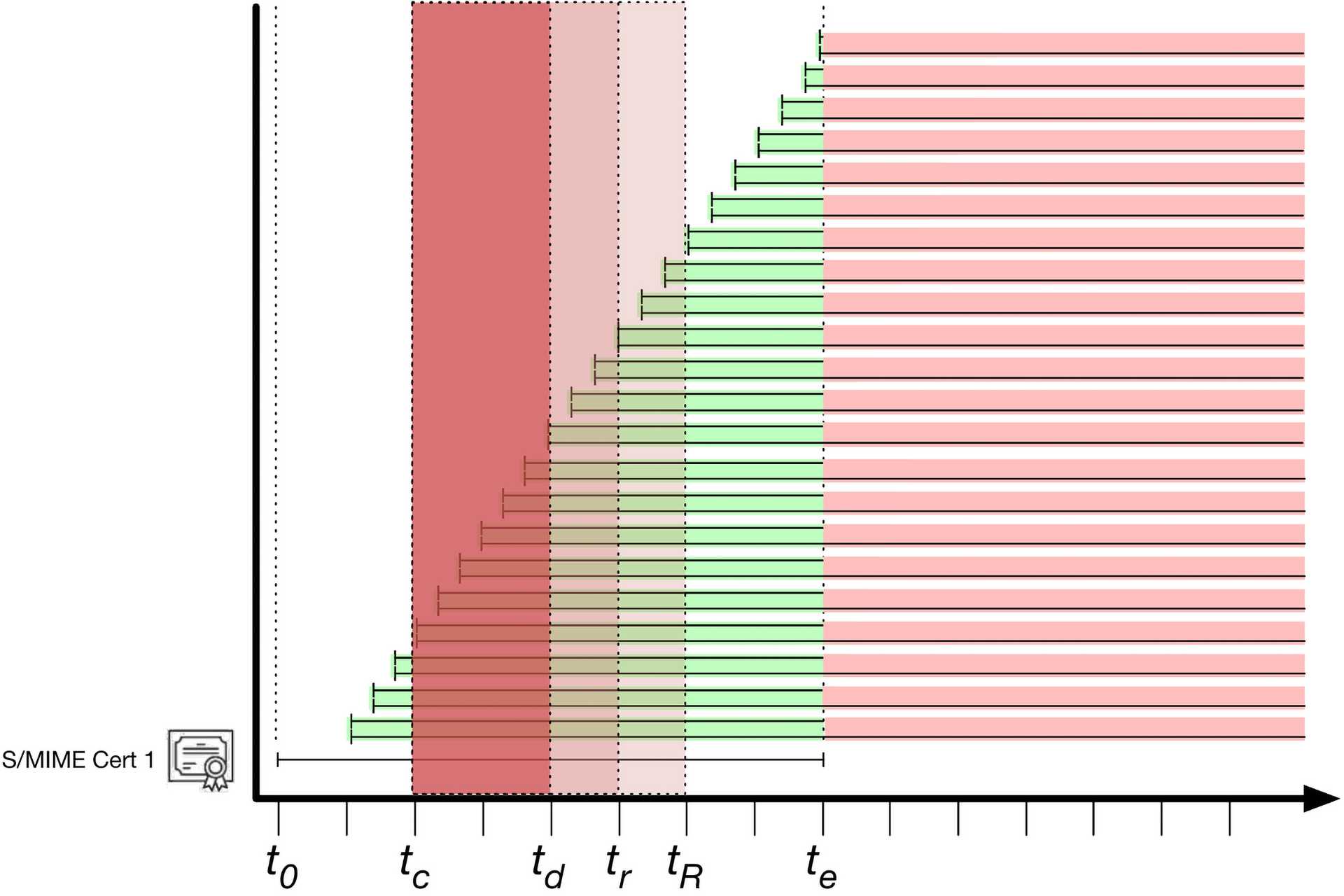
Consider a scenario where a sender is issued a certificate at time t0 that expires at time te, signs S/MIME secure emails with the corresponding private key, and where the certificate is compromised before it expires.
The evaluation framework models the compromise with a vulnerability window defined by four values:
The framework is illustrated for the secure email use case in the figure above, taken from the technical report. In the graph, a vulnerability window, shaded in red, is overlaid upon a series of signed emails or “protections” dated at different times, shown in green. (The technical report “Origin Verification is Not Enough” discussed the difference between protections and origin authentication in more detail.) The exposure cost is the area of the intersection between the vulnerability window and the protections.
A few points may be helpful in understanding the model:
The technical report proposes that the exposure cost, as a measure of area, can be expressed in a composite unit such as protection-days (pdays), where protections refers to the number of objects (e.g., emails) affected and days to the amount of time. If r is the number of emails sent per day, then the exposure cost can be calculated as follows, assuming for simplicity a constant rate of emails sent:

The technical report gives these examples for illustration:
Updating certificate status information for effectuation by the relying party software within one hour thus provides more than a 26-fold reduction in the exposure cost compared to not providing status information at all. The details will vary based on all the parameters.
The importance of this calculation is not so much the specific numbers but the fact that there are numbers to compare at all — that the risk is being quantified.
Once the vulnerability window and exposure cost are quantified in a particular deployment, the next step is to reduce the risk. The reduction may involve improvements in all three “gaps” within the vulnerability window: how long it takes for the compromise to be detected (tc to td); how long it the takes for the revocation of the certificate to be initiated (td to tr); and how long it takes for a relying party to become aware of the compromise and the revocation to be effectuated (tr to tR).
By delivering high-availability, at-time-of-use status information, Verisign InformedTM can be part of the solution for the third gap, complementing organizations’ efforts to reduce the other two gaps to help close vulnerability windows, lower exposure costs, and enhance trust.
Sponsored byDNIB.com

Sponsored byCSC
Sponsored byWhoisXML API

Sponsored byIPv4.Global

Sponsored byRadix

Sponsored byVerisign

Sponsored byVerisign


A World-Renowned Source for Internet Developments. Serving Since 2002.