
Welcome:
Login
|
Sign Up
|
About CircleID
Follow:
|
|



|
||
|
||
I read Amin Dayekh’s piece on the Constituent Community Doctrine a few weeks ago and recognized every mechanism he described and found it real. I left a comment laying out what happened with .africa. He responded saying he is already using .africa as a case study in a forthcoming paper.
It was only after that exchange that I noticed .amazon sitting there as the primary illustration for the Independent-Judgment Principle. Not because Amin made an error in his reasoning, he did not. But because the case he cited to illustrate that principle came two years after mine, and Amazon’s own lawyers cited my panel ruling directly to make the identical argument.
So here it is.
Dayekh identifies the .amazon Independent Review Process as an illustration of his Independent-Judgment Principle: a governing body receiving advisory input must still exercise its own independent judgment and cannot hide behind institutional presumption.
But this was not the first time an IRP panel had made that finding. It was the second.
The first was in 2015, in DotConnectAfrica Trust v. ICANN, ICDR Case No. 50-2013-001083. That panel found that ICANN’s Board had acted inconsistently with its Articles of Incorporation and Bylaws by accepting GAC advice concerning the .africa application without requiring any reasoning, without conducting any diligence on how that advice was developed, and without affording DCA any meaningful opportunity to respond.
The panel defined accountability in terms that would be quoted back to ICANN two years later:
“Such accountability requires an organization to explain or give reasons for its activities, accept responsibility for them and to disclose the results in a transparent manner.”—DotConnectAfrica Trust v. ICANN, ICDR Case No. 50-2013-001083, Final Declaration, ¶ 74 (July 31, 2015).
Two years later, Amazon’s lawyers cited that ruling directly. Paragraph 88 of the Amazon IRP Panel Final Declaration states:
“Amazon argues the decision in the DCA Trust IRP, particularly paragraph 74, is precedent for proposition that the GAC must provide a reason for its advice. In that IRP, the Panel held: ‘As previously decided by this Panel, such accountability requires an organization to explain or give reasons for its activities, accept responsibility for them and to disclose the results in a transparent manner.’”—Amazon EU S.à r.l. v. ICANN, IRP Final Declaration, ¶ 88 (July 11, 2017), citing DotConnectAfrica Trust v. ICANN, Case No. 50-2013-001083, Final Declaration, ¶ 74 (Int’l Centre for Dispute Resolution, July 31, 2015). [Full declaration: icann.org]
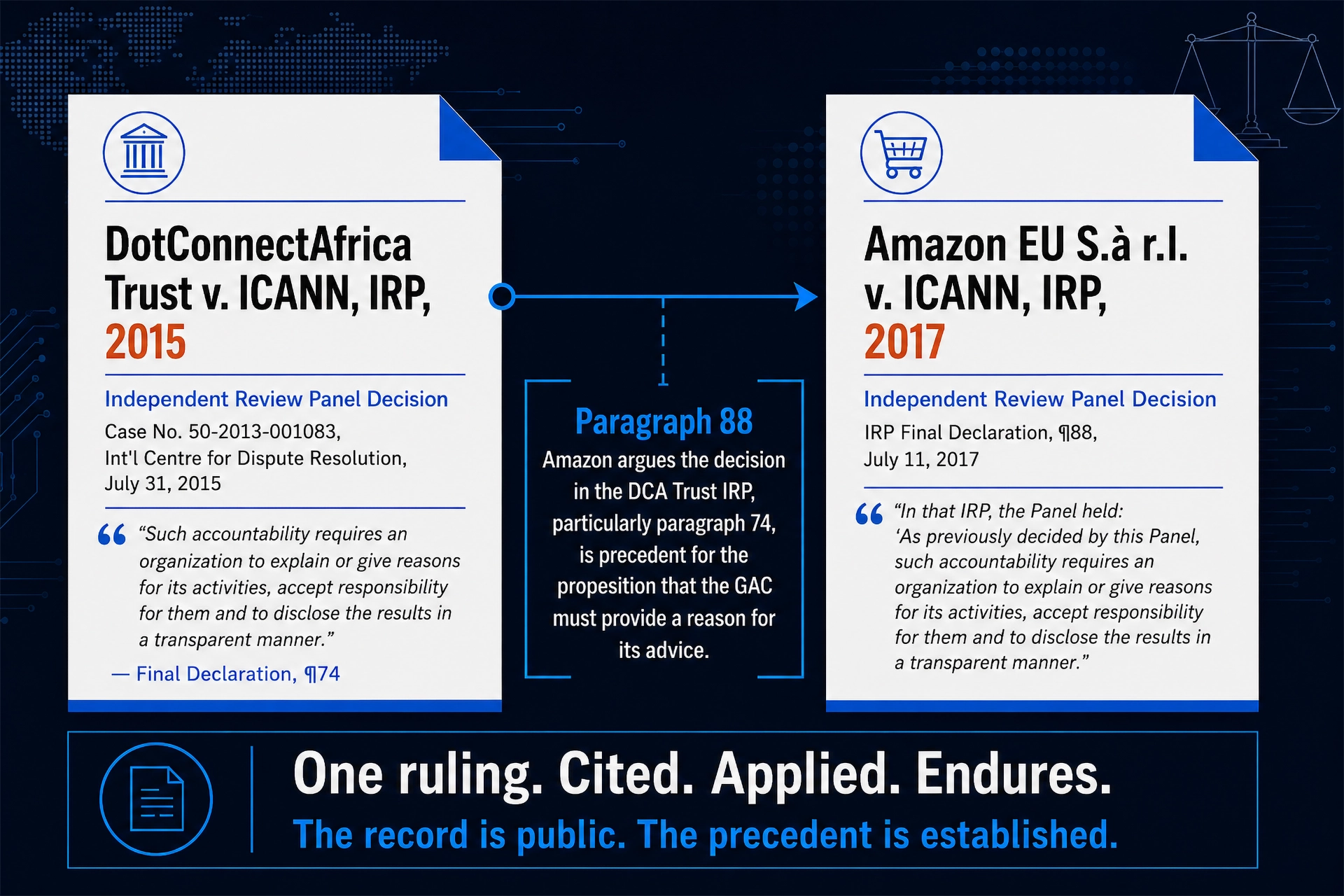
The precedent runs from .africa to .amazon. Not the other way around.
They followed my lead twice. And because they won the string, they became the reference point.
The others found a winner and followed it too. The Gulf Cooperation Council cited DCA’s ruling directly in their .persiangulf IRP. Booking.com’s panel measured its own reasoning against ours. None of them needed anyone to point them to it. That is how precedent is supposed to work. You establish the standard, others cite it, the argument compounds across cases.
The difference is that every applicant who cited DCA’s ruling got to use the precedent we built. We remained the only ones who won the argument and did not get the string.
Dayekh uses .amazon because it is legible. Amazon is a trillion-dollar company. Everyone in any governance room already knows who they are and what was at stake. The moment you name .amazon, you have context, scale, and a narrative that resolves cleanly. Amazon fought, Amazon won, Amazon got the string.
.africa requires more. It requires you to understand who DCA was, what the African Union’s role was, how GAC advice was manufactured and deployed, why ICANN staff drafted an endorsement letter for a competing applicant, and why the applicant who established the precedent did not get the string.
This is what I mean by the multistakeholder model’s brand problem. When a more visible party borrows intellectual architecture built by a smaller applicant and achieves a more visible outcome, the original construction can disappear from the narrative.
The precedent migrates to the winner.
Dayekh uses .amazon not as legal precedent but as an illustration of the Independent-Judgment Principle. But using .amazon to illustrate that principle skips over where it was forged. The GAC accountability argument began when ICANN accepted GAC advice without reasoning, diligence or a meaningful opportunity for DCA to respond, and when I challenged that while ICANN’s own lawyer insisted GAC advice was beyond challenge.
The same pattern. The same argument. Two years later.
The significance of the DCA IRP was not merely my interpretation of our own victory.
In July 2017, Milton Mueller, founder of the Internet Governance Project and Internet Governance expert, published “Amazon Win Sets Good Precedent”, describing Amazon’s successful .amazon IRP as a victory arguing that the decision carried important precedent value, particularly in establishing that the ICANN Board could not simply defer to GAC consensus advice without independently establishing a well-founded public-policy basis for doing so. Mueller’s framing was incomplete.
That accountability principle did not begin with Amazon.
Even Mueller’s own readers pointed to his blind spot on his .amazon framing. Commenters pointed back to the earlier DCA .africa IRP and challenged the impression that the principle being celebrated was new. The correction did not depend on DCA retrospectively claiming precedence. Others recognised the connection themselves.
Two years earlier, Robin Gross, founder and Executive Director of IP Justice and former Chair of ICANN’s Non-Commercial Stakeholders Group, had examined DCA’s 2015 .africa IRP victory in “ICANN Accountability Deficits Revealed in Panel Ruling on .AFRICA”, and described .africa as “among the most important and precedential IRP declarations ICANN has ever received,” highlighting the Board’s obligations of due diligence, independent judgment, fairness and transparency.
Nor was Gross the only contemporary observer to recognize the significance of DCA’s proceedings. In April 2015, John Poole of Domain Mondo published “IRP Panel in DCA Trust Case Overrules ICANN Bylaws Provision,” documenting how the panel challenged procedural restrictions on its authority to conduct an independent review. This was months before DCA’s final July 2015 victory and two years before the .amazon ruling. The significance of DCA’s case was already being recognized and documented in real time. The precedent did not begin with Amazon; neither did its recognition.
Expertise does not eliminate narrative blind spots. Sometimes it merely gives them more authoritative language.
The .africa precedent was not invisible. It was known, discussed and recognised. What differed was the amplification. Selective amplification has its own amnesia. It does not erase the record. It simply stops looking for it.
Selective amplification need not be deliberate. It can emerge when institutional noise, established narratives and repeated commentary make one version of events easier to see, and therefore easier to repeat, than another. That is what this is. Not necessarily the suppression of a fact, but the repeated elevation of one part of the record until another, equally consequential part becomes easier to forget.
I want to be precise here, because precision is what distinguishes a documented account from a grievance.
In the .africa case, the community invoked to justify blocking DCA’s application was not organic. It was constructed. ICANN staff advised the African Union Commission at the commissioner’s staff to reserve .africa for a regional body rather than endorse an individual applicant.
The AUC’s letter dated 27 August 2009 did not revoke our endorsement in any legal sense. It stated:
“Following consultations with relevant stakeholders, the African Union Commission has reconsidered its approach in implementing the subject Internet Domain Name (DotAfrica) and no longer endorses individual initiatives in this matter related to continental resource.”—African Union Commission letter to DotConnectAfrica Trust, 27 August 2009.
We never accepted it as a revocation, and we sought to have the legal standing of the original endorsement examined on its merits. What the letter did in practice was open the door to a parallel process.
That process produced ZACR, whose initial endorsement documents failed the Geographic Names Panel’s formal requirements. Rather than fail the application, ICANN staff with the knowledge and instruction of the CEO drafted a replacement endorsement letter for the AUC to issue on ZACR’s behalf, mirroring the form and substance of the original endorsement DCA had received years earlier, an affirmation that she.africa must know what she is doing, becoming the template for ZACR’s rescue.
This sequence is not contested. The panel found that GAC advice in our case included proposals from an individual who no longer represented Kenya as a GAC advisor, that the genuine Kenya GAC advisor had expressly refused to endorse that advice, and that ICANN acted on the advice without any diligence on how it was developed.
The ICANN Board’s own resolution acknowledged that its actions were inconsistent with its Articles of Incorporation and Bylaws. That resolution is publicly available on ICANN’s website.
Dayekh terms this Community Gerrymandering: drawing the boundary of the relevant community in a manner that predictably privileges a desired outcome. That is precisely what happened. The “African community” invoked to block DCA’s application was assembled after DCA had already secured genuine continental endorsements, for the purpose of displacing them. My 2015 CircleID article on the ICANN Africa Strategy documented this from the inside.
Here is where the record exposes the real contradiction.
ICANN never said our endorsement was invalid. When ZACR’s own endorsement later failed the Geographic Names Panel’s requirements, ICANN staff used the form and substance of DCA’s original endorsement letter to help draft a replacement one.
Meanwhile, our own valid endorsement was sent to extended evaluation, requiring us to get an update from the AUC, the same AUC that had already negotiated .africa’s legal rights with ZACR. ICANN had therefore placed DCA in the position of having to return for validation to the very institution that had already aligned itself with the competing applicant.
That is not an independent evaluation process. That is a setup.
That is why we went to court. The ICANN IRP reviews Board conduct, not staff conduct, yet ICANN’s lawyers argued that DCA could simply have pursued another IRP.
We sued ICANN for fraud. The first judge to hear the case, Judge Howard Halm of the Los Angeles Superior Court, ruled the fraud claims were triable and the case proceeded toward trial. The underlying fraud evidence was therefore not disposed of as factually insufficient. ICANN never won on the facts.
Once a different judge took over, ICANN avoided a jury trial through judicial estoppel, based on our IRP lawyer’s earlier good-faith statement that “...DCA has only this forum for relief…”
The fraud evidence was never heard on its merits. It still hasn’t been.
The deeper question is why ICANN could not simply follow its own process. The answer sits outside the application itself.
At the time, ICANN was fighting for independence from US government oversight through the IANA stewardship transition. It needed African governments behind that transition rather than pushing internet governance toward the UN or ITU. The African Union Commission was the gateway to that support. And the relationship between the two issues was not occurring in separate rooms: AUC representatives were openly linking African support for ICANN’s transition agenda to the outcome of .africa at ICANN public meetings.
I had brought the AUC to the ICANN table in the first place, built the introduction, and secured the original endorsement, something then Deputy Chairperson of the AUC, Mwencha, later confirmed under oath in sworn testimony.
In exchange for that endorsement, ICANN was understood to deliver .africa to the AUC’s aligned registry, who had been given the right to the AUC. Meanwhile, ZACR had signed a separate arrangement with the AUC concerning .africa’s operation and rights. DCA challenged that arrangement in public comments, IRP documents and court filings. Yet ICANN continued moving ZACR forward, signing a registry agreement before DCA’s IRP was resolved.
This arrangement ran directly against the rules of the gTLD guidebook. Yet ICANN moved ZACR forward at every opportunity regardless, signing a registry agreement with them before DCA’s IRP was even resolved.
Both institutions, ICANN and AUC, used what I had built to serve their own arrangement. The .africa string was the currency of that exchange.
DCA was the pawn in a game neither institution had the honesty to name, and ICANN, to this date, wants to erase that this dual quid pro quo ever existed. But the record exists.
People equate winning the string with having the stronger case. Amazon received .amazon. Therefore, people assume, their IRP established the standard. DCA did not receive .africa. Therefore, the assumption goes, something must have been weaker in our position.
What actually happened is this:
Those are three separate events. The precedent came from the first. The string came from the third. The second would not have been possible without the first.
The real stress test is what happens when an applicant wins the accountability argument but still cannot obtain the remedy.
That is where the distance between institutional accountability on paper and institutional accountability in practice becomes visible, and where the constitutional stress test lives.
Dayekh has done something important by naming the manipulation of procedure itself. I would add that manipulation can continue into institutional memory: who gets credited, whose case becomes the reference point, and which parts of the record get amplified.
Three concepts matter here:
The Constituent Community Doctrine asks institutions to identify the source of their authority, trace the mandate through the Community Authority Chain, and ensure that the Claimed Community Mandate does not exceed what the Conferred Community Mandate actually authorized.
I would add a parallel requirement for precedent attribution: when an institution, review panel, or governance actor cites a prior case as authority for a proposition, the citation should reflect the actual origin of that proposition, not just its most recently visible application.
This is not a matter of institutional pride. It is a matter of accuracy.
A 2026 applicant reading about GAC accountability through .amazon may never know that the standard was established in .africa, or that winning the IRP and receiving the string are two entirely different outcomes.
That gap in the record is not neutral. It is a structural disadvantage for every applicant who comes after.
Records can be quietly reduced. In the weeks following the publication of my June 2026 CircleID article on multilingualism and Universal Acceptance, the ICANNWiki biography documenting my work in this space was substantially reduced. An Internet Archive snapshot from July 2026 shows the full record. What is live today shows a fraction of it.
This was documented in my July 2026 CircleID article, ICANNWiki, SHE.africa, AI, and the Integrity of Digital Platforms, where an Internet Archive snapshot confirms what the full record contained before the reduction, and confirmed in a formal notice published by DotConnectAfrica on July 18, 2026.
The primary source documents do not change. The IRP declaration is public. The Board resolution is public. The Amazon IRP filing citing our panel is public. Paragraph 88 cites DotConnectAfrica Trust v. ICANN by name and case number.
Those citations are the record. The rest is institutional memory management.
I look forward to reading Amin’s forthcoming paper on .africa. I hope this account gives him more to work with, and gives the field a version of the story told by the person who was actually there.
The community was manufactured. The precedent migrated. The record was managed.
What happened to DotConnectAfrica did not stay in Africa. It traveled through every IRP panel that cited it afterward.
The domain was African. The precedent was global. The doctrine names all three mechanisms. Now let’s make sure the history names them too.
Sponsored byRadix

Sponsored byVerisign

Sponsored byDNIB.com

Sponsored byIPv4.Global

Sponsored byCSC

Sponsored byWhoisXML API

Sponsored byVerisign


A World-Renowned Source for Internet Developments. Serving Since 2002.
Thank you for engaging with the Constituent Community Doctrine so seriously and, more importantly, for testing its concepts against an earlier and difficult institutional record.
Your point concerning the chronology of the independent-judgment principle deserves attention. If the 2015 .AFRICA IRP established the earlier accountability precedent, and that reasoning was subsequently invoked in the .AMAZON proceedings, the historical sequence should be recognised accurately. That does not necessarily diminish the usefulness of .AMAZON as a forensic illustration. A distinction may be necessary: .AFRICA may be the earlier accountability precedent, while .AMAZON may remain the cleaner forensic illustration of the independent-judgment problem.
Your application of concepts such as the Community Authority Chain, Community Gerrymandering, and the separation between Conferred and Claimed Community Mandates also raises a larger question that deserves examination independently of the positions taken by any party to the original dispute.
Because .AFRICA concerns continental identity, governmental and institutional representation, competing claims of community authority, ICANN accountability, and a long and contested evidentiary record, I do not think it should be addressed casually or folded into the existing paper through a brief amendment.
Now, I intend instead to develop a separate .AFRICA forensic analysis, applying the published doctrine as it presently stands and working principally from the primary record: the applications, Applicant Guidebook, AUC and GAC materials, ICANN decisions, IRP record, subsequent proceedings, and delegation history. All information you may share will be valuable rather than relying on web resources.
That distinction is important to me. The purpose will not be to validate the narrative of either side retrospectively. It will be to ask what the doctrine itself asks: Who constituted the relevant community? What authority did each actor actually possess? What mandate was conferred, what mandate was subsequently claimed, how did authority move through the institutional chain, and where did final decisional responsibility legally remain?
Whether or not the evidence supports a doctrinal finding, it should be stated just as clearly.
Your article has therefore raised something valuable beyond the question of which precedent is better remembered and the paper I am working on: whether a doctrine developed years after these events can be applied, without changing its tests, to reconstruct what actually happened to community authority during one of ICANN’s most consequential governance disputes.
That is worth examining.
Amin Dayekh
https://circleid.com/posts/the-missing-constitutional-question-in-multistakeholder-internet-governance
https://zenodo.org/records/21416365
https://amindayekh.com/who-is-the-community/
Amin - Thank you for this thoughtful response and for the seriousness with which you are approaching the historical record.
On the "cleaner forensic illustration" point, I would only note that I drew the same distinction myself in my article. I said .amazon is a cleaner illustration in one specific sense. Let me elaborate. There was no endorsement requirement that manufactured a competing community claim the way ours did. That manufactured community dynamic is what made .africa so contested and so consequential. As for the outcome, Amazon won the IRP but the string did not follow automatically. They faced continuous opposition from over eight South American countries even after their IRP win. It was US government intervention at the Montreal meeting that finally opened the door. That is how they got the string. The precedent and the politics travelled separately.
On primary source material, I welcome your commitment to working from the primary record. The most comprehensive account of the .africa domain history is documented at the DotConnectAfrica domain history archive:
https://dotconnectafrica.org/initiatives/dotafrica-domain-history-2008-2021/
I am also happy to share additional materials directly as your analysis develops.
On the community authority question, this is where precision matters. Both DCA and ZACR applied as standard gTLD applicants under the same Applicant Guidebook rules. The difference is that ZACR failed the Geographic Names Panel evaluation because they could not produce the required endorsements. Those endorsements had been secured by DCA. The African governments that provided support gave it to the African Union Commission to reserve the name on behalf of the continent, not to ZACR. No one in those governments knew who ZACR was. The AUC subsequently ran an RFP process and appointed ZACR, but that RFP was framed around a community TLD mandate. Which raises the question your doctrine is well positioned to ask: if ZACR was appointed under a community mandate, why did they apply as a standard gTLD? They have shifted positions multiple times across the proceedings and the primary record documents every shift. That is precisely the kind of authority chain your doctrine is designed to trace.
On your final paragraph, I understand the methodological caution you are exercising. The primary record in this case is exceptionally well documented. The doctrine's own questions, who constituted the relevant community, what authority was conferred versus claimed, where decisional responsibility legally remained, are all answerable from that record. I look forward to seeing where the analysis leads.
Sophia Bekele Co-author, 2012 ICANN New gTLD Applicant Guidebook
… … but wasn’t the main problem either that application that someone applied for the string .dotafrica and not .africa?
Volker, no misremembering required. For a General Counsel, I presume you will know that .africa and .dotafrica are two entirely different strings.
Questioning which string DotConnectAfrica applied for is therefore not a matter of memory. It is a matter of the public record, contested for over 15 years, which you would have looked up before commenting.
DotConnectAfrica applied for .africa. The pre-TAS application, which was intended for the reveal day, was definitively for .africa, not .dotafrica. We all know that ICANN staff was not to intervene with the application before reveal day. At least that is what we are told, just like the GNP and many other irregular steps taken by ICANN staff.
Following the TAS failure, ICANN staff had to intervene to fix what they called the “TAS bug”, which means they had access to the system. So the string edit was made by whomever, presumably to avoid a contested string with the AUC .africa.
That is when I started auditing. The fact that they reported it publicly without notifying DCA says much about their intention.
Given ICANN’s position with the AUC/ZACR versus DCA as we found out, it was expedient that they offered us a withdrawal, similar to ICANNWiki’s recent “erasure and deletion request”. It is the organization’s culture. Therefore, the incident was an ICANN technical failure, which is why they corrected the mistake, and for many other IDN applicants, not just ours.
As a former Fortune 500 technology auditor, that audit instinct challenged ICANN on not having a string input control edit on the TAS system, exposed it via a press release June 14, 2012 (see below), while at the same time, I confronted ICANN staff and their internal lawyer directly in person over it. That is when they stepped back and corrected it.
“During the geographic names review, it would also be shown that DCA Trust applied for the ‘Africa’ gTLD - an ASCII 6-character string. -It is ridiculous for anyone to suggest that DCA Trust has applied for .dotAfrica as a geographic name without seeing the exact details of the underlying application which is yet to be evaluated by ICANN or considering the stipulations of the Guidebook regarding String Similarity Reviews and how String Contention Sets are arrived at”
If they did not correct it, the TAS system would have been part of my IRP audit trust me.
On the other hand, if there is any string confusion on record, it belongs to the other applicant. As DCA’s press release of June 14, 2012, (see below) the day after Reveal Day, noted:
“The purported letter of appointment from the AU addressed to UniForum’s Neil Dundas references ‘dotAfrica gTLD,’ yet UniForum applied for ‘.africa.’ Does this mean that UniForum got a letter of appointment from the AU to apply for ‘dotAfrica gTLD’ and has now applied instead for the ‘Africa’ string?”
DCA has always applied for .africa. That has been clear since June 14, 2012.
For context, this is your first comment on CircleID after sixteen years, with no article contributions. The public record of .africa has been available throughout that time.
However, It is always a pleasure for me to clarify ICANN’s process and culture. I hope this helps.
I also hope the 2026 applicants take note of this comment for their own lesson on how string similarities can be easily manipulated by the institution.
Sophia Bekele
Co-author, 2012 ICANN New gTLD Applicant Guidebook
References:
DCA Press Commentary, June 14, 2012: https://archive.constantcontact.com/fs053/1102516344150/archive/1110237447043.html
DCA Press Release, November 2, 2012: https://archive.constantcontact.com/fs123/1102516344150/archive/1111325860695.html