
Welcome:
Login
|
Sign Up
|
About CircleID
Follow:
|
|



|
||
|
||
Domain names are an essential component of the digital ecosystem, enabling businesses, institutions, and individuals to establish a digital identity on the Internet. This identity can be strengthened through the use of country-code top-level domains (ccTLDs), which can help consolidate the presence of content of national interest.
This study examines: (1) the structure of domain names registered under the Dominican Republic’s country-code top-level domain (.do) and (2) their strategic uses. To this end, a structural characterization approach is applied to more than 41,000 .do domains. The results show that a significant proportion of registered domains (61% in certain scenarios), based on data updated through 2026, lack a properly configured website.
The ccTLD .do administration has been delegated to the Pontificia Universidad Católica Madre y Maestra (PUCMM) through nic.do. It includes extensions to second-level domains such as .org, .sld, .web, .edu, .mil, .net, .gob, .gov, .com, and .art.
At present, there are more than 46,000 .do domains registered, which quadruple many of the ccTLD registrations of the neighbouring Caribbean islands. This high number of registrations leads to the following question: What is the strategic purpose behind the acquisition of .do domains?.
To answer this research question, we explored a dataset comprising 41,140 domain names obtained from Domain-Monitor. Our results show signals of potential domain speculation and other strategic uses beyond commercial brand marketing.
Several structural components of a domain name can be useful to explore its strategic use. Domain name length, measured by the number of characters, helps assess preferences for short and long domain names. Shorter names tend to improve the user experience because they are easier to remember and type, whereas longer domain names may more accurately reflect brand identity.
For example, a domain name such as jce.gob.do can be typed quickly, whereas colegiobuenavista.edu.do, although longer, more accurately reflects the institution’s brand identity. For the purposes of this study, a domain name was considered long if it contained more than 15 characters, whereas a short domain name was defined as one containing fewer than 4 characters, a criterion inspired by the article in Domain Name Statistics.
Another important aspect is the numerical composition, which is related to the number of digits contained in a domain name. This study also considered the frequency of specific numerical sequences.
In some cases, a domain name such as 911.gob.do must have an exclusively numerical composition, as the use of numbers serves a functional or institutional purpose. However, there are domains such as 8888.do, whose numerical structure does not reflect a clear brand identity but may instead be driven by user experience considerations, potential domain speculation, or cultural preferences for using numbers as communicative and semiotic elements rather than merely technical identifiers, as observed in countries such as China; see One in seven new gTLD domain names are actually just numbers, or Numeric domain names and national domains: Trends in internet onomastics.
It is worth highlighting in this study that we define the semiotic function of numerals in domain names as: (a) the linguistic substitution of a word with a numeral, for example, 2 → “to” / “do,” as in 2do.do, and (b) the cultural significance of numerals, such as the number 8, which symbolizes wealth in Chinese culture.
Finally, Character entropy can be used as a measure of the degree of randomness in domain names. This metric helps identify structural patterns associated with both simple domain names and those potentially generated automatically.
Low entropy, as in the case of aaa.do, indicates a high degree of character repetition and, consequently, low structural complexity. Conversely, high entropy, as in dreamsvillasplayadelcarmenresortandspa.com.do, reflects greater character diversity and complexity. Both extremes may be associated with different phenomena, such as domain speculation, brand protection, or automated name generation (e.g., through Domain Generation Algorithms, or DGAs).
For this study, the following thresholds were established: (a) high entropy, greater than or equal to 3.5; (b) medium entropy, less than 3.5 and greater than or equal to 1.5; and (c) low entropy, less than 1.5. Entropy was calculated using Shannon entropy, as shown in the following Equation, where pi is the probability of occurrence of character (i) in the domain name, (c) is the total number of distinct characters, and (n) represents a domain name.
H(n) = −c∑i=1(pi)
This analysis evaluates the domain’s availability. To this end, DNS resolution responses, service availability, and application-layer behavior were examined.
First, DNS records, specifically A and AAAA records, were used to determine whether domain names could be resolved to IPv4 and IPv6 addresses, respectively. Subsequently, the availability of web services was verified by testing connectivity on standard ports 80 (HTTP) and 443 (HTTPS), providing an indication of whether a domain was associated with a website.
Finally, we analyzed HTTP response codes, particularly 200 (OK) responses, which confirm resource availability, and 3xx responses, which indicate redirection configurations to other resources or domains.
Together, these metrics characterize the operational profile of each domain and provide relevant evidence for understanding its strategic purpose.
Evaluating a domain’s registration and content characteristics helps identify relevant administrative and semantic attributes. We used WHOIS queries to obtain registrant information and registration dates to assess the domain’s age and administrative accountability.
Privacy-protected WHOIS records and recent registration dates provide useful administrative information. However, these characteristics alone do not establish suspicious or malicious activity.
Additionally, analyzing the language of website content provides insights into its geographic orientation. Finally, checking whether a domain appears on blacklists serves as a critical reputation indicator, potentially revealing associations with malicious activities such as phishing or malware distribution. Together, these elements establish a technical and reputational profile that helps identify the domain’s strategic purpose.
For example, the findings reveal a strong tendency toward predominantly international use of the .do domain, with web content not primarily targeting a domestic audience. The results also suggest the possibility of domain resale strategies.
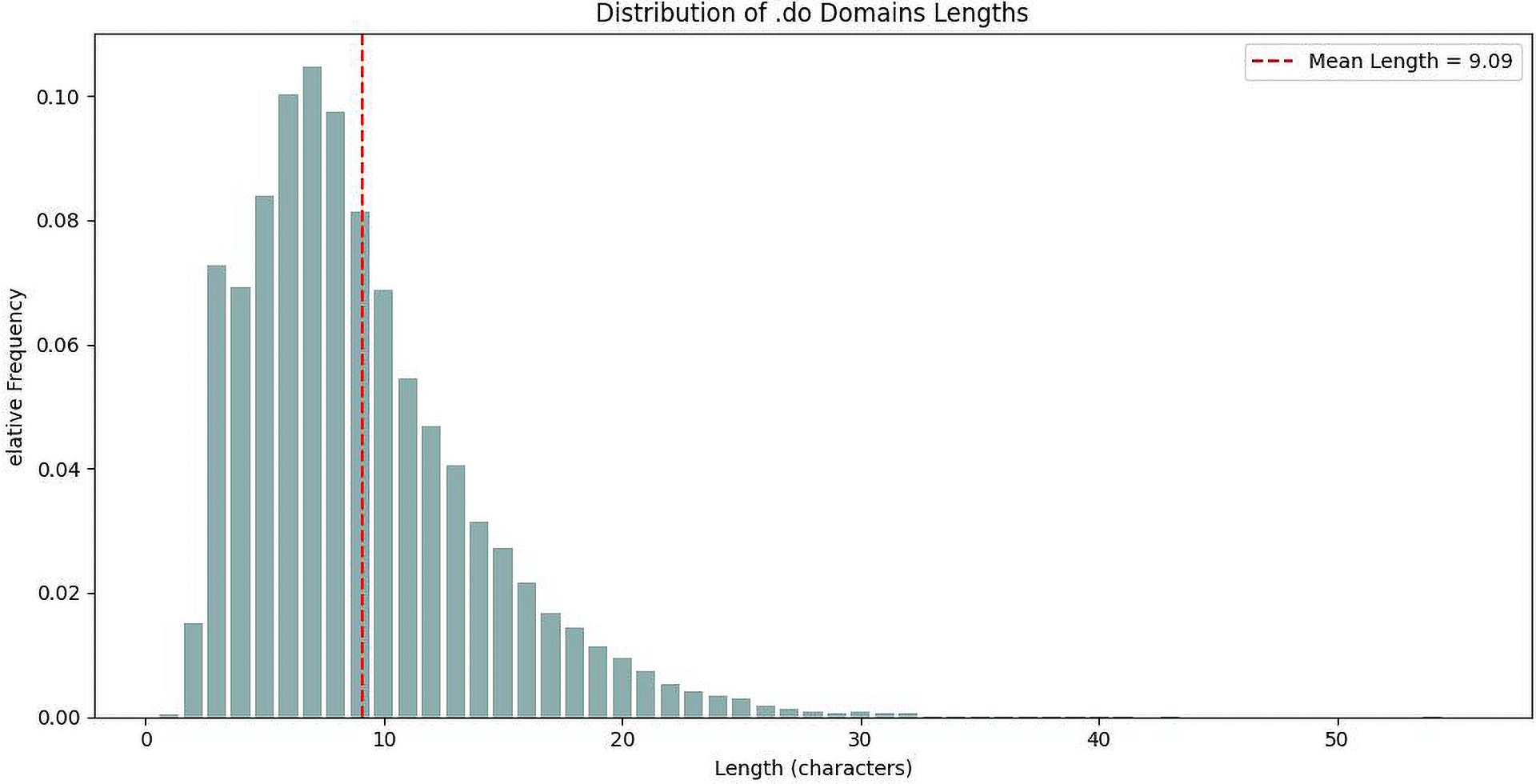
The descriptive analysis of domain name length reveals consistent structural patterns, as shown in Figure 1. The mean length is 9.08 characters, while the most frequent length (mode) is 7 characters. Together, these measures of central tendency indicate a clear concentration of domain names within relatively short length ranges. The difference between the mean and median suggests that, although shorter domain names predominate, longer names increase the average length.
In other words, some domain names exceed 15 characters, potentially reflecting strategic purposes such as brand identity protection. This pattern is consistent with scenarios in which domain names optimized for simplicity and ease of use coexist with longer names intended to more accurately represent a commercial or institutional identity.
It is worth noting that 64% of domain names classified as long do not have a properly configured web server. Therefore, structural anomalies can, to some extent, provide insights into the strategic purpose of a domain name. For example, santodomingoverde.gob.do is a long domain name that does not host a website, suggesting a potential brand identity protection strategy.
Similarly, 52% of short domain names do not host a website. Many of these cases may reflect domain speculation strategies aimed at potential resale. This interpretation is supported by the fact that 31% of short domain names were registered before 2020, a slightly higher proportion than the 30% observed among long domain names.
In summary, the analysis of domain name length reveals a predominant preference for shorter names, potentially driven by user experience considerations, alongside a smaller group of longer domain names associated with brand identity protection strategies.
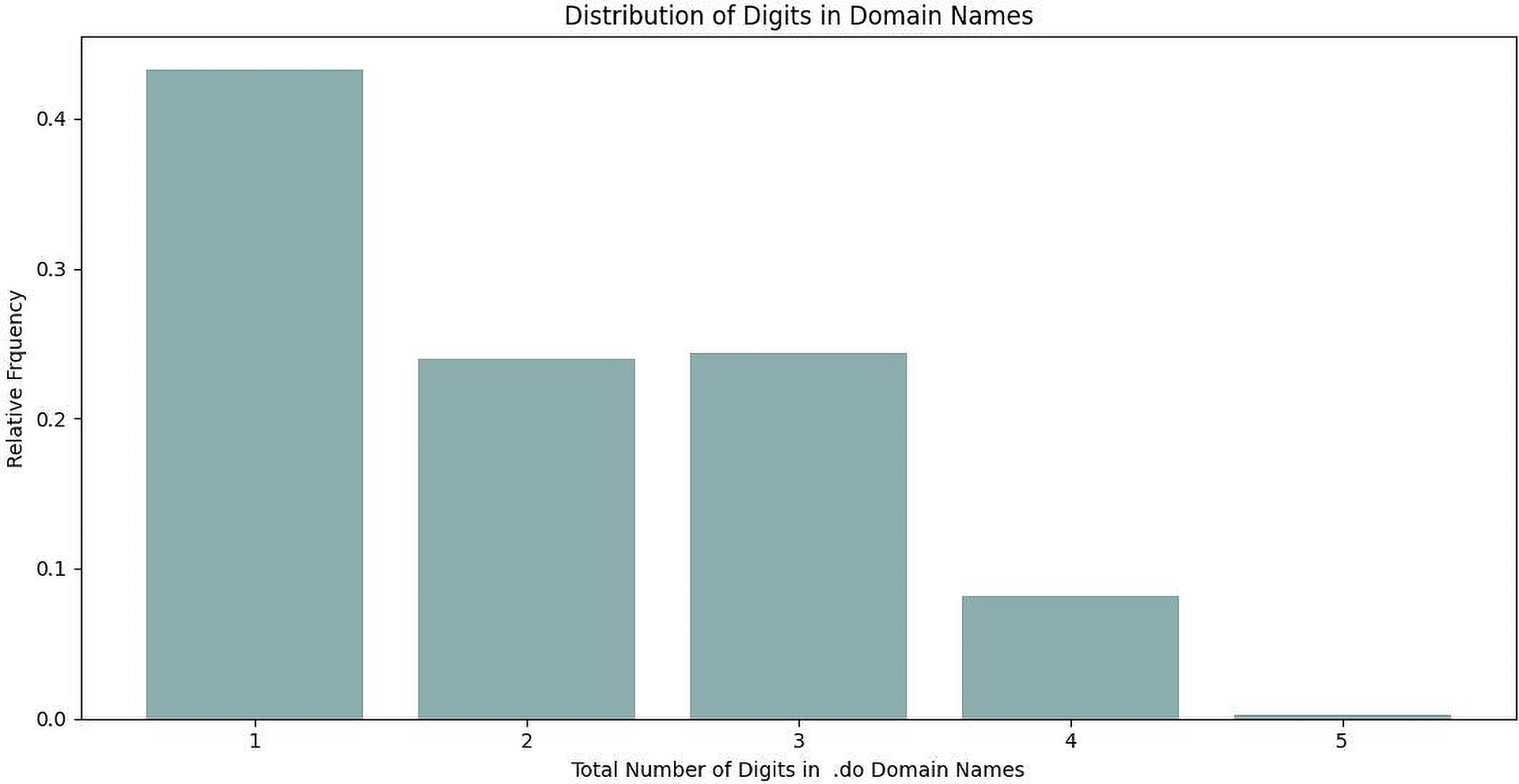
As part of the structural analysis of domain names, the frequency and distribution of numerical characters were also examined to identify compositional patterns associated with the use of digits, as shown in Figure 2.
The results reveal that the inclusion of numerical components in the analyzed domain names is limited in terms of length, as no domain names containing more than five digits were observed. This suggests a preference for short numerical sequences to improve the user experience.
In fact, only two domain names contain five or more digits (based on data from March 2026). Neither of these domains, 12345.do and 58099.do, had A, AAAA, or MX records configured. In other words, they have no associated website and are not configured to receive email. Furthermore, WHOIS queries did not reveal the identities of their registrants. Therefore, it is likely that these domains were registered for speculative purposes, potentially targeting future international use, given that both rely on Alibaba Cloud’s name server infrastructure (AliDNS).
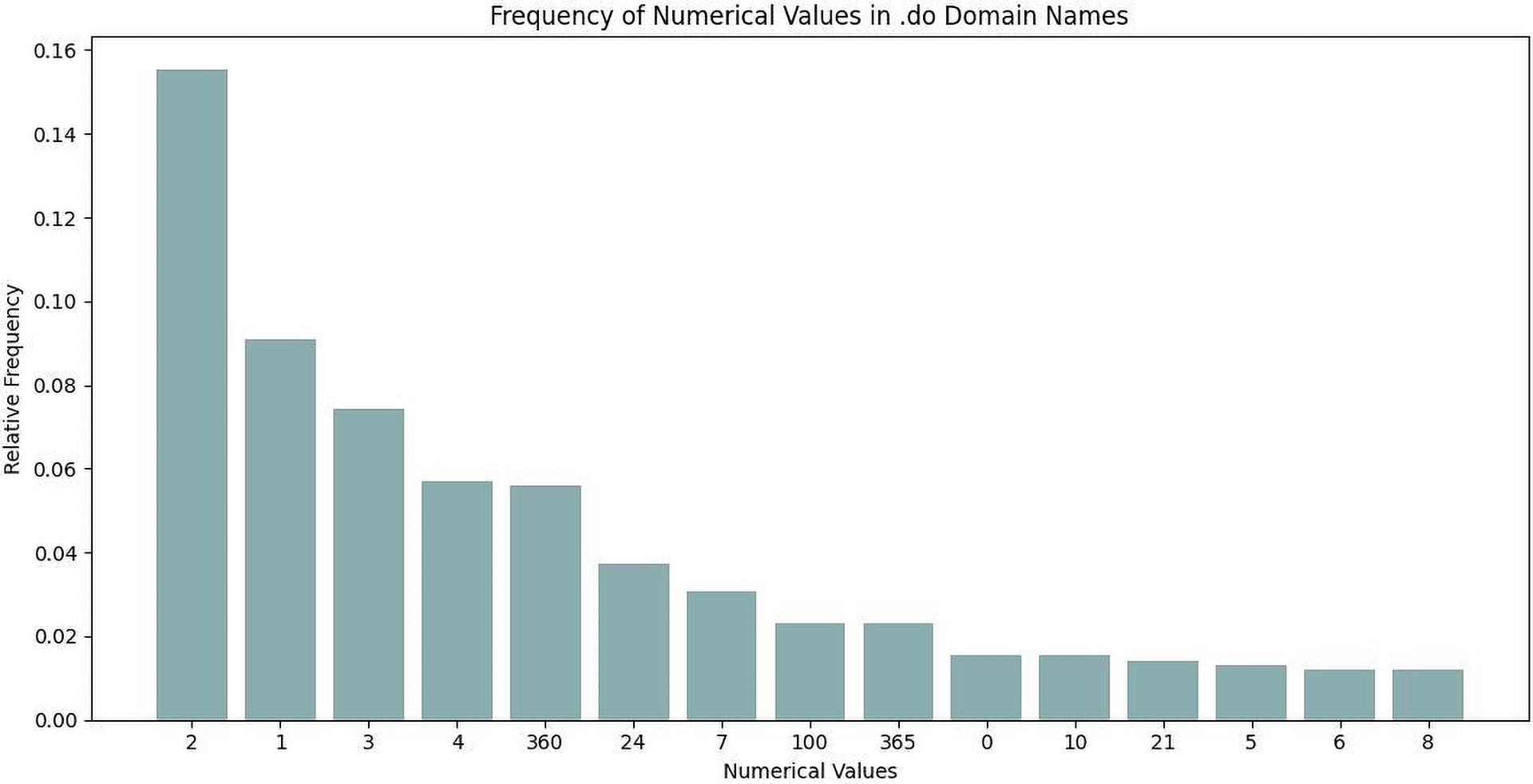
Additionally, the analysis of numerical composition reveals that certain digits occur significantly more frequently than others, as illustrated in Figure 3, which presents the most common numerical values. In many cases, patterns of semiotic polysemy or alphanumeric homophony can be observed. In particular, the frequent digits are 2, 4, and 8, which may carry semantic associations with familiar words or concepts, such as “to” or “do” in English and “tu” in Spanish, as illustrated by domain names such as 2espacio.do. A similar phenomenon occurs with the number 8, which is associated with wealth in Chinese culture.
This cultural association helps explain why many domain names containing the digit 8 are linked to websites targeting Asian audiences, as in the case of 8888.do, providing evidence of the international use of the .do ccTLD. Other similar examples include 56, 57, and 1024.do.
Finally, it is worth noting that 61% of domain names containing numerical characters do not have a properly configured web server, as they fail to respond correctly to HTTPS requests. Furthermore, 4% do not even have a properly configured IP address. Some of these domains may reflect brand identity protection strategies, as potentially illustrated by natgeo1.do, while others may be associated with suspicious activities, including possible phishing or typosquatting attempts, as in the case of then0tl0u1s.com.do. However, the proportion of numerically composed domain names potentially associated with brand protection or speculation is relatively low. Only 20% of these domains were registered before 2020, suggesting that most are associated with relatively recent digital identities.
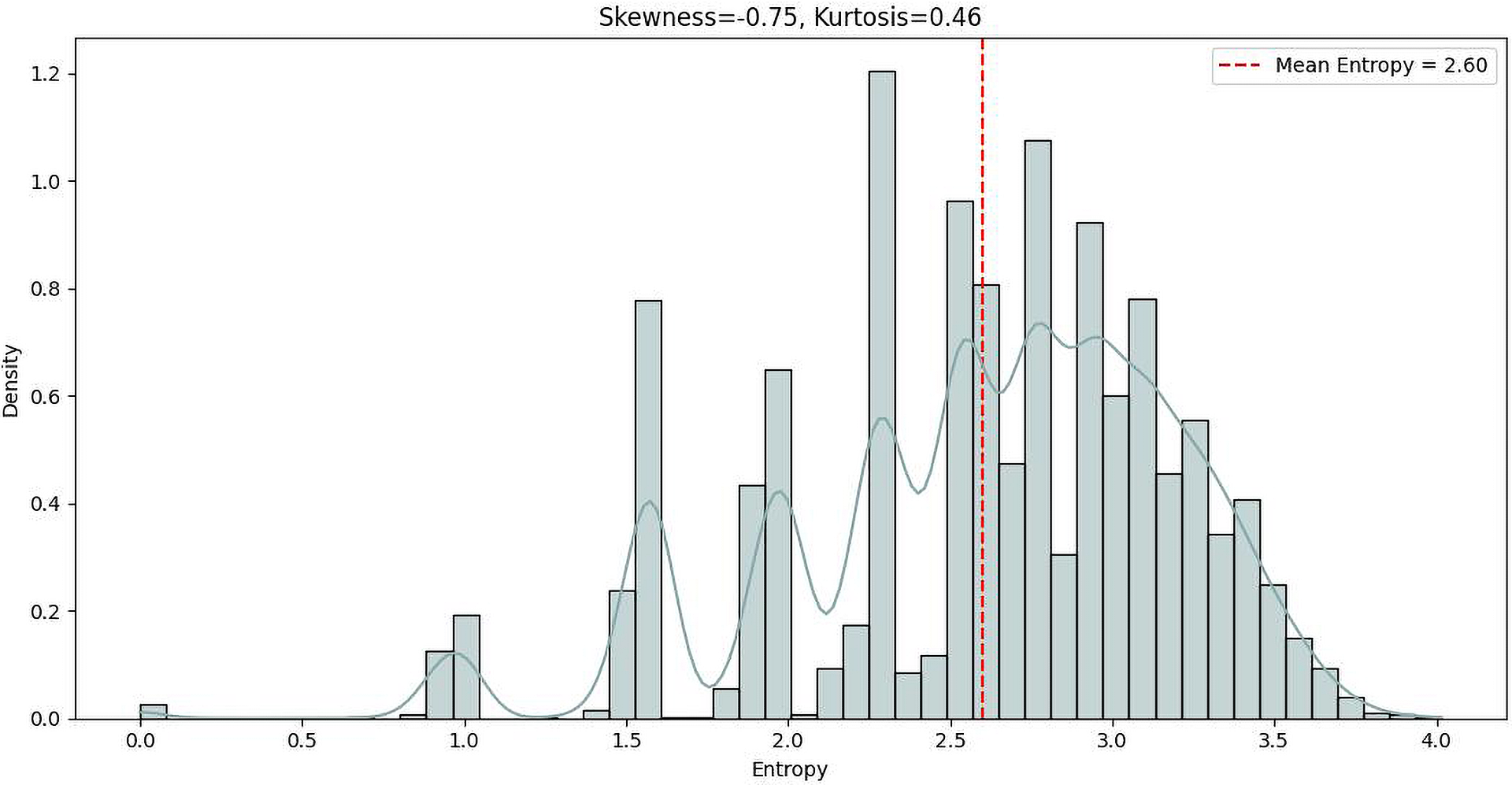
The results of the entropy analysis applied to domain names reveal a distribution with well-defined statistical characteristics, as illustrated in Figure 4, showing the graphical representation of the entropy distribution using a kernel density estimation (KDE).
The findings show a mean entropy of 2.60 bits, accompanied by a slightly higher median (2.72 bits), suggesting relatively stable values despite moderate asymmetry. In other words, domain names tend to exhibit moderate-to-high levels of length and randomness. This pattern is consistent with domain names representing acronyms and compound terms, many of which are intended for domestic use of the ccTLD. This behavior is further supported by the standard deviation (0.61 bits), which reflects moderate dispersion around the mean, indicating that although entropy varies across domain names, this variability is not excessively large.
Regarding the shape of the distribution, the skewness value of −0.75 indicates negative asymmetry, characterized by a tail extending toward lower entropy values. This suggests the presence of a subset of domain names with entropy levels significantly below the mean, potentially associated with shorter domain names. This pattern is also reflected in the mode of 1.58 bits, indicating a notable concentration of domain names with low entropy. These domains exhibit repetitive character patterns or less complex structures, forming a subset whose entropy values are considerably below the mean and median.
Consequently, the most frequently observed entropy value corresponds to domain names with low entropy, whose strategic purposes may include domain resale or international use of the .do ccTLD, as discussed in previous sections. Nevertheless, most entropy values are concentrated at higher levels.
Furthermore, the positive excess kurtosis of 0.46 suggests a modest departure from normality, without necessarily implying a lower occurrence of extreme value. In other words, the analysis does not reveal a substantial proportion of domain names with extreme entropy values, which could otherwise suggest suspicious patterns.
This study analyzes more than 41,000 domain names, representing approximately 96.76% of all registered domains (as of March 2026) under the Dominican Republic’s ccTLD.
The main findings are as follows: (1) there is significant international use of the national ccTLD; (2) approximately 61% of domain names containing numerical characters or exhibiting extreme values of length and entropy do not host a website, suggesting a behaviour that might be a signal of domain speculation or brand identity protection strategies; and (3) there is a notable tendency toward the international use of numerically composed domain names, in which digits carry semantic meanings beyond their numerical value.
These findings provide empirical evidence on the evolution of the Dominican Republic’s domain name ecosystem and its implications for digital governance. Similar patterns may also be observed in countries with comparable economic and sociodemographic characteristics.
Sponsored byWhoisXML API

Sponsored byDNIB.com
Sponsored byVerisign

Sponsored byIPv4.Global

Sponsored byCSC

Sponsored byRadix

Sponsored byVerisign


A World-Renowned Source for Internet Developments. Serving Since 2002.