
Welcome:
Login
|
Sign Up
|
About CircleID
Follow:
|
|



|
||
|
||
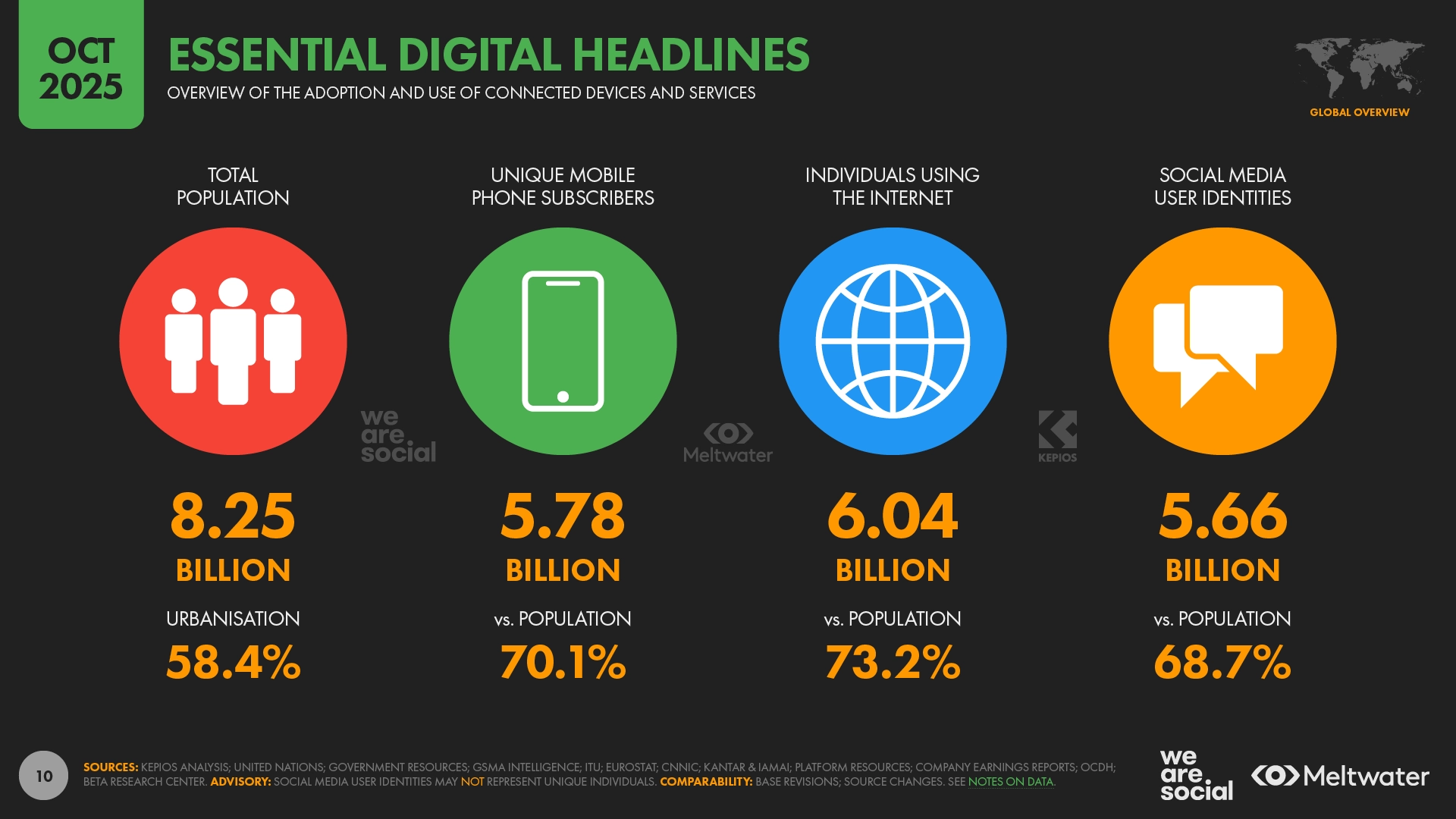
At the start of a new year, I thought it would be interesting to take a fresh look at the state of the Internet around the world. The following statistics come from the DataReportal Digital 2026 Global Overview Report.
Global Population. There are 8.25 billion people on the planet, up 69 million over the last year, an increase of 0.8%. 58.4% of people now live in an urban center. The overall literacy rate in the world is 87.4%.
Internet. The number of people using the Internet has grown to 6.04 billion, or 73.2% of the people on Earth. That number grew by 294 million in the last year, a growth rate of 5.1%. This means that 2.2 billion people still don’t have access to the Internet.
86.5% of urban residents around the world have access to the Internet, while only 54.5% of rural residents have access.
The countries with the lowest levels of Internet adoption are North Korea (<1%), Burundi (11.1%), Central African Republic (12.0%), South Sudan (13.2%), and Chad (13.2%).
The highest rate of Internet adoption is in northern Europe (97.7%), followed by western Europe (95.1%). The lowest adoption is in eastern Africa (26.0%) and central Africa (33.5%). North America is at 93.3%. 75.7% of men around the world have access to the Internet compared to 70.7% of women.
Worldwide median download broadband speeds have grown from 82.8 Mbps in August 2023 to 104.4 Mbps in August 2025.
The fastest median download speeds in the world are in Singapore (394.3 Mbps), Chile (347.4 Mbps), Hong Kong (332.7 Mbps), the United Arab Emirates (327.6 Mbps), and France (308.0 Mbps). The slowest median download speeds are in Syria (3.4 Mbps), Cuba (3.5 Mbps), Afghanistan (4.5 Mbps), Ethiopia (9.4 Mbps), and Libya (11.0 Mbps).
The average weekly time spent using broadband online per Internet user worldwide was 33 hours, 27 minutes.
Cell Coverage. There are 5.78 billion unique cellular users in the world, meaning that 70.1% of people have a cellphone. That number increased by 108 million during the last year, an annual growth rate of 1.9%. Ericsson says that 86.9% of phones in use are smartphones.
Worldwide median download cellular speeds have more than doubled in the last two years, from 43.2 Mbps in August 2023 to 90.7 Mbps in August 2025.
The fastest median download speeds in the world are in the United Arab Emirates (614.4 Mbps), Qatar (511.4 Mbps), Kuwait (414.6 Mbps), Brazil (289.4 Mbps), and South Korea (224.5 Mbps). The slowest median download cellular speeds are in Bolivia (14.7 Mbps), Belarus (18.6 Mbps), Eswatini (19.7 Mbps), Pakistan (24.3 Mbps), and Syria (24.7 Mbps).
Social Media. There are 5.66 billion users of social media, an increase of 259 million users and a growth rate of 4.8%.
The worldwide average time spent using social media is 18 hours 36 minutes per week.
The ten most widely used social media apps, in order, are YouTube, WhatsApp, Instagram, Facebook, TikTok, Messenger, SnapChat, Telegram, Pinterest, and Threads.
Devices. The devices used to access the Internet (as a percentage of total world users) are smartphones (93.7%), laptops or desktops (59.6%), connected televisions (31.6%), and tablets (28.0%).
The percentage of worldwide broadband traffic, by device used: cellphones (59.1%), laptops or computers (39.3%), tablets (1.6%), other devices (0.03%)
33% of adults now own some form of smart wrist device.
Sponsored byVerisign

Sponsored byIPv4.Global

Sponsored byCSC

Sponsored byDNIB.com

Sponsored byWhoisXML API

Sponsored byRadix

Sponsored byVerisign


A World-Renowned Source for Internet Developments. Serving Since 2002.