
Welcome:
Login
|
Sign Up
|
About CircleID
Follow:
|
|
|

ARIN today recognizes Interop, an organization with a long-standing presence in the Internet industry, for returning its unneeded Internet Protocol version 4 (IPv4) address space. Interop was originally allocated a /8 before ARIN's existence and the availability of smaller-sized address blocks. The organization recently realized it was only using a small portion of its address block and that returning the remainder to ARIN would be for the greater good of the Internet community. more
 Between December 2, 2018 and May 4, 2019, 197,524 phishing domains were discovered, 66% of which directly targeted consumers according to the latest State of the Internet report by Akamai. more
By 2021, it is estimated that cybercrime will cost the global economy more than $6 trillion in damages, exceeding annual costs for natural disasters and the global drug trade. more
The notorious social networking website 8chan was taken offline on Monday afternoon following discontinuation of support from various service providers to the platform over its links to the mass shooting in El Paso, Texas. more
Security firm, Armis Labs, has revealed a new attack vector that can target major mobile, desktop, and IoT operating systems, including Android, iOS, Windows, and Linux, and the devices using them.
more
Surveillance cameras in China can detect fevers with infrared cameras to an accuracy within 0.3℃ and recognize faces even if they are wearing masks. more
A surge in AI-generated deepfake scams is reshaping the cybersecurity threat landscape, with fraudsters now impersonating company executives to deceive employees and siphon off millions. more
US Congress asked to develop an internet data privacy legislation similar to the EU's General Data Protection Regulation (GDPR) to enhance consumer protections. more
U.S. Department of Justice says federal authorities successfully carried out a "significant" coordinated effort to disrupt Business Email Compromise (BEC) schemes designed to intercept and hijack wire transfers from businesses and individuals. more
 In observance of World IPv6 Day being held today, Earl Zmijewski of Renesys takes a closer look at the state of the IPv6 today. Zmijewski writes: "Today is World IPv6 Day, a day when major content providers have agreed to furnish service over IPv6 for a 24-hour test period. Hopefully, you didn't notice anything different about your Internet experience today, but providers will have gained valuable experience with the technology and any technical hurdles that remain to be overcome..." more
According to recent study conducted by Minds + Machines, historical data analysis suggests brand owners do not necessarily register their brands when it comes to new generic Top-Level Domains. From the report: "A survey of the domain registration behavior of Fortune 100 companies reveals that they have not registered many of their trademarks in recently created generic top-level domains (gTLDs). A sample of 1043 brands were registered in less than 30% of the eight new open gTLDs created after 2001. If historical registration data is a guide, brands are unlikely to undertake many defensive domain name registrations in the proposed new gTLDs, and furthermore are unlikely to be the victims of cybersquatting." more
Kieren McCarthy reporting in The Register writes: "The US Federal Trade Commission (FTC) has responded to questions over the legality of .sucks domain pricing with a three-page "I told you so" letter to domain name overseer ICANN. more
Tim Berners-Lee has called on governments, companies and individuals to back a new "Contract for the Web" that aims to protect people's rights and freedoms on the internet. more
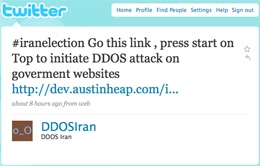 In the midst of heavy demonstrations in the street of Iran against current regime and controversial election results, online activist have began organizing online attacks against government websites. Activists are asking supporters to use tools currently being spread via Twitter, Facebook, and other social networking sites to participate in the attack. However as one blogger writes, the attack might in fact back fire in a country like Iran where network infrastructure is relatively centralized... more
 A Chinese state-backed company has successfully launched its first 18 satellites, marking the initial phase of a significant project to establish a vast orbital network intended to compete with Starlink, according to The China Securities Journal. more
Sponsored byCSC

Sponsored byWhoisXML API

Sponsored byRadix

Sponsored byVerisign

Sponsored byIPv4.Global

Sponsored byDNIB.com

Sponsored byVerisign

A World-Renowned Source for Internet Developments. Serving Since 2002.