
Welcome:
Login
|
Sign Up
|
About CircleID
Follow:
|
|


|
||
|
||
A backdoor dubbed “Keenadu” has been identified in the firmware of devices from various Android smartphone brands. Researchers believe the infection stemmed from a malicious static library linked with libandroid_runtime.so during the firmware build phase. In other cases, the compromised firmware was delivered via OTA updates.
Keenadu is a multistage loader that grants its operators unrestricted ability to control victims’ devices remotely. Its payloads include hijacking search engines, monetizing new app installs, and stealthily interacting with ad elements.
Securelist published several network IoCs related to the threat. And after extracting domains from subdomains identified as IoCs and weeding out legitimate domains from their list, we further analyzed 29 IoCs comprising five subdomains, 20 domains, and four IP addresses, which allowed us to uncover these findings:
A sample of the additional artifacts obtained from our analysis is available for download from our website.
According to the results of our queries for the five subdomains identified as IoCs on the WhoisXML API MCP Server, all of them have already been flagged as malware between 19 February to 12 March 2026.
And while three of them were hosted on legitimate cloud servers, it is not uncommon for threat actors to abuse such services for their nefarious gain. It is also worth noting that the remaining two subdomains were hosted on a domain—istaticfiles[.]com—that seems to have been purposely registered to host malicious content.
We then sought out more information about the 20 domains that have been identified as IoCs.
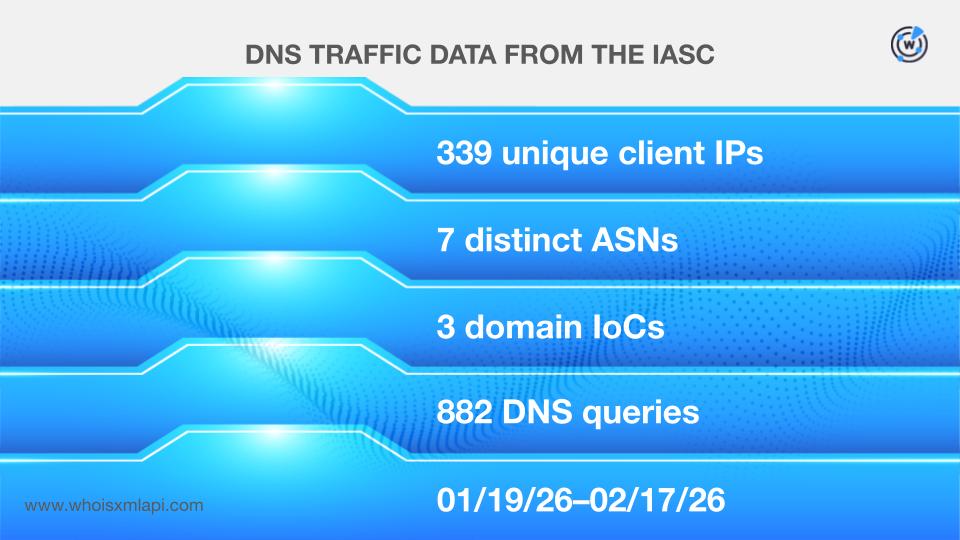
Sample network traffic data from the IASC, for one, revealed that 339 unique client IP addresses communicated with three of the domains tagged as IoCs via 882 DNS queries made between 19 January and 17 February 2026. These IP addresses fell under seven distinct ASNs.
Data from the First Watch Malicious Domains Data Feed, meanwhile, showed that three of the domains dubbed as IoCs were deemed likely to turn malicious 357—628 days before they were dubbed as such on 17 February 2026. Here are more details.
| DOMAIN IoC | FIRST WATCH DATE | NUMBER OF DAYS BEFORE THE REPORT DATE |
|---|---|---|
| gvvt1[.]com | 05/30/24 | 628 |
| dllpgd[.]click | 12/16/24 | 428 |
| playstations[.]click | 02/25/25 | 357 |
Next, we queried the domains on WHOIS API and learned that:
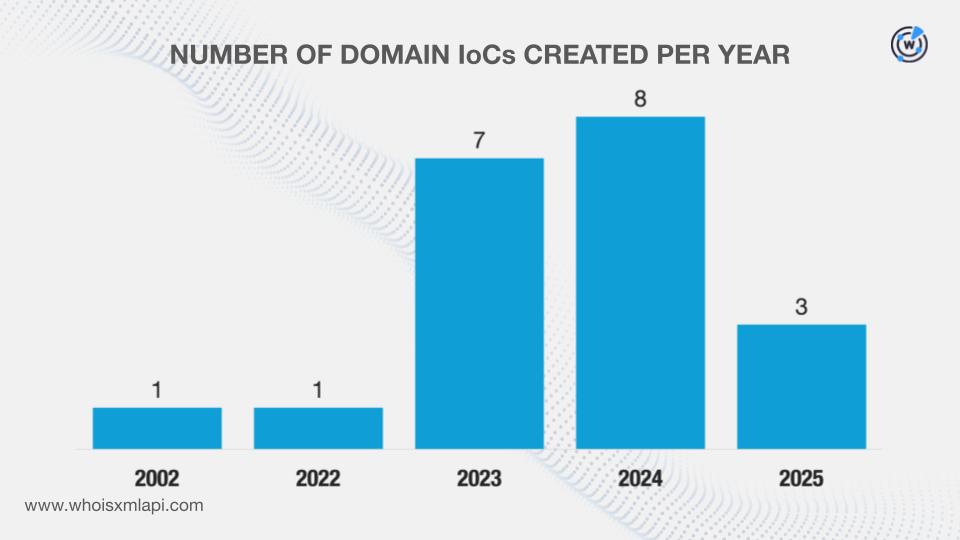
They were administered by five different registrars.
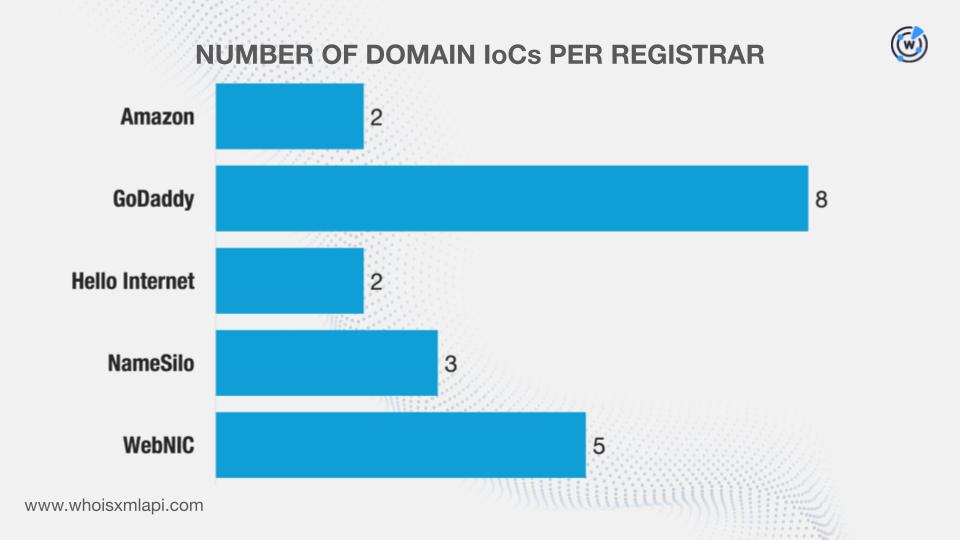
They were registered in four disparate countries.
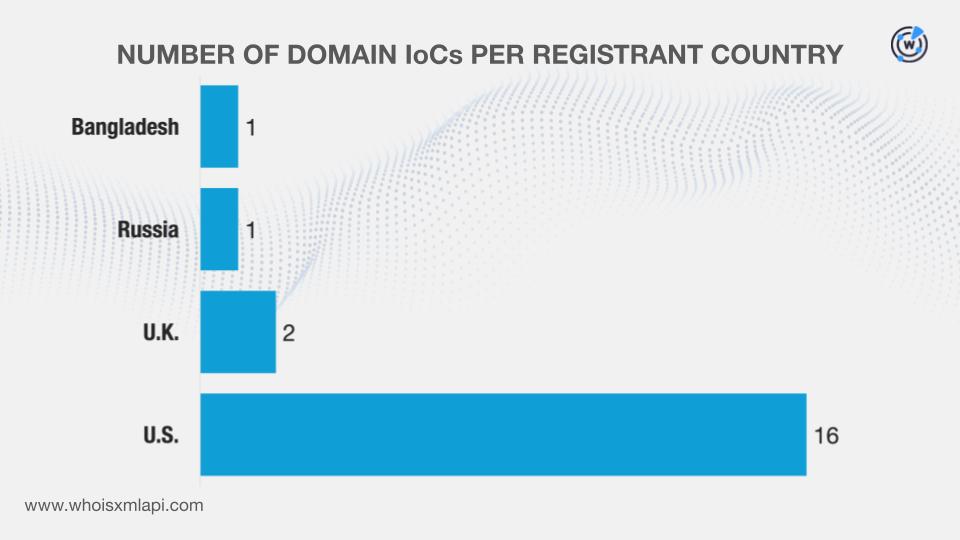
DNS Chronicle API queries for the domains revealed that 12 recorded 1,245 historical domain-to-IP resolutions over time. Take a look at the five domains with the oldest first resolution dates below.
| DOMAIN IoC | NUMBER OF DOMAIN-TO-IP RESOLUTIONS | DATES SEEN |
|---|---|---|
| gsonx[.]com | 106 | 08/12/17–02/07/24 |
| fbgraph[.]com | 47 | 08/16/19–12/31/25 |
| proczone[.]com | 42 | 01/09/21–02/09/22 |
| keepgo123[.]com | 30 | 01/28/22–04/02/24 |
| istaticfiles[.]com | 190 | 06/28/23–02/09/26 |
It is also interesting to note that many domains, five to be exact, first resolved to IP addresses sometime in 2023.
Next, we focused on the four IP addresses identified as IoCs.
First off, sample network data from the IASC revealed that 61 unique potential victim IP addresses communicated with two of the IP addresses tagged as IoCs between 19 January and 17 of February 2026. The victim IP addresses fell under five distinct ASNs.
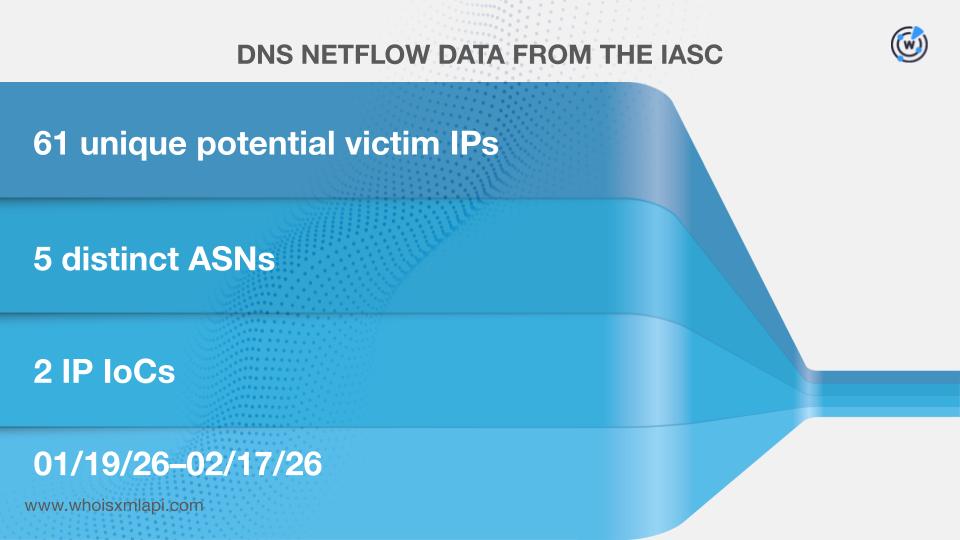
Next, we queried the IP addresses on Bulk IP Geolocation Lookup and discovered that:
They were geolocated in two countries. Note that the U.S. was also named as the registrant country of several of the domains tagged as IoCs.
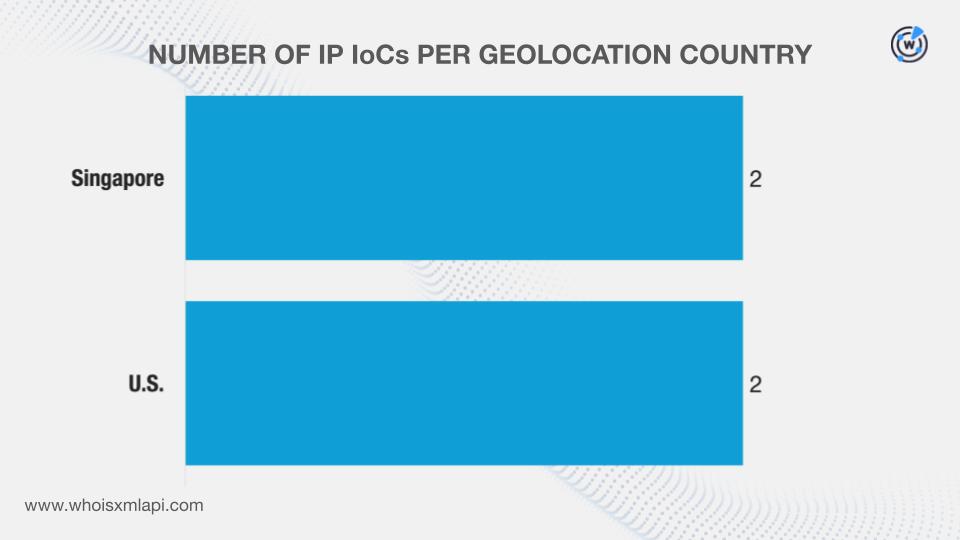
They were all administered by VPLS.
DNS Chronicle API queries for the IP addresses, meanwhile, showed that all four posted 1,896 historical IP-to-domain resolutions over time. Here are more details.
| IP IoC | NUMBER OF IP-TO-DOMAIN RESOLUTIONS | DATES SEEN |
|---|---|---|
| 110[.]34[.]191[.]81 | 20 | 11/29/17–12/20/25 |
| 67[.]198[.]232[.]187 | 934 | 10/05/19–02/17/26 |
In this final phase of our investigation, we scoured the DNS for artifacts potentially connected to Keenadu.
We started by querying the 20 domains identified as IoCs on WHOIS History API. We learned that 14 of them had 27 unique email addresses in their historical WHOIS records. Closer scrutiny allowed us to determine that six were public email addresses.
Reverse WHOIS API queries for the public email addresses led to the discovery of 80 unique email-connected domains after those already tagged as IoCs were filtered out.
We then queried the email-connected domains on Threat Intelligence API and found out that 12 have already been weaponized for various attacks. Take a look at five examples below.
| MALICIOUS EMAIL-CONNECTED DOMAIN | ASSOCIATED THREAT | DATES SEEN |
|---|---|---|
| fuhidd[.]com | Malware distribution | 07/24/25–02/17/26 |
| huulog[.]com | Malware distribution | 07/24/25–02/17/26 |
| huuww[.]com | Malware distribution | 07/24/25–02/17/26 |
| mtcpmpm[.]com | Malware distribution | 07/24/25–02/17/26 |
| mtcprogram[.]com | Malware distribution | 07/24/25–02/17/26 |
Next, we queried the domains dubbed as IoCs on DNS Lookup API and discovered that five resolved to eight additional IP addresses.
Threat Intelligence API queries for the additional IP addresses revealed that four have already figured in various malicious campaigns. Here are more details.
| MALICIOUS ADDITIONAL IP ADDRESS | ASSOCIATED THREAT | DATES SEEN |
|---|---|---|
| 104[.]21[.]87[.]166 | Malware distributionPhishing | 08/22/25–02/17/2601/31/24–12/23/25 |
| 172[.]67[.]144[.]175 | Malware distributionPhishing | 08/22/25–02/17/2601/31/24–12/23/25 |
This post only contains a snapshot of the full research. Download the complete findings and a sample of the additional artifacts on our website or contact us to discuss your intelligence needs for threat detection and response or other cybersecurity use cases.
| MALICIOUS ADDITIONAL IP ADDRESS | ASSOCIATED THREAT | DATES SEEN |
|---|---|---|
| 104[.]21[.]87[.]166 | Malware distributionPhishing | 08/22/25–02/17/2601/31/24–12/23/25 |
| 172[.]67[.]144[.]175 | Malware distributionPhishing | 08/22/25–02/17/2601/31/24–12/23/25 |
We take a cautionary stance toward threat detection and aim to provide relevant information to help protect against potential dangers. Consequently, it is possible that some entities identified as “threats” or “malicious” may eventually be deemed harmless upon further investigation or changes in context. We strongly recommend conducting supplementary investigations to corroborate the information provided herein.
Sponsored byWhoisXML API

Sponsored byVerisign

Sponsored byRadix

Sponsored byVerisign

Sponsored byIPv4.Global

Sponsored byDNIB.com

Sponsored byCSC


A World-Renowned Source for Internet Developments. Serving Since 2002.