
Welcome:
Login
|
Sign Up
|
About CircleID
Follow:
|
|
|



|
||
|
||
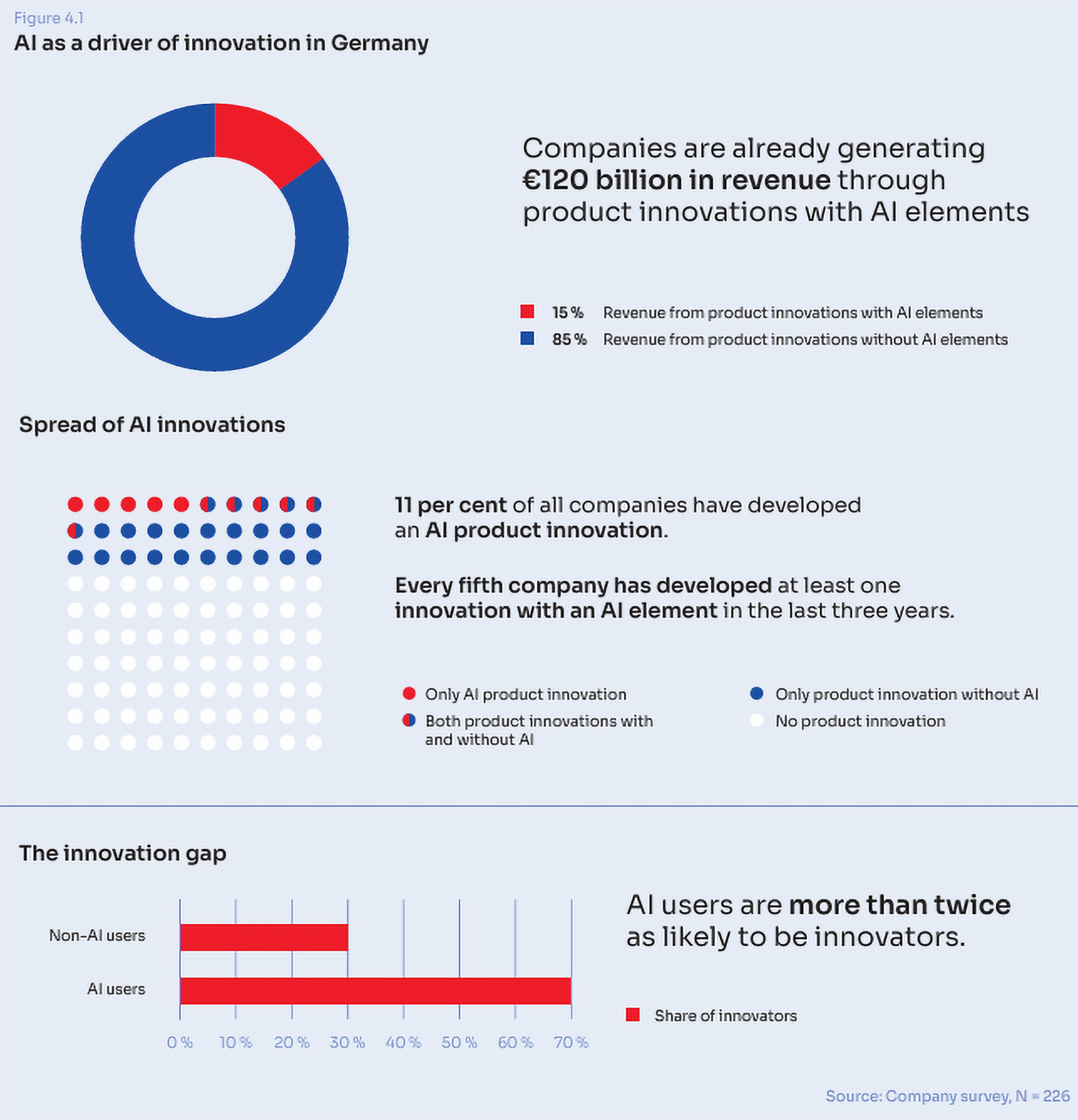
German companies are generating more than €120 billion in revenue from products and services incorporating artificial intelligence, according to a new study that identifies industrial applications, rather than homegrown foundation models, as Germany’s emerging strength in AI.
The study commissioned by eco—Association of the Internet Industry and conducted by IW Consult examines how German companies and AI startups use the technology, drawing on company surveys, startup research, job-posting analysis and a literature review.
One in five German companies now uses AI for innovation. Among companies using AI, 54% fall into a category that adapts and develops existing models for specific applications rather than concentrating on building foundation models. The pattern is even clearer among AI startups: 83% of those surveyed build on existing models, while 51% specifically develop industrial AI applications.
That model connects AI systems with proprietary company data, machines, sensors and real-time information in production and engineering environments. The researchers argue that Germany’s large industrial base and engineering expertise give companies an opportunity to specialize in this application layer.
The findings also point to a diverse market for AI models and cloud infrastructure. Companies surveyed were familiar with an average of 6.4 foundation models and actively used 2.7. More than 70% used multiple models, while 56% used more than one cloud provider. Among startups, multi-cloud use reached 79%.
Those figures matter beyond the AI model market because industrial AI depends on the Internet infrastructure connecting applications, data and computing resources. eco identifies data centers and cloud services as foundations for effective AI deployment; its study page also links cloud use with productivity and innovation.
Infrastructure and policy could determine how far the model scales. The study identifies access to data, AI skills, digital infrastructure and predictable regulation as important conditions for wider deployment. In a subsequent policy statement, eco estimated an additional €96 billion in potential value creation from AI and automation in German industry and called for clearer implementation of the EU AI Act and fewer regulatory overlaps.
The full study provides a deeper look at Germany’s emerging AI model. Readers can access The Deutschland Case: How AI Is Reinventing the Industrial Business Model through eco’s study page for additional findings on AI adoption, startups, cloud use, infrastructure and the conditions researchers identify for scaling industrial AI.
Sponsored byIPv4.Global

Sponsored byVerisign

Sponsored byCSC

Sponsored byDNIB.com

Sponsored byRadix

Sponsored byVerisign

Sponsored byWhoisXML API


A World-Renowned Source for Internet Developments. Serving Since 2002.