
Welcome:
Login
|
Sign Up
|
About CircleID
Follow:
|
|


|
||
ICANN has published a new set of guidelines for advancing Universal Acceptance, shifting its decade-long effort to make all valid domain names and email addresses work across Internet applications toward more systematic implementation and measurement.
The September 9 publication follows work by ICANN’s Universal Acceptance Expert Working Group, established in August 2025. The group’s final guidelines target technology companies, open-source projects, standards bodies, software developers, DNS providers, hosting companies, governments and academia. ICANN said it will use them to shape its future Universal Acceptance work.
The guidelines treat Universal Acceptance as a technology-stack problem rather than a front-end fix. A UA-ready system must accept, validate, store, process, display and interoperate with domain names and email addresses regardless of script, language or length. The working group identifies dependencies ranging from Unicode and programming libraries through operating systems, browsers, authentication systems and applications. It calls for coordinated remediation where lower-level software prevents higher-level services from supporting internationalized identifiers.
Among the functions singled out are email and domain-name validation, internationalized email, linkification, sign-in and two-factor authentication, spam filtering and DNS operations. The group also recommends prioritizing widely used applications including social media, content-management and CRM systems, browsers, email software and programming frameworks.
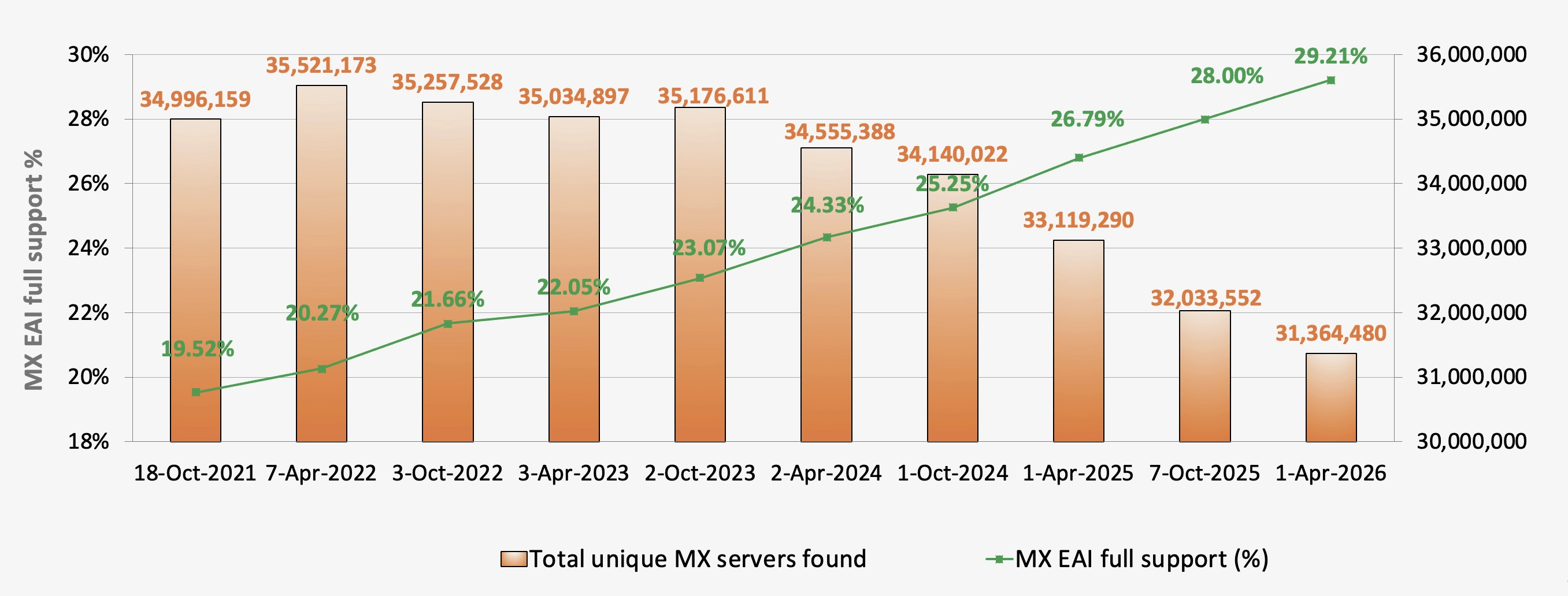
Existing measurements show why those dependencies still matter. ICANN’s current readiness data indicate that the share of domains with mail servers capable of handling Email Address Internationalization rose from roughly 20% in 2022 to about 29% in 2026. Gmail and Microsoft Outlook are among large services that can send to and receive from internationalized addresses, but a 2025 UASG assessment said users still encounter problems creating accounts with local-language email addresses on websites, software and social platforms, while automatic recognition and linkification of internationalized addresses remain uneven.
The available platform benchmarks are themselves uneven in age. ICANN’s evaluation inventory points to browser testing last updated in 2022 and an assessment of Okta, Auth0 and OpenIAM identity platforms from 2023, alongside newer 2025 testing of websites, e-commerce platforms and JavaScript libraries. That makes refreshed testing of browsers, identity services and major SaaS platforms an obvious measure of progress under the new framework.
Universal Acceptance is also tied directly to ICANN’s 2026 new-gTLD round: additional internationalized and nontraditional domain strings have limited practical value when applications refuse the resulting domains or email addresses. ICANN’s guidelines call for measuring progress across awareness, policy support, implementation and technical capacity rather than adoption claims alone.
Sponsored byVerisign

Sponsored byDNIB.com

Sponsored byIPv4.Global

Sponsored byRadix

Sponsored byVerisign

Sponsored byCSC

Sponsored byWhoisXML API


A World-Renowned Source for Internet Developments. Serving Since 2002.