
Welcome:
Login
|
Sign Up
|
About CircleID
Follow:
|
|


|
||
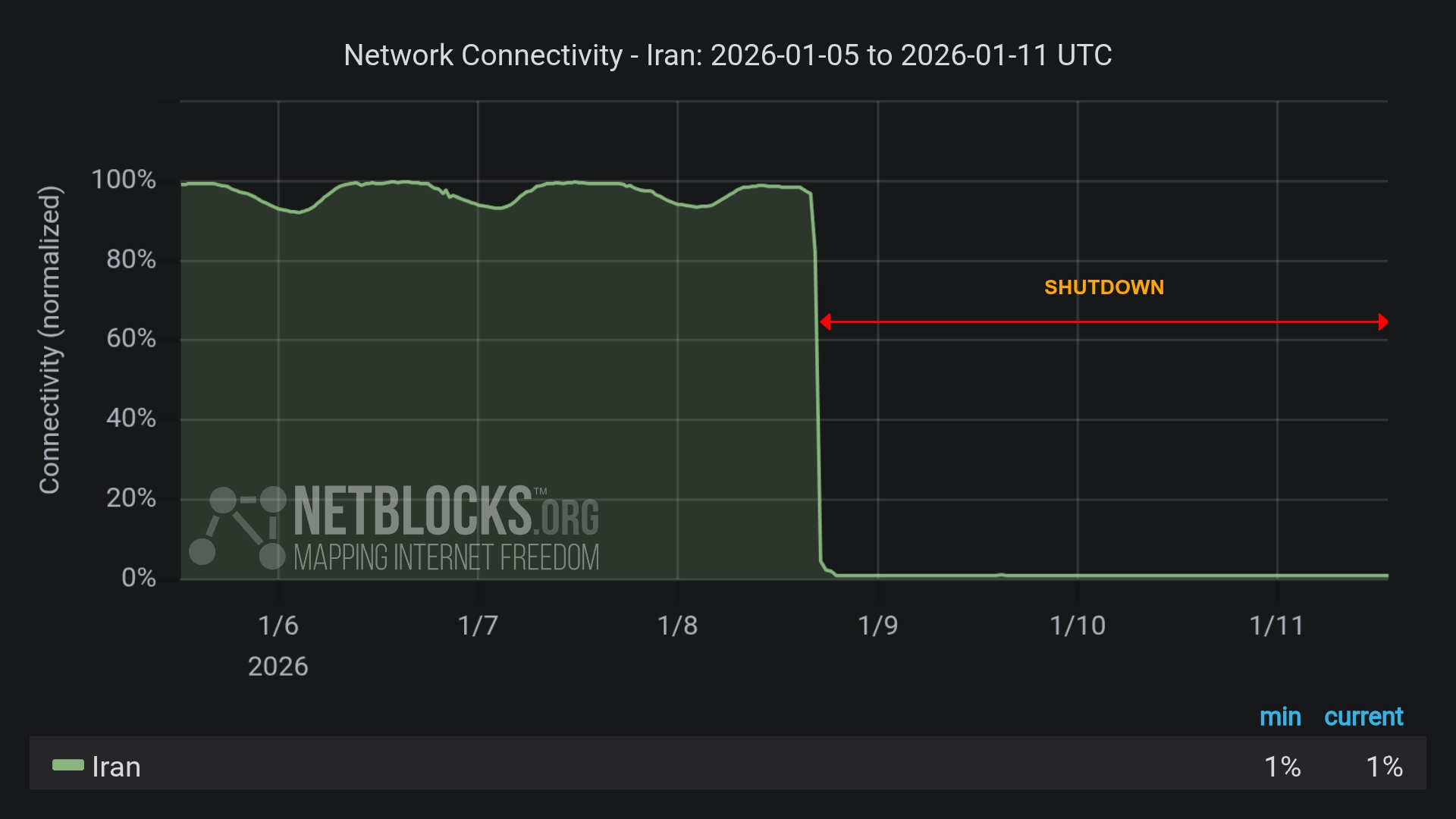
In a dramatic escalation of its information-control strategy, Iran has launched an unprecedented digital blackout—one that appears to extend even to Starlink, the satellite internet service long considered a lifeline for activists and dissidents. The move follows days of intensifying anti-government protests driven by deteriorating economic conditions, and it marks the most sophisticated—and concerning—effort yet by the Islamic Republic to silence dissent.
Satellite disruption: The shutdown, which began Thursday evening, has disconnected millions from mobile networks, fixed-line internet, and increasingly, from satellite connectivity. NetBlocks, a watchdog group tracking internet freedom, confirmed a nationwide blackout, while digital rights experts noted a sharp drop in data traffic from Starlink receivers operating inside Iran. Analysts now suggest that Iranian authorities have deployed high-powered GPS jammers, and possibly mobile interference units, to cripple satellite communications—an effort more typically seen in battlefield conditions than domestic unrest.
Advanced jamming: “This is a first,” said Amir Rashidi, a digital security expert at the Miaan Group. “What we’re seeing is not just GPS jamming, but possibly military-grade signal disruption designed to target even low-earth orbit satellites like those used by Starlink.”
Starlink silenced: The implications are severe. Satellite internet, particularly Starlink, has been a crucial channel for Iranian citizens to share videos, photographs and real-time updates with the outside world. During the 2022 Mahsa Amini protests, Starlink emerged as a Plan B for circumventing Tehran’s increasingly restrictive digital architecture. This time, however, the authorities appear better prepared. In some regions, data packet loss on Starlink devices has reached 80%, rendering the system all but useless.
State control: Iranian officials have not publicly acknowledged the new jamming efforts, but their intent is evident. By blocking every channel of communication—domestic or foreign, legal or clandestine—the regime aims to prevent a repeat of the mass mobilisations that have shaken its grip on power in recent years. The attorney general’s warning that protestors may be treated as “enemies of God,” a charge carrying the death penalty, underscores the high stakes.
Global implications: The digital blackout also carries geopolitical weight. Iran has long lobbied the International Telecommunication Union to ban Starlink from operating over its territory. Its current actions appear designed to enforce that outcome unilaterally, despite international law prohibiting signal jamming of this scale.
For now, only a trickle of information is escaping the country, mostly via encrypted apps and the few Starlink units that remain functional. Yet using such tools is perilous. “If they catch someone with a Starlink receiver, they could accuse them of spying for the US or Israel,” said Azam Jangravi, an exiled cybersecurity expert.
With protesters risking death, and communications crumbling under state pressure, the fate of Iran’s latest uprising may depend not only on political will—but on the strength of its last digital signals.
Sponsored byVerisign

Sponsored byVerisign

Sponsored byDNIB.com

Sponsored byWhoisXML API

Sponsored byIPv4.Global

Sponsored byCSC

Sponsored byRadix


A World-Renowned Source for Internet Developments. Serving Since 2002.