
Welcome:
Login
|
Sign Up
|
About CircleID
Follow:
|
|



|
||
|
||
A single company, Cloud Innovation, accounts for more than 80% of AfriNIC addresses detected outside their region by IPinfo. The measurements raise questions about the use of 4 address blocks and the commitments made to Africa’s registry. This investigation explains what the numbers show, what the agreement requires and what the company disputes.
Cloud Innovation occupies a central position in the findings published by IPinfo. Of 461,393 AfriNIC IPv4 addresses detected outside their region, 375,808 belong to blocks allocated to the company, or 81% after rounding. Other blocks account for 85,585. These observations, dated 24 October 2026, call for a documented explanation of how the resources are used.
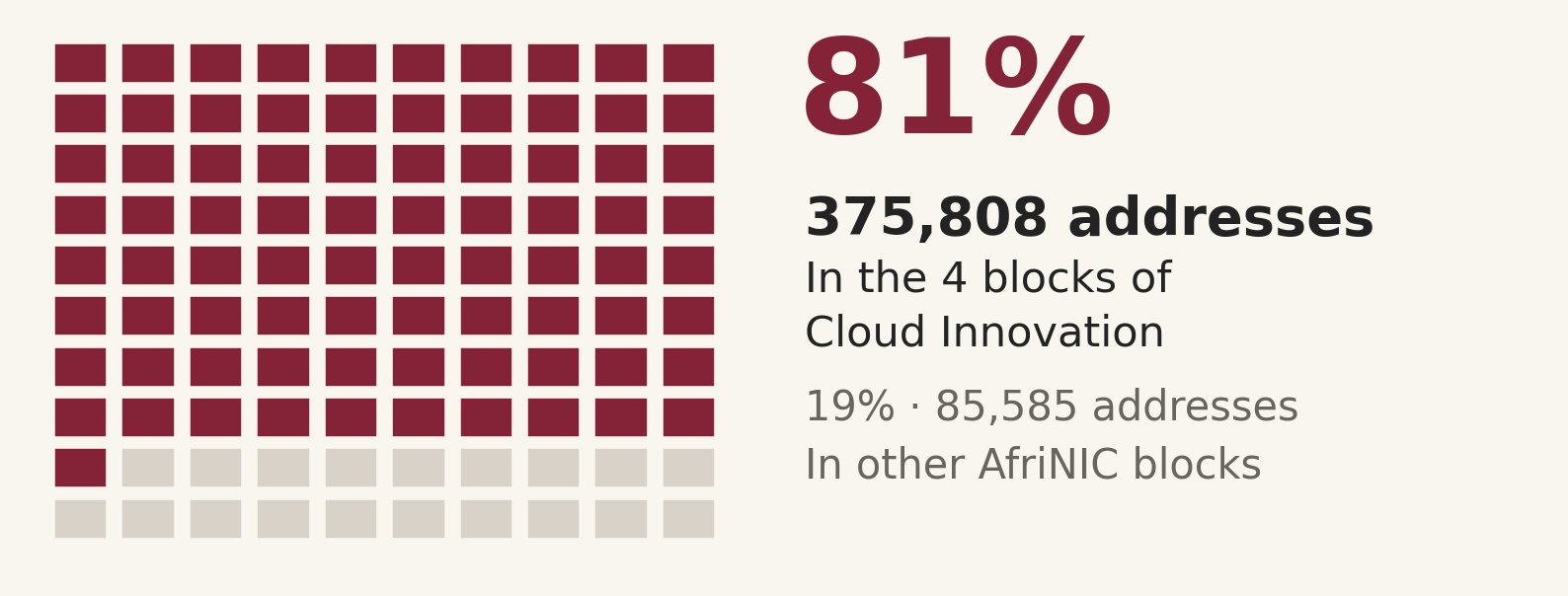
The issue extends beyond the presence of machines abroad. It concerns the original commitment, the holder’s responsibilities and the purpose the resources actually serve. A company granted conditional usage rights must be able to explain how its activities meet those conditions. A registry challenging that use must, in turn, provide verifiable evidence.
The study, the model agreement, the policies and the parties’ correspondence allow these requirements to be examined together. They reveal a concerning concentration and support a legitimate request for justification. They do not establish that a contractual breach has been definitively adjudicated.
Imagine a ship registered in Mauritius. Its operator has obtained access to a shared resource to provide a service to Senegal. An observer finds the ship in a Chinese port. Its flag remains Mauritian, its location is Chinese and its stated mission concerns Dakar. These 3 facts can all be true at the same time.
Finding the vessel in China is not enough to establish wrongdoing. It may be loading goods destined for Senegal. However, if its operator persistently uses it for an activity unrelated to the promised mission, the registration papers no longer answer the central question. The agreement, the journeys and the services actually provided must be examined.
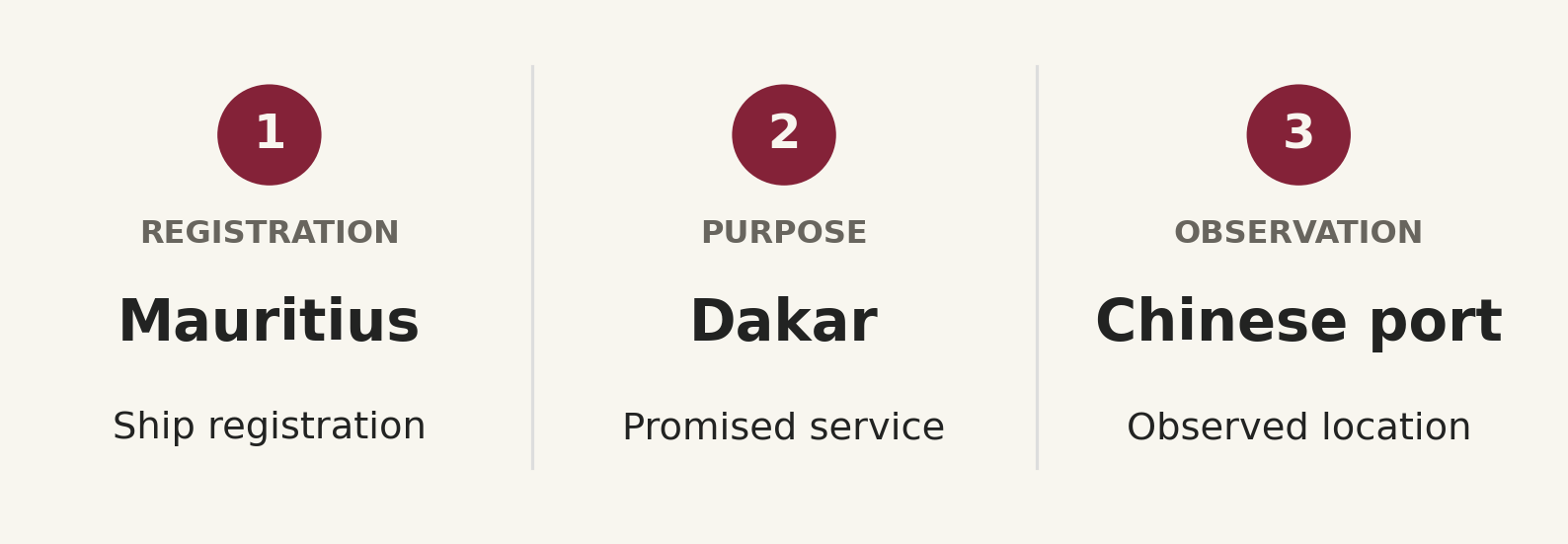
This is a fictional scenario. It does not mean that all the addresses concerned are located in China. It helps explain the Cloud Innovation case without confusing a company’s registered address, the location from which equipment responds and the use the resource holder committed to making.
Very broadly, an IP address acts as a number used to route communications to a network interface. IPv4 uses 32 bits, allowing 4,294,967,296 theoretical combinations, some reserved for particular purposes. An address therefore does not automatically correspond to a person, a website or a country.
Registries coordinate the allocation of these unique identifiers. AfriNIC belongs to the system of 5 regional registries. A block’s regional affiliation describes registration responsibility; it is not a GPS device. RFC 7020 explains this system and its coordination objectives.
The terminology can mislead readers. Calling an address “African” here refers to its registration with AfriNIC. It does not mean that a physical object was loaded into a container and exported. What changes is the use of an identifier, made observable through network responses and registration records.
The 4 blocks examined contain 6,291,456 addresses. This portfolio must be distinguished from the fraction detected outside the region. The difference resembles the distinction between the size of a fleet and the number of ships observed in particular ports. Confusing the 2 would turn a limited observation into an allegation about the entire portfolio.
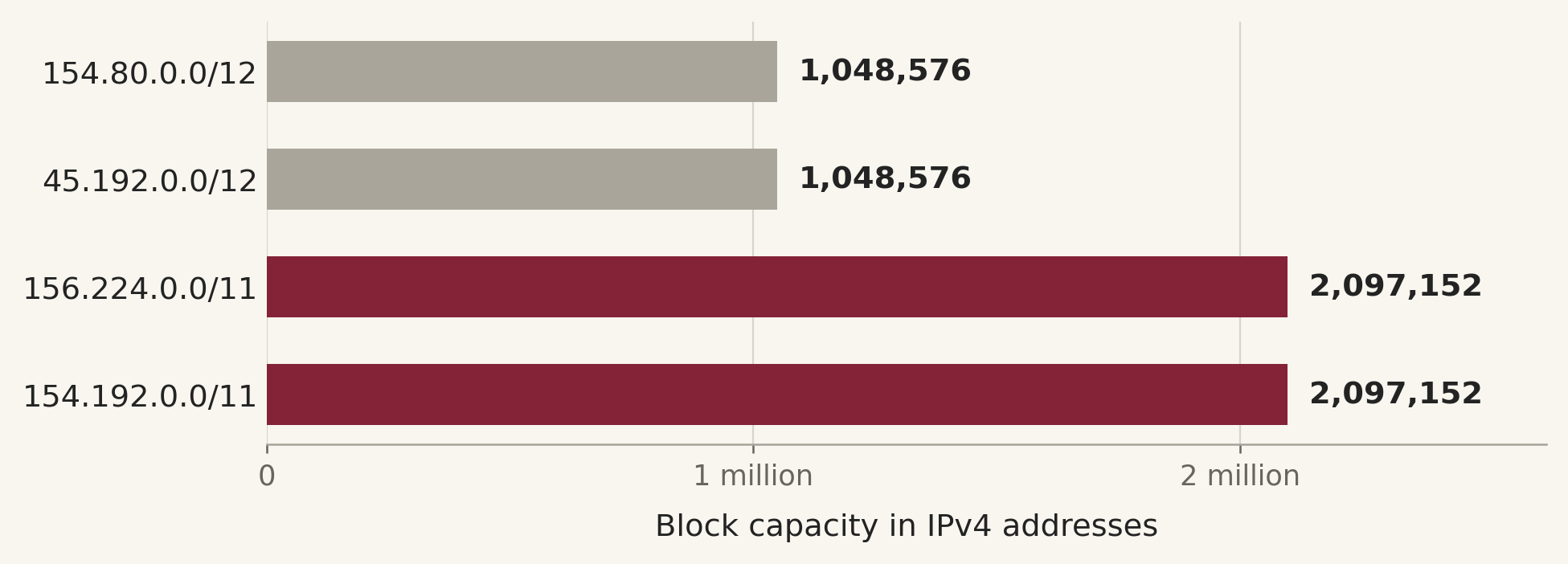
Block sizes can be calculated without a commercial valuation. The notation “/12” corresponds to 2 to the power of 20 addresses, or 1,048,576. A “/11” contains twice as many. The identifiers of the 4 blocks appear in public AfriNIC community exchanges; converting their sizes into address counts relies on CIDR notation.
An allocation can subsequently be divided into smaller sets for customers. The holder of the large block, the user of part of it and the network operator carrying communications are therefore not necessarily the same company. This arrangement explains why a customer’s name may appear alongside resources originally allocated to Cloud Innovation.
It does not make the holder’s responsibilities disappear. AfriNIC’s policy manual allows local registries to reassign addresses to customers and maintains their responsibility for allocations registered in their names until transfer or return. The question becomes whether the chain of decisions, authorisations and uses can be reconstructed.
In the maritime analogy, a shipowner may entrust a vessel to an operator. That delegation explains who organises the voyages. It does not, by itself, establish compliance with the conditions imposed on the owner. For IP addresses, the analysis must work back from the observed service to the customer, then to the holder’s authorisation and the need presented to the registry.
This requires more work than searching a database for names. It also provides stronger evidence. It avoids indiscriminate accusations against customers while preventing a proliferation of intermediaries from obscuring the original holder’s responsibilities.
The denominator is essential to understanding the 81% figure. It describes the concentration of cases detected outside the region, not the share of AfriNIC’s entire address stock used abroad. Within the measurable portion of the 4 blocks, IPinfo reports an out-of-region rate of 13.5%.
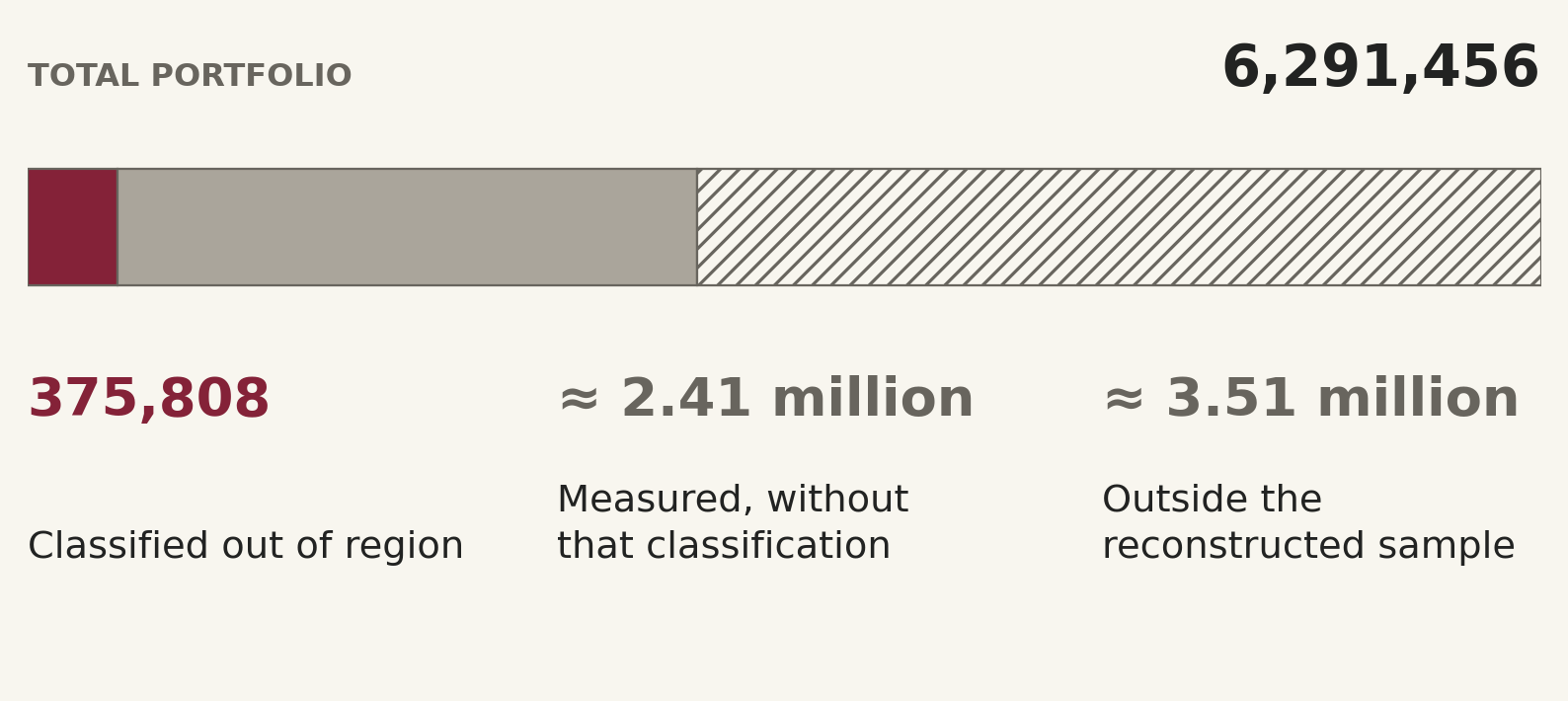
This distinction allows an additional calculation, presented here as an estimate. Dividing the number observed outside the region in these blocks by 13.5% reconstructs a sample of approximately 2.78 million measured addresses. That is about 44.2% of the total portfolio. The result remains indicative because the published percentage is rounded.
This reconstruction separates 3 groups. The first contains addresses classified as out of region. The second contains measured addresses that do not receive that classification. The third is the remainder of the portfolio, outside the reconstructed sample. The chart does not turn any of these groups into evidence of a location within Africa.
Returning to the ship, a radar that does not detect a vessel offshore does not establish that it is in port. The vessel could be out of range, silent or outside the monitored area. Similarly, equipment that does not respond to a probe does not reveal its location through silence.
A further calculation shows that the addresses detected outside the region represent approximately 6% of the total portfolio. This is a ratio between an observed subset and total capacity. It provides no basis for claiming that the remaining 94% are in Africa or that all of them are active.
This breakdown strengthens the analysis. The finding is substantial without adding addresses whose locations have not been established. A rigorous assessment should therefore publish its coverage, exclusions and indeterminate cases. Precision strengthens the request for explanations directed at Cloud Innovation and prevents it from resting on an exaggerated interpretation.
The comparison between registries shows an AfriNIC rate of 2.43%. IPinfo indicates that it would fall to 0.5% when the 4 blocks are excluded. The other rates appear below.
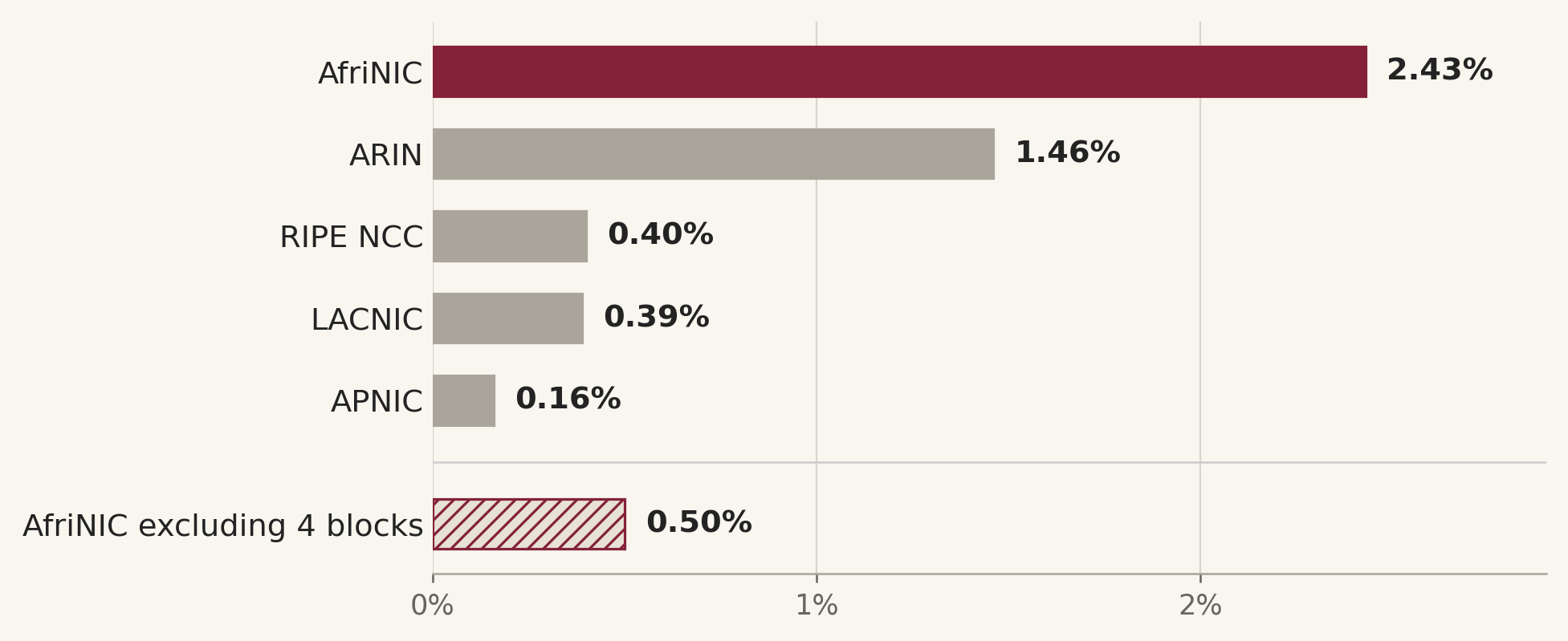
Excluding the blocks is a comparison scenario. It does not represent an actual return of resources, relocation or disappearance of services. The denominator also changes when part of the measured portfolio is removed. The chart shows how strongly a concentrated set of observations can affect a regional indicator.
This finding supports a focused examination. Portraying the entire African ecosystem as deficient would obscure the highly uneven distribution of the observations. Conversely, the existence of cases in other regions does not relieve the holder concerned of the need to document its own. Whether a particular use complies does not depend on how many other actors face comparable questions.
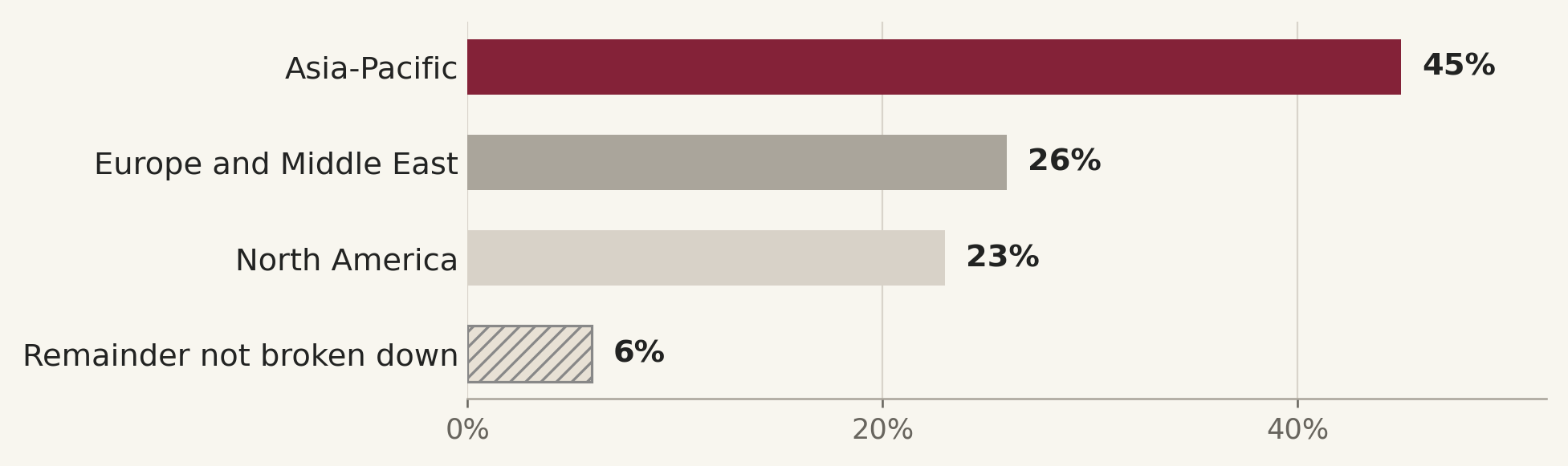
This geography covers all AfriNIC cases observed outside the region. It does not describe Cloud Innovation’s resources alone. The remaining 6% are not broken down here.
It would therefore be misleading to turn the first bar into an allegation that the resources were all “sent to China”. A service region covers several countries, and a location observation does not automatically reveal the nationality of the economic beneficiary. Responsibility must be documented through contractual and operational relationships, not through assumptions about people’s origins.
WHEREIS was written by Robert Beverly, Amreesh Phokeer and Oliver Gasser. The work was presented at the ACM IMC research conference in October 2026. Its protocol uses response times to constrain a target’s physically possible locations and then compares those constraints with registration information.
The idea is accessible. If someone answers almost immediately from the other end of a corridor, they cannot have travelled across an entire city during that exchange. Internet signals travel very quickly, but not instantaneously. An extremely short response time therefore limits the possible distance between the probe and the responding equipment.
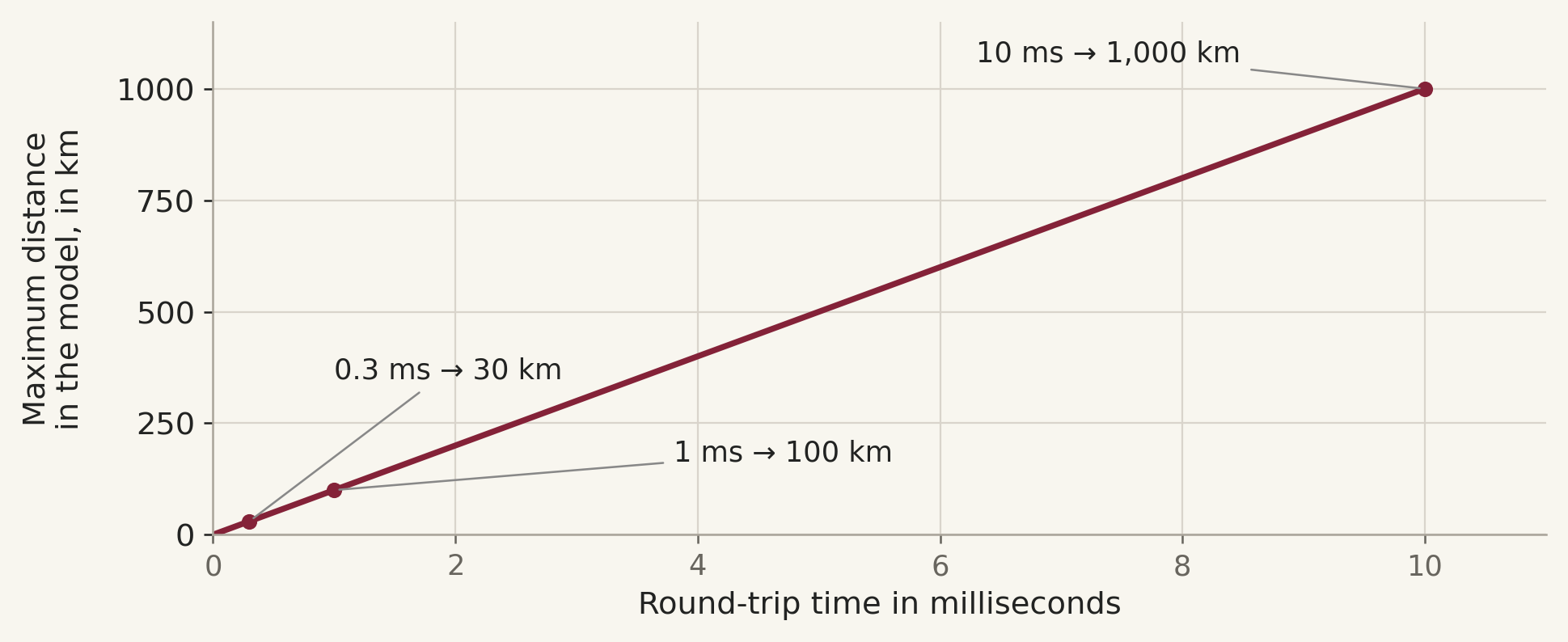
The illustration assumes propagation at approximately 200,000 kilometres per second through fibre. The measured delay includes an outward and a return journey. A 1-millisecond exchange therefore corresponds to an upper bound of approximately 100 kilometres in this model; 10 milliseconds gives approximately 1,000 kilometres. These are educational calculations, not new measurements.
The relationship is not symmetrical. A very fast response rules out certain large distances. A slow response does not prove that the target is far away, because detours, queuing in equipment and message processing can increase the delay. The protocol therefore prioritises minimum response times and compares several observation points. Its first version uses 20 points per target, with 3 requests from each.
The quality of the observation points matters as well. An accurate stopwatch associated with an incorrectly located probe can produce a wrong geographical conclusion. RIPE Atlas documentation explains how probe locations are recorded and how anomalies can be corrected.
Some architectures require particular care. Anycast allows the same identifier to respond from several locations; RFC 4786 describes how it works. A diagram assigning a single location to such a service can be misleading. WHEREIS also addresses difficulties associated with block subdivision and route announcements.
This method provides observations independent of administrative declarations. It does not read an invoice, a service commitment or an agreement. It helps establish where a response can originate. Whether that situation complies with applicable requirements demands a further stage of assessment.
The agreement has a specific name, the Registration Service Agreement, or RSA. It governs a registration service and the member’s obligations. In the public model, clauses 6(d)(iii) and 6(d)(iv) distinguish usage rights tied to demonstrated need from ownership of the resources.
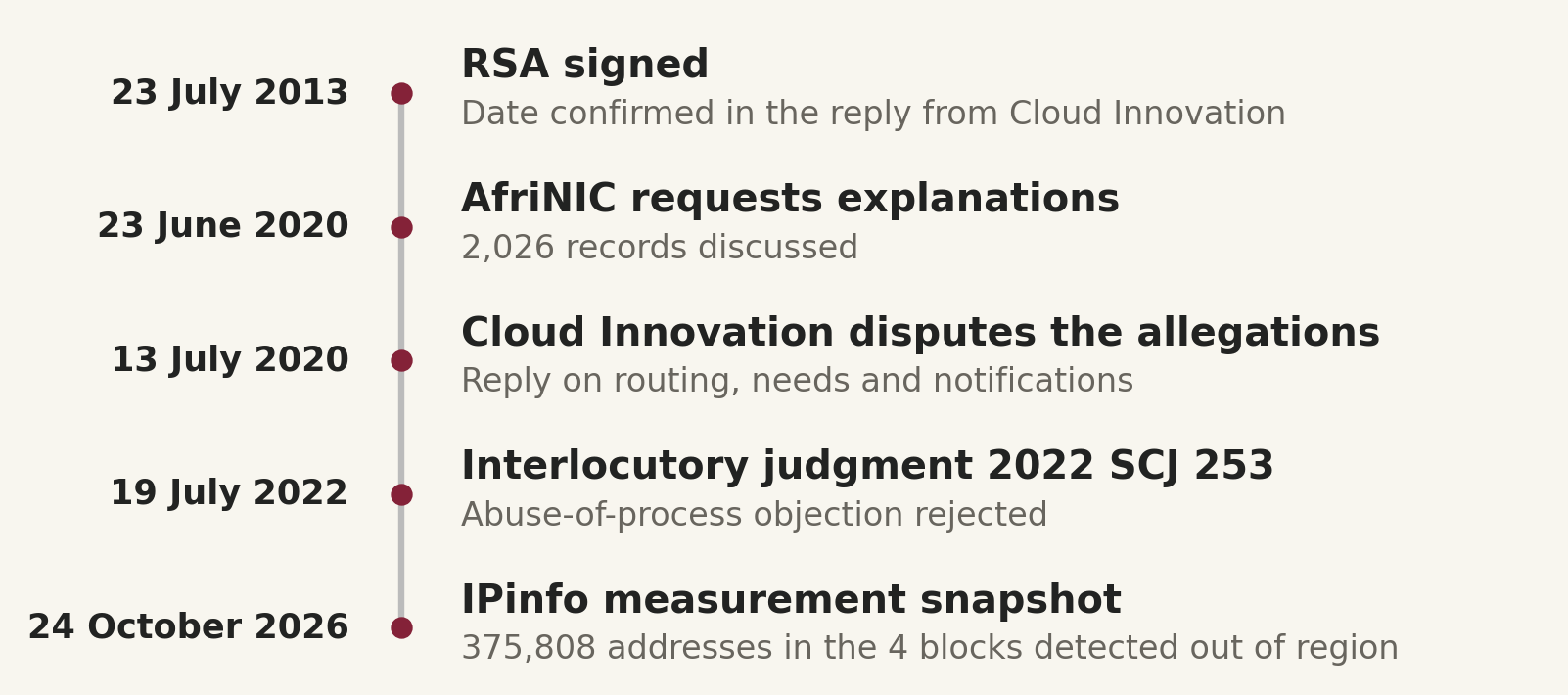
Cloud Innovation’s case is documented beyond this model. In its reply of 13 July 2020, the company confirms signing an agreement on 23 July 2013. AfriNIC’s letter of 23 June 2020 identifies 3 obligations at the heart of the dispute. Clause 2(d) concerns information about changes, clause 4(c)(i) use consistent with the purpose requested, and clause 6(d)(iii) the need justifying the right of use.
The issue can be understood through permission to use a shared facility. Obtaining permission for a particular project does not establish that every subsequent project is covered. It is necessary to check whether the new operation remains within the agreed scope and which formalities apply to its evolution.
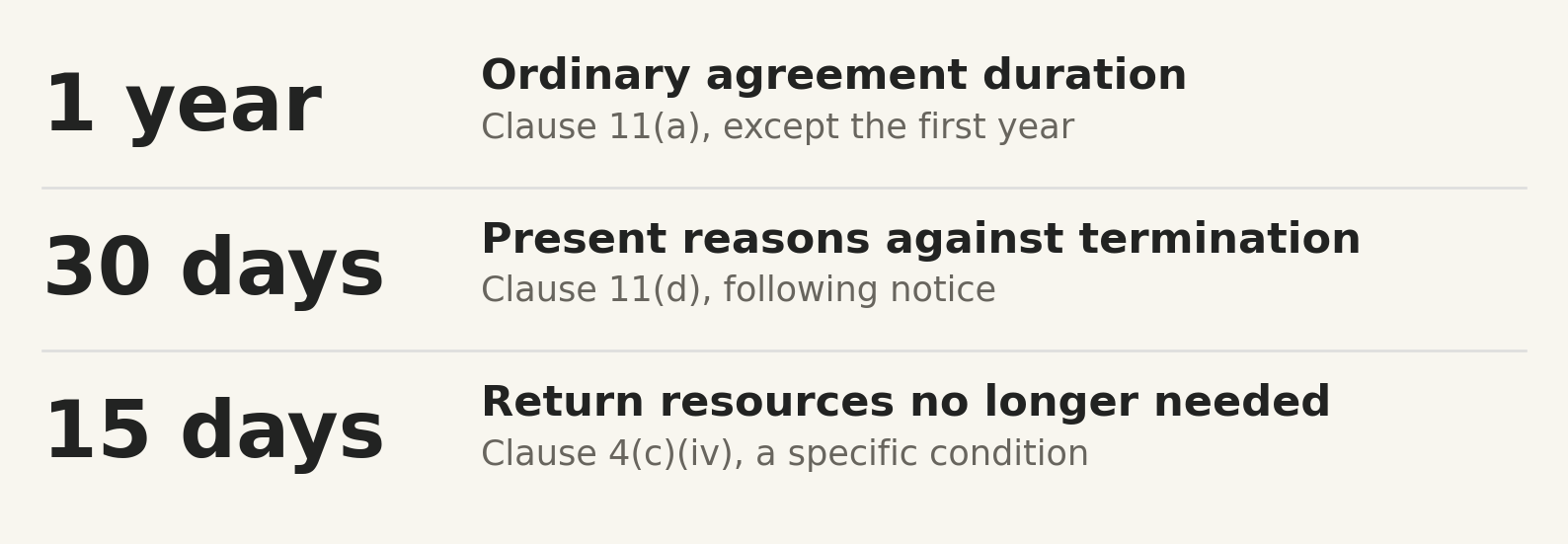
The public model provides for cooperation with checks, particularly under clause 4(b). It also provides for notice before termination and a 30-day period to present reasons or corrective measures under clause 11(d). The 15-day return period in clause 4(c)(iv) addresses a different situation, when the member indicates that it no longer needs the resources.
It would be inaccurate to apply every word of the public model dated 27 November 2017 automatically to an agreement signed in 2013. The relevant versions, renewals and validly incorporated amendments must be established. The correspondence nevertheless identifies obligations actually discussed between the parties without inventing a copy of the original agreement.
The practical implication is straightforward. Paying a membership fee does not answer every compliance question. Payment and adherence to the agreed use are 2 separate obligations. A receipt establishes that money has been paid; on its own, it does not describe the beneficiaries, operating locations or purposes of the resources used.
The word “customer” covers several relationships. A company that is an AfriNIC member may obtain resources directly from the registry. A customer subsequently receiving a service from an intermediary does not automatically become a party to the same agreement. Confusing these relationships obscures who made which commitment.
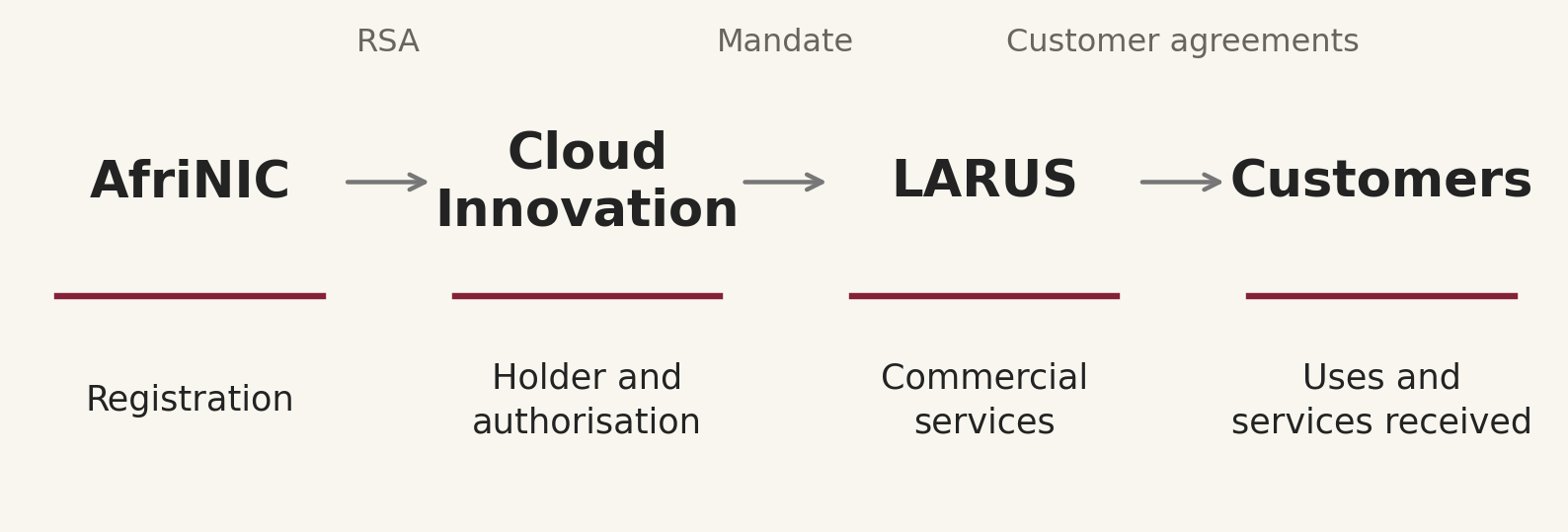
Cloud Innovation publicly describes a division of responsibilities. It retains registration and authorisation responsibilities, while LARUS provides commercial, operational and technical services to customers. Its website directs requests concerning leasing, deployment, support and renewal to LARUS.
A published operational mandate sets out this arrangement. It authorises LARUS to manage IPv4 leasing, routing coordination, renewals and customer relationships. Cloud Innovation retains its authorisation role, and the document places strategic and commercial coordination under Lu Heng’s direction.
These documents make part of the chain visible. They do not disclose all customer agreements, the prices charged or the margins earned. It would therefore be unfounded to announce a Cloud Innovation profit figure by multiplying its portfolio by a leasing price found elsewhere. Total capacity, capacity actually leased and revenue are different quantities.
The question requiring an answer is more precise. How does this commercial arrangement relate to allocation requests and commitments to AfriNIC? Which uses were authorised? Which changes were notified? What documents would allow an observed address to be traced to the service it supports?
An analogy with subletting helps explain the issue without deciding which legal rules apply. A subtenant may have a valid agreement with its supplier. That agreement does not, by itself, establish that the supplier complies with every obligation owed to the party that originally granted usage rights. Protecting the customer therefore requires both levels to be examined.
AfriNIC’s manual recognises sub-allocation while maintaining obligations on the holder. Intermediation is therefore not inherently evidence of wrongdoing. Nor is it a sufficient answer to a request for justification concerning the original usage rights.
The public fee schedule consulted specifies an annual fee of USD 1,400 for a local Internet registry holding between 1,024 and 4,095 addresses. From 4,194,304 addresses upwards, the “Extra large” category carries an annual fee of USD 38,400. These are service fees, to which separate allocation fees may be added.
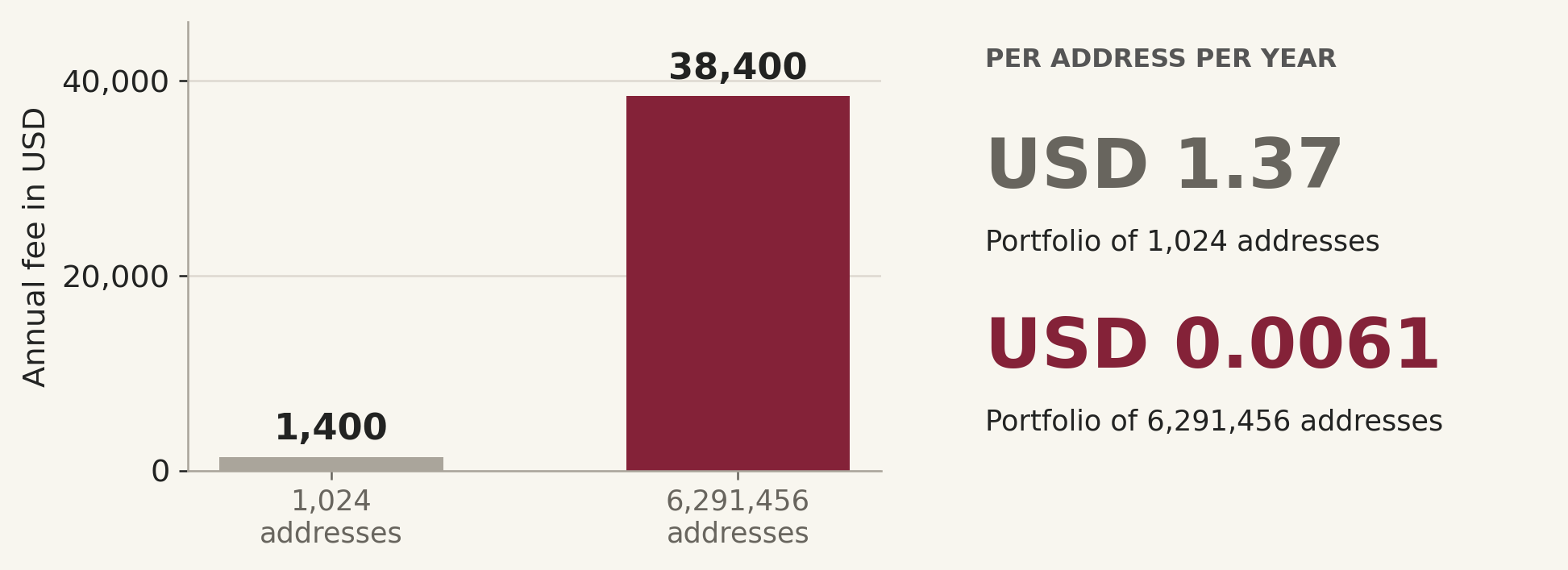
Applied to 2 reference portfolios, this schedule produces a marked contrast. For 1,024 addresses, the annual fee is approximately USD 1.37 per address. For a portfolio of 6,291,456 addresses, it is approximately USD 0.0061, or 0.61 US cents. The second unit cost is approximately 224 times lower.
These calculations describe the public schedule at the consultation date. They do not reconstruct invoices actually issued to Cloud Innovation, any discounts it may have received, its historical payments or its operating expenses. Nor do they establish a full cost, because network operations involve other expenditure.
The economic lesson remains useful. The second portfolio contains 6,144 times as many addresses, while its reference annual fee is approximately 27.4 times higher. Pricing a shared registration service therefore does not work like retail sales in which every address has an identical purchase price.
An irrigation cooperative offers an analogy. The contribution required to administer the canals is not necessarily the market value of all the water available to each user. Funding the organisation and setting the conditions for using the resource address different questions. A payment does not turn a conditional right into unlimited freedom of use.
This difference makes scrutiny of commitments particularly important for large portfolios. It does not establish that the original allocation was unjustified or that size itself constitutes wrongdoing. It explains why the registry must be able to document needs and assess changes using a proportionate method. Resource scarcity makes these obligations more consequential; it does not replace evidence.
In June 2020, AfriNIC identified 2,026 records it considered inconsistent with routing information. The registry also alleged a divergence from declared needs and a failure to notify changes. These were allegations sent to Cloud Innovation to obtain explanations, not findings by a court.
Cloud Innovation replied that a network’s country of registration was insufficient to locate its announcements or equipment. It stated that it documented customer needs, considered WHOIS updates sufficient notification and complied with applicable policies. It also disputed the geographical scope the registry attributed to its bylaws.
The technical objection matters. A company may be registered in a country while operating equipment in several others. Inferring a machine’s position solely from a network’s registered location would be unreliable. The measurement method presented here supplies a different type of evidence, based on response times.
That contribution does not automatically dispose of Cloud Innovation’s contractual arguments. A measured location does not yet prove that a use was prohibited at the relevant date. It does, however, shift the discussion towards a more concrete question. Which service is associated with that overseas presence, and how does it fit the original commitment or a duly accepted change?
Section 5.4.6.2 of the manual provides that out-of-region use should support connectivity back to the AfriNIC service region. It appears within the IPv4 exhaustion management framework known as “soft landing”. Its temporal scope and application to older allocations must therefore be examined, rather than presumed from its current wording alone.
The debate cannot be resolved by combining 2 figures separated by several years. The records discussed in 2020 are not the same unit as the addresses measured in 2026. They form 2 documentary sets to be compared block by block and date by date. Responsibility is established through that matching process, not through a striking addition.
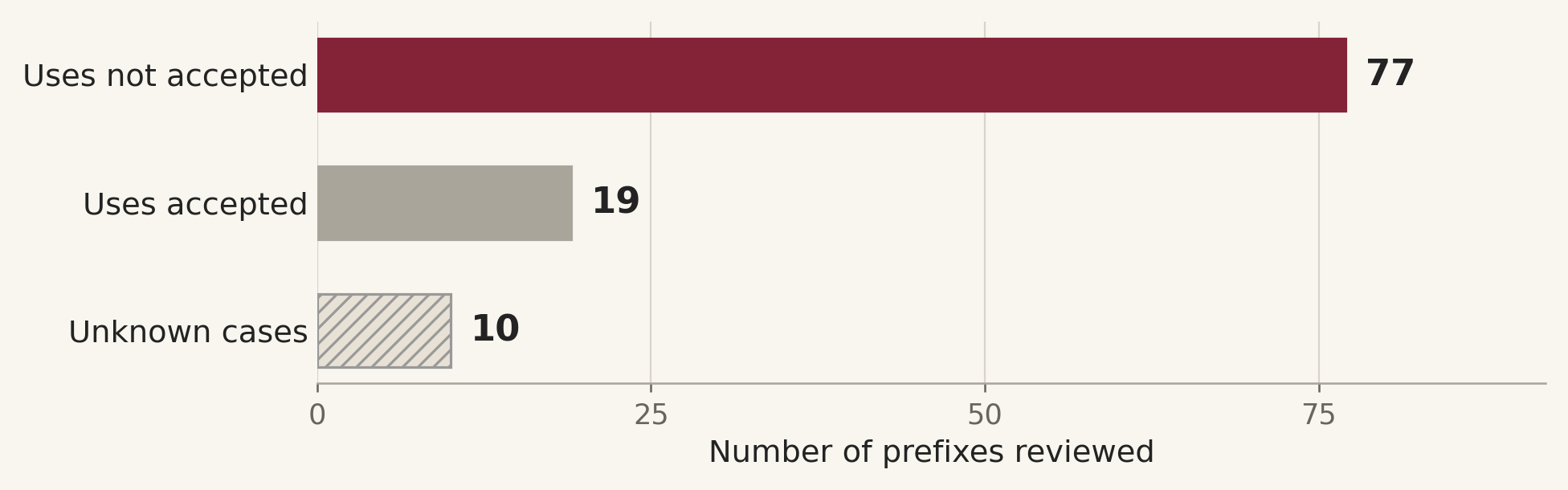
The scientific study reports AfriNIC’s examination of 106 flagged prefixes. The registry classified 77 uses as not accepted under its policies, 19 as accepted and 10 as unknown. This sample concerns AfriNIC as a whole, not Cloud Innovation alone.
The existence of accepted cases is instructive. Equipment outside the region can fulfil a legitimate function for an African network. In the maritime analogy, a foreign port call may help deliver the promised service. The relevant question is the connection between the voyage and the mission, not an abstract prohibition on crossing a border.
Calculated from the published counts, the categories represent 72.6%, 17.9% and 9.4%, respectively, after rounding. This distribution must not be mechanically applied to Cloud Innovation’s portfolio. The sample does not provide a representative non-compliance rate for the company. It primarily illustrates why detection and assessment of explanations must remain distinct.
Court decisions require the same precision. In the interlocutory judgment 2022 SCJ 253 of 19 July 2022, the judge rejected AfriNIC’s abuse-of-process objection and emphasised the absence of a final determination of the substantive issues then under examination. That judgment is neither a finding against Cloud Innovation for its use of addresses nor a blanket validation of all its uses.
On its current website, Cloud Innovation advocates continuity of use, transferability and a conception of address rights favourable to the networks using them. This position clarifies its disagreement with a more restrictive understanding of the registry’s role. It does not remove the need to produce the applicable instruments and evidence specific to each situation.
A firm critique is therefore possible without turning an article into a verdict. The scale of the concentration justifies detailed scrutiny. The company must be able to present documents and explanations. The registry must be able to show how it moves from a technical signal to a specific allegation. That examination will help the public distinguish what is established, disputed or still missing.
The next useful step is to compare the measurement data with the commitments actually undertaken. For each block concerned, the record should identify the original request, the stated need, the applicable terms, notified changes, authorisations given to intermediaries and the function of the service observed outside the region. Disclosure can preserve legitimate commercial confidentiality while making the conclusions verifiable.
The persistence of these uses also deserves measurement. A snapshot does not show an itinerary. Tracking the same addresses or prefixes at several dates would help distinguish repeated presence from an isolated observation. Periods without a response should remain identified as such, rather than being treated as a return to the region.
Connectivity explanations should also be tested. If an overseas presence supports an African service, that function should be documentable through architecture, network relationships and dated evidence. The aim is not to require all traffic to remain on the continent. It is to verify the relationship between the rights granted and the justification offered.
AfriNIC’s own responsibility remains part of this examination. The registry must preserve agreement versions, demonstrate proper notification and apply consistent criteria across members. A clear procedure protects the community, resource holders and customers who depend on operating services. Continuity of those services must be considered in any corrective measure.
For Cloud Innovation, the most persuasive response would therefore be an affirmative demonstration. It should show how the observed uses fit the rights granted, rather than allowing the debate to remain a clash of principles about ownership or sovereignty. The rights claimed and the obligations disputed need to be examined within the same evidentiary record.
The central finding is strong enough without exaggeration. The data identify a specific concentration, the documents identify commitments and the correspondence reveals a longstanding dispute. Read together, they support a substantive request for explanations from Cloud Innovation. A ship’s flag does not tell us where it sails. Its position does not, by itself, tell us whether it fulfils its mission. The agreement and evidence of service should answer that final question.
Originally published on AfroDIG on 6 November 2026.
Sponsored byWhoisXML API

Sponsored byVerisign

Sponsored byIPv4.Global

Sponsored byRadix

Sponsored byDNIB.com

Sponsored byCSC

Sponsored byVerisign


A World-Renowned Source for Internet Developments. Serving Since 2002.