
Welcome:
Login
|
Sign Up
|
About CircleID
Follow:
|
|



|
||
|
||
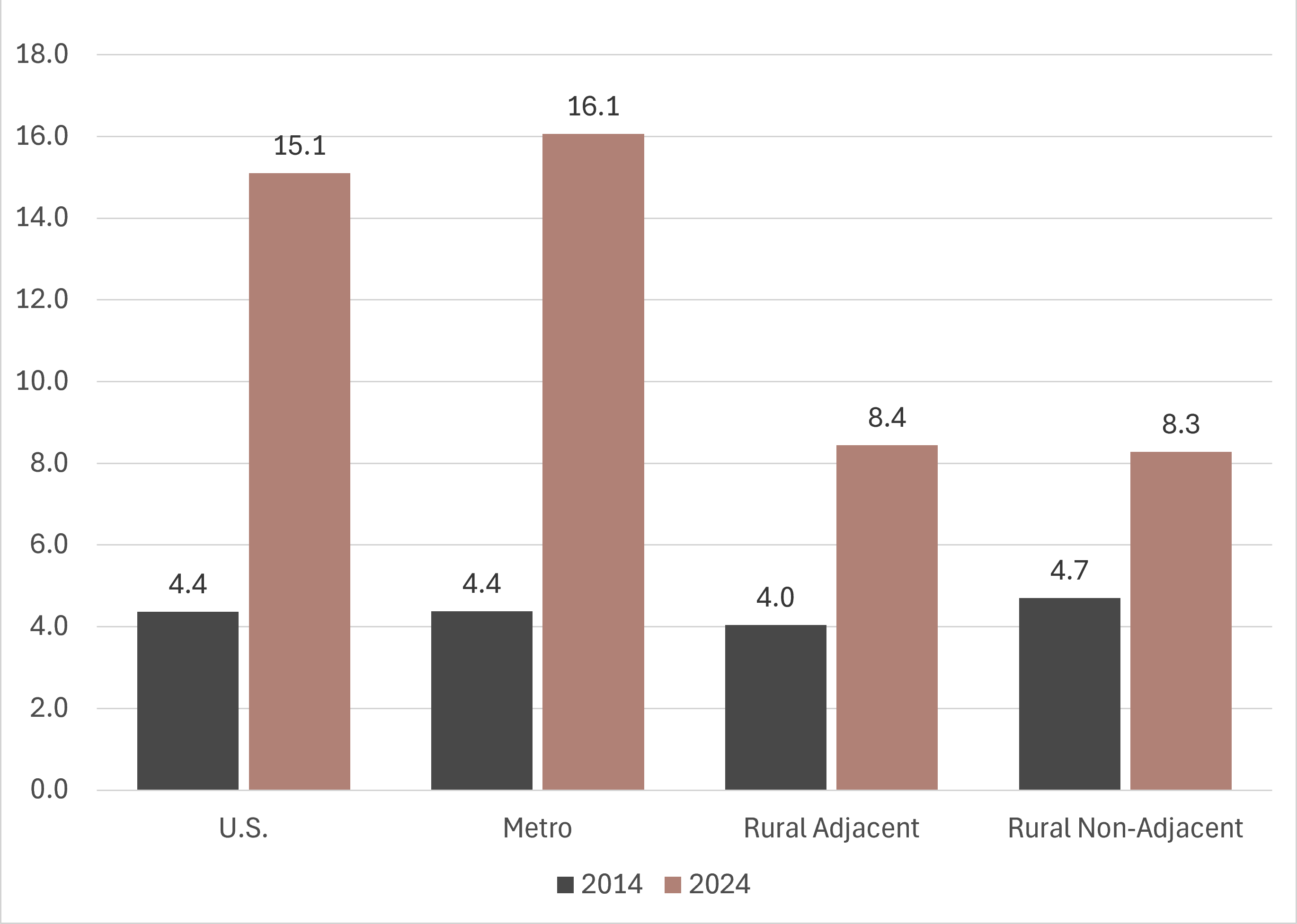
Working from home is still one of the most important uses of broadband, particularly in rural communities. Roberto Gallardo, who writes in Substack as the “Data Whisperer”, recently wrote an article discussing the change over time in those who work from home. For those who don’t know Roberto, he’s an Associate Professor and the Vice President for Engagement in the Agricultural Economics Department at Purdue University.
Everybody remembers the explosion of working from home during the COVID-19 pandemic. Many people decided they liked working from home, and the percentage doing so has not dropped to anywhere near pre-pandemic levels.
The article starts out by comparing the percentage of those who worked from home in 2014 and 2024. Overall, the percentage of those who are working from home more than tripled over the decade. In 2014, 4.4% of the U.S. labor force worked from home, and in 2024 that had grown to 15.1%.
There is still a big disparity in the percentage of home workers in urban versus rural areas. In 2024, 16.1% of urban residents work from home while around 8.4% of those living in rural areas work from home. Gallardo credits the difference to two reasons. First, there is a higher percentage of jobs in urban areas that can be done from home. He says that over 36% of jobs in urban areas could be done from home, while only around 28% of jobs in rural areas can be done remotely.
But there is also still a difference due to the lack of good broadband in rural areas. While there has been a lot of grant funding aimed at rural America, a lot of it hasn’t been built yet. Even where there is broadband that supposedly meets the FCC definition of broadband, there are many rural ISPs that are not delivering a good enough upstream path to reliably work from home. For example, a recent Ookla report said that only about 45% of Starlink customers have speeds that meet that FCC speed definition.
One of the most interesting parts of his article is an interactive map that shows the percentage of people who work at home in each county in 2014 and 2024 compared to the number of jobs that could be done remotely. Gallardo acknowledges that a lot of remote workers work for somebody in another county or state, but this is still an intriguing map that shows the level at which remote work has become an important part of local economies. The map shows that remote work has been more accepted in New England, the Pacific Northwest, Colorado, and the Mid-Atlantic. Interestingly, the states with the highest level of remote work in 2014 had bigger gains by 2024 than other states.
As most people will do, I looked at my own county in North Carolina first. The county had 15.4% of eligible workers working remotely in 2014, which grew to 34.8% in 2024. I can attest that remote work is common here, and there are numerous people on my own block who work from home. But examining the map shows a lot of counties where the percentage of those working from home is below 10%, some at only half that level.
I’ve heard stories about how getting good broadband can transform communities. I talked to a cooperative in Alabama that told me that there were practically no rural home workers before fiber was built, but that many homes in the coop territory now have people working remotely. They said that higher incomes from remote work are transforming the economics for families and the local community, and that the fiber is also attracting some people who already work from home to move to the county.
Sponsored byCSC

Sponsored byRadix

Sponsored byIPv4.Global

Sponsored byVerisign

Sponsored byDNIB.com

Sponsored byWhoisXML API

Sponsored byVerisign


A World-Renowned Source for Internet Developments. Serving Since 2002.