
Welcome:
Login
|
Sign Up
|
About CircleID
Follow:
|
|
|

A group of experts from Interisle Consulting Group released a paper today, reporting a comprehensive study of the phishing landscape in 2020. The study's goal was to capture and analyze a large set of information about phishing attacks to better understand how much phishing is taking place, where it is taking place, and better ways to fight them. more
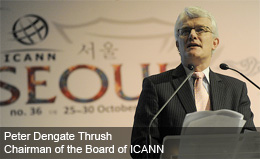 The Internet is on the verge of undergoing one of its most significant changes in its 40-year history. The Internet Corporation for Assigned Names and Numbers (ICANN) is finalizing plans to introduce non-Latin characters such as Arabic, Korean, Greek, Hindi, Japanese and Cyrillic. Non-Latin domain names -- commonly referred to as Internationalized Domain Names or IDNs -- could be up and running as early as middle of next year according to ICANN. Peter Dengate Thrush, chairman of the ICANN board, told reporters: "This is the biggest change technically to the Internet since it was invented 40 years ago... [a] fantastically complicated technical feature." more
Internet service was down for nearly 900 customers in Tumbler Ridge, British Columbia, over the weekend after beavers chewed through a crucial fiber cable, resulting in "extensive" damage. According to a statement from the area's telecom provider, Telus, the outage also affected some cable TV customers and caused disruptions to local cell phone services. more
Colonial Pipeline, which accounts for close to half of the United States East Coast's fuel, has shut down its operations due to a cyberattack. The incident, believed to be the largest successful cyberattack on oil infrastructure in the U.S., was disclosed over the weekend. more
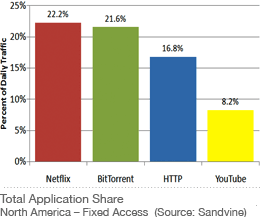 Netflix has become the largest source of Internet traffic in North America, according Sandvine's Spring 2011 Global Internet Phenomena Report. Company further reports that currently, Real-Time Entertainment applications consume 49.2% of peak aggregate traffic, up from 29.5% in 2009 -- a 60% increase [see figture]. Sandvine forecasts that the Real-Time Entertainment category will represent 55-60% of peak aggregate traffic by the end of 2011. more
In a video interview conducted during the NSCS ONE conference, Paul Vixie CEO of Farsight Security further discusses the topic of his presentation titled: "Defective by Design -- How the Internet's Openness is Slowly Poisoning Us". more
 Iran's political filtering during the recent 2009 presidential campaign and the role of the Internet in the post-election turmoil has brought a heightened level of attention to the country's Internet filtering system. According to a status report just updated by the OpenNet Initiative, the Internet censorship system in Iran has become one of the most comprehensive and sophisticated in the world. Iran and China are the only countries that aggressively filter the Internet using their own technology. Iran's aggressive filtering measures "have contributed to the implementation of a centralized filtering strategy and a reduced reliance on Western technologies," says OpenNet. more
The US Department of Defense gave a small unknown Florida company control to millions of its dormant IP addresses, minutes before President Trump left office. According to reports, the unknown Florida company, Global Resource Systems LLC, initially obtained control of 56 million Pentagon-owned IP addresses on January 20 and later increased to near 175 million IP addresses. more
 Governments across Africa increasingly wield internet blackouts as a tool to suppress dissent, with 2024 marking a record high for digital censorship. According to a report by Access Now and #KeepItOn, 21 internet shutdowns were recorded across 15 African nations, surpassing previous highs in 2020 and 2021. more
Larry Seltzer writes: Politico? Comcast's PR gets an 'A' for this article, an upbeat tech-lite description of the impending depletion of the IPv4 space and efforts to adopt IPv6. It also seems that the Obama administration is behind this, and that the Federal government has had "remarkable foresight on this issue." I feel better already. more
Cloudflare's new report warns about the significant increase of DDoS attacks and their level of sophistication. The numbers doubled from Q1 to Q2 and doubled again in Q3, resulting in a four-fold increase compared to the pre-COVID level in the first quarter. more
 Announced in a blog post today, ICANN's Manager of Root Zone Services, Kim Davies, reports: "Today the first three production non-Latin top-level domains were placed in the DNS root zone. ... The three new top-level domains are ????????. (“Al-Saudiah”), ??????. ( “Emarat”) and ???. (“Misr”). All three are Arabic script domains, and will enable domain names written fully right-to-left. Expect more as we continue to process other applications using the “fast track” methodology." more
Minds + Machines reports: "A quantitative analysis of UDRP data for all open generic Top-Level Domains (gTLDs) concludes that the introduction of new gTLDs will result in approximately 316 new cases of cybersquatting, and that the resultant cost to trademark holders, overall, will be $870,000 per year -- less than less than $.10 for each trademark registered worldwide, or about $.44 per trademark registered in the United States. The data show that cybersquatting correlates to registration volume across all open gTLDs, not to the number of gTLDs, but is more prevalent in .com." more
 Amazon's Project Kuiper has confirmed the use of laser-based inter-satellite links (OISL) for its satellite communication system. The technology has undergone successful testing in orbit, with data transmission speeds of 100 gigabits per second (Gbps) over a distance of 621 miles achieved. more
RIPE NCC and CENTR have released a statement today in response to the upcoming European Commission's Digital Services Act, urging policymakers to distinguish between the Internet's core infrastructure and operations. more
Sponsored byCSC

Sponsored byVerisign

Sponsored byDNIB.com

Sponsored byRadix

Sponsored byWhoisXML API

Sponsored byIPv4.Global

Sponsored byVerisign

A World-Renowned Source for Internet Developments. Serving Since 2002.