
Welcome:
Login
|
Sign Up
|
About CircleID
Follow:
|
|
|

 Eugene Kaspersky, co-founder of Internet security software Kaspersky Lab, was recently interviewed PC World where he talked about his views regarding cybersecurity and the evolution of malware. In response to fixing the problems with malware on the Internet, Kapersky says: "The Internet was never designed with security in mind. If I was God, and wanted to fix the Internet, I would start by ensuring that every user has a sort of Internet passport: basically, a means of verifying identity, just like in the real world, with driver's licenses and passports and so on. The second problem is one of jurisdiction. The Internet has no borders, and neither do the criminals who operate on the Internet. However, law enforcement agencies have jurisdictional limits, and are unable to conduct investigations across the globe. ... There is no such thing as anonymity on the Internet, for the average user." more
M86 Security today released it's bi-annual security report for the first half of 2010, highlighting the evolution of obfuscation through combined attacks. From the report: "This threat trend is the latest to emerge as cybercriminals seek new ways to limit the effectiveness of many proactive security controls. Because existing techniques for 'covering their tracks' are becoming less effective, cybercriminals have begun using combined attacks, which are more complex and difficult to detect. By splitting the malicious code between Adobe ActionScript language - built into Adobe flash - and JavaScript components on the webpage, they limit the effectiveness of many of the the proactive security detection mechanisms in place today." more
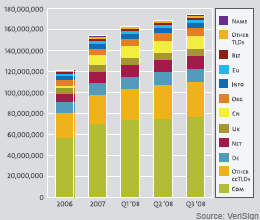 According to recent reports, the total number of new domain name registrations in the third quarter of 2008 reached 11.5 million, pushing the total number of domain names registered in total across all Top-Level Domain Names (TLDs) to 174 million. While the growth continues, the newly released Domain Report by Verisign, indicates a "a decline of new registrations by 2%t from second quarter and 2% from third quarter 2007, driven by declines in both gTLD and ccTLD growth." The decline in new domain name registrations are found to be partly due new changes made by Google to its AdSense program -- the report explains... more
Internet's oldest domain name registrar, Network Solutions, today announced that it has agreed to be acquired by Web.com. Network Solutions was founded in 1979 and pioneered the domain name registration business. In addition to domain name registration, the company also offers services such as web site design and hosting, e-commerce solutions, online security products, SSL certificates, and search engine marketing and optimization. According to Network Solutions, the company manages over 7 million domains, 3 million email boxes and more than 400,000 web sites. more
 Google Fiber is pushing the boundaries of internet speed with the testing of its 20 Gigabit product. After successful trials in domestic settings, the tech giant is now taking its ultra-fast service to educational and professional organizations to further test its capabilities. more
Kevin Murphy reporting in DomainIncite: "NTIA boss Larry Strickling has come out in support of ICANN and its new top-level domains program, warning that its opponents 'provide ammunition' to authoritarian regimes. Speaking in Washington DC yesterday, Strickling warned that organizations fighting to put a stop to the new gTLD program risk provoking a UN takeover of the internet." more
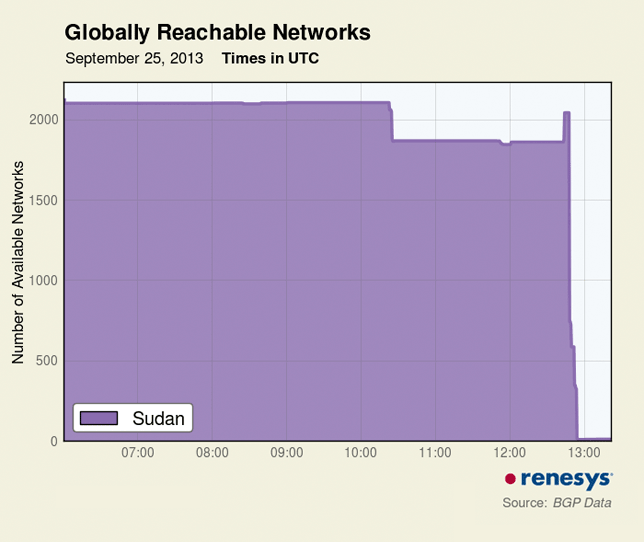 Senior Research Engineer, Doug Madory at Renesys reports: "A few hours ago, we observed a total Internet blackout in Sudan and, as we publish this blog, the Internet remains largely unavailable. By count of impacted networks, it is the largest national blackout since Egypt disconnected itself in January 2011. The massive outage came as the government began a violent crackdown on protests triggered by the government’s decision to end fuel subsidies." more
In his commentary, The Internet Yalta Alexander Klimburg, Fellow and Senior Adviser at the Austrian Institute for International Affairs, argues that the December 2012 meeting of the World Conference on International Telecommunications (WCIT) may be the digital equivalent of the February 1945 meeting of the Allied powers in Yalta: the beginning of a long Internet Cold War between authoritarian and liberal-democratic countries. more
 Google has launched a "Take Action" page to urge people to speak out amidst the gathering of the UN's International Telecommunications Union (ITU) taking place next month in Dubai to update global telecom rules for the first time since 1988. Google and others have raised concern as some countries may see this as an opportunity to set up new rules for the internet. more
Shalini Singh reporting in the Hindu: "The raging controversy over possible excessive state regulation of the internet based on the IT Rules 2011 is now likely to be dwarfed by discussions in Geneva later this week over India's proposal to the United Nations General Assembly, for government control of the Internet... In its proposal submitted to the General Assembly in New York on October 26, 2011, India has argued for a radical shift from the present model of multi-stakeholder led decision-making, to a purely government-run multilateral body..." more
The U.S. Federal Trade Commission (FTC) proposed on Wednesday a do-not-track list for the Web. "The proposal, which would allow consumers to opt out of having their online activities tracked, was included as part of the agency's preliminary report on consumer privacy," reports Gautham Nagesh in The Hill. "The report is intended as a framework for any potential privacy legislation from Congress but stops short of explicitly calling for a legislative solution." more
 Responding to market demand for more energy-efficient datacenters, Sun Microsystems, Inc. has announced the completion of its new Broomfield, Colo. datacenter. The largest datacenter consolidation project undertaken in the company's history is expected to save more than $1 million in electricity costs and 11,000 metric tons of CO2 per year in Broomfield. The new Broomfield datacenter follows similar Sun projects completed in Blackwater, UK, Santa Clara, Calif. and Bangalore, India in August 2007. more
"A Los Angeles court has rejected a demand for a preliminary injunction preventing ICANN delegating .africa, meaning the new gTLD can go live soon," Kevin Murphy reporting Domain Incite. more
Amidst U.S. Congress approval of legislation reversing Internet privacy rules, Major U.S. Internet providers, Comcast, Verizon and AT&T, said they would not sell customers’ individual internet browsing information. more
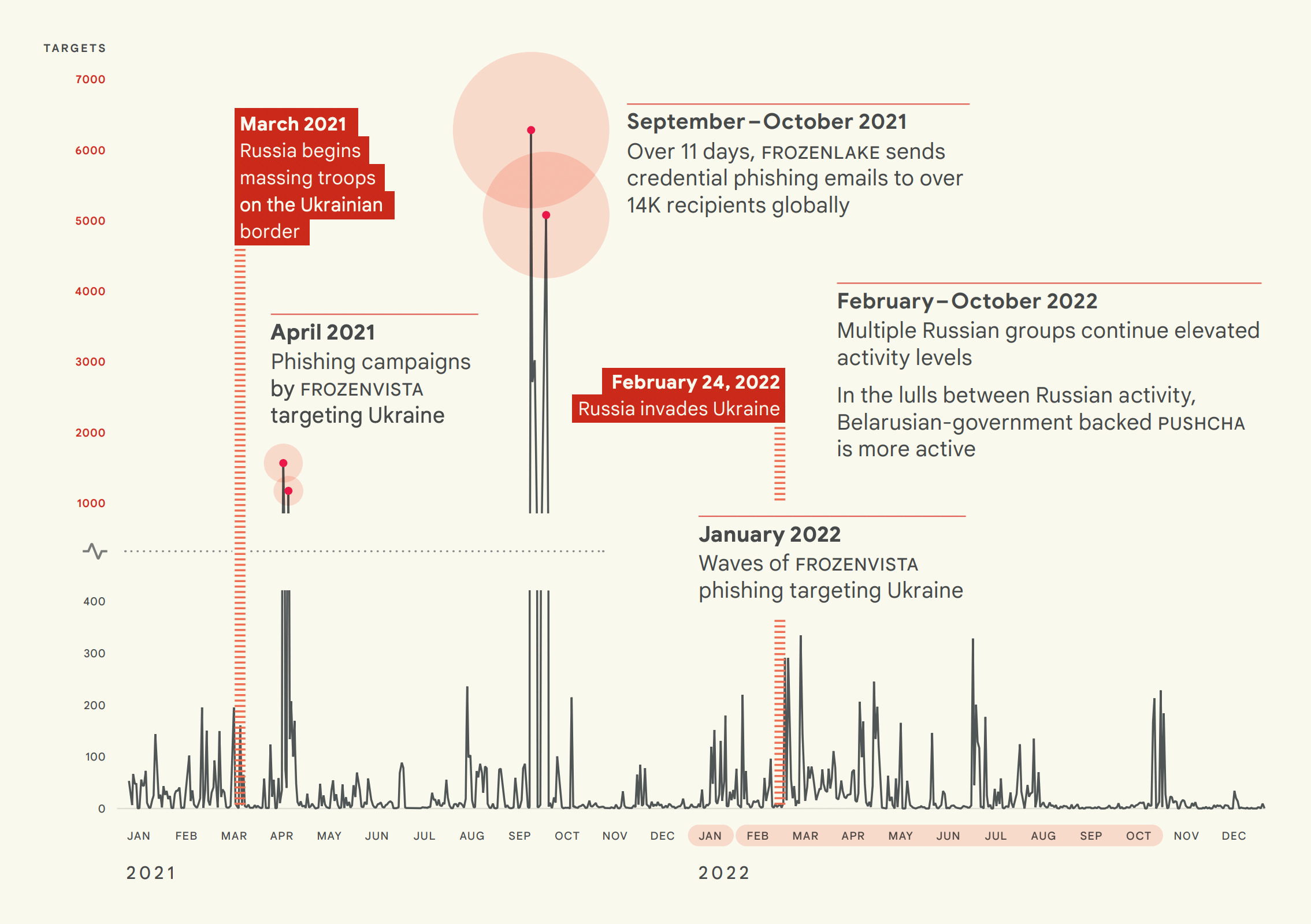 According to a recent analysis, the cyber threat landscape has changed dramatically one year since the Russian invasion of Ukraine. Google TAG, Mandiant, and Trust & Safety have released a report titled, Fog of War: How the Ukraine Conflict Transformed the Cyber Threat Landscape, based on analysis from Google’s Threat Analysis Group (TAG), Mandiant, and Google Trust & Safety. more
Sponsored byRadix

Sponsored byIPv4.Global

Sponsored byDNIB.com

Sponsored byWhoisXML API

Sponsored byVerisign

Sponsored byCSC

Sponsored byVerisign

A World-Renowned Source for Internet Developments. Serving Since 2002.