
Welcome:
Login
|
Sign Up
|
About CircleID
Follow:
|
|


|
||
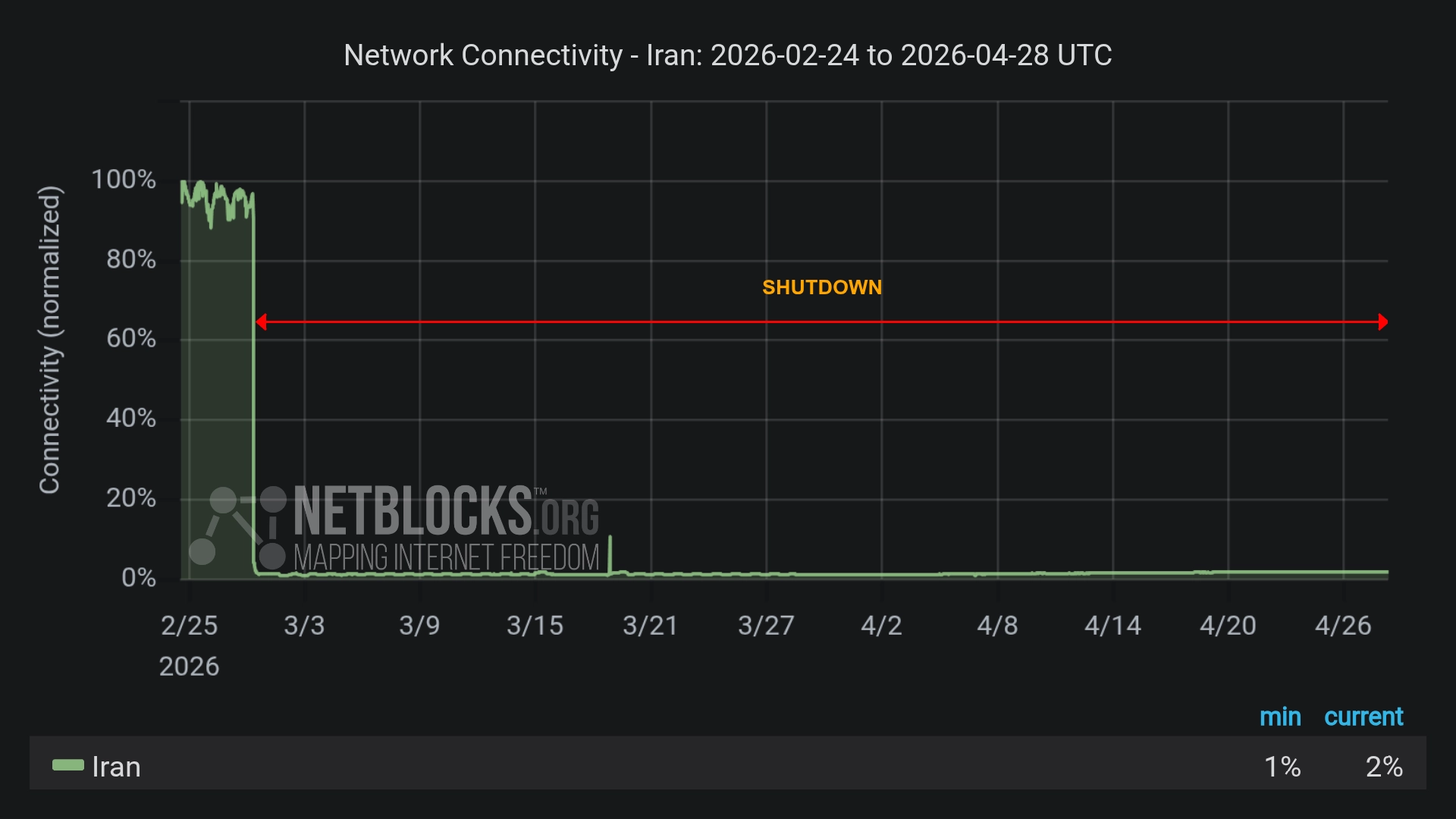
Two months after Iran abruptly severed access to the global internet, the country remains largely offline, with mounting economic losses and an increasingly unequal digital landscape. What began on February 28 as a sharp drop in connectivity has now extended beyond 1,400 hours, according to monitoring group NetBlocks, leaving most citizens confined to a restricted domestic network.
The economic consequences are substantial. Estimates from Iran’s Chamber of Commerce suggest daily direct losses of $30m—$40m, rising to as much as $80m when indirect effects are included. Small and medium-sized enterprises, many of which depend on digital tools for sales and communication, have proven especially vulnerable. Officials warn that as many as 10m livelihoods are at risk. Women-led and home-based businesses appear disproportionately affected, reflecting their reliance on online platforms for income.
Business impact: Export sectors have also been disrupted. Iranian saffron producers, among the world’s leading suppliers, report difficulties maintaining contact with international buyers or verifying shipments. This breakdown in communication risks ceding market share to competitors, including neighbouring Afghanistan, which may exploit the disruption to rebrand similar products.
Social impact: Beyond economics, the shutdown has reshaped daily life. For younger Iranians in particular, internet access is closely tied to education, social interaction and identity. The prolonged outage has therefore imposed not only logistical constraints but also social isolation. Meanwhile, a visible divide has emerged: select institutions and individuals retain limited access to global networks, while the majority remain disconnected.
This disparity is being formalised through a policy known as “Internet Pro”. Approved by Iran’s Supreme National Security Council, the plan would grant connectivity to approved businesses and, eventually, certain industrial users. Officials present the initiative as a pragmatic response to crisis conditions, aimed at preserving essential economic activity. Yet reports that such access is being sold at high prices have prompted concerns over corruption and discrimination, with even senior judicial figures calling for investigation.
Critics argue that the policy entrenches digital inequality, effectively creating a two-tier system of access. Professional associations and civil-society groups have rejected participation, insisting on universal and affordable connectivity. Their objections highlight a broader tension between state control and the increasingly indispensable role of open internet access in modern economies.
At the same time, authorities are accelerating efforts to expand domestic digital infrastructure, reducing reliance on global networks. Proponents frame this as a move towards technological self-sufficiency; detractors see it as laying the groundwork for prolonged isolation.
Future implications: The longer the blackout persists, the clearer its structural consequences become. What began as a temporary restriction is evolving into a test case for state-managed connectivity. Its outcome may shape not only Iran’s digital economy, but also broader debates over internet governance in an increasingly fragmented global landscape.
Sponsored byRadix

Sponsored byDNIB.com

Sponsored byCSC

Sponsored byVerisign

Sponsored byWhoisXML API

Sponsored byVerisign

Sponsored byIPv4.Global


A World-Renowned Source for Internet Developments. Serving Since 2002.