
Welcome:
Login
|
Sign Up
|
About CircleID
Follow:
|
|



|
||
|
||
In CSC’s latest Domain Security Report, we analyzed the world’s top 100 unicorns and compared them with the Forbes Global 2000 companies to see who has a better domain security posture.
Firstly, a unicorn is defined as a private company with a valuation of over $1 billion and is usually a start-up or relatively new company. Many of these companies are in the technology or AI space, and are likely leading supply chain providers for many of the Global 2000 public companies.
In CSC’s 2026 Domain Security Report, we focus our analysis on critical security measures around domain names and look at the adoption rates across the companies.
Some of our key findings where we saw unicorns’ adoption at a higher rate included:
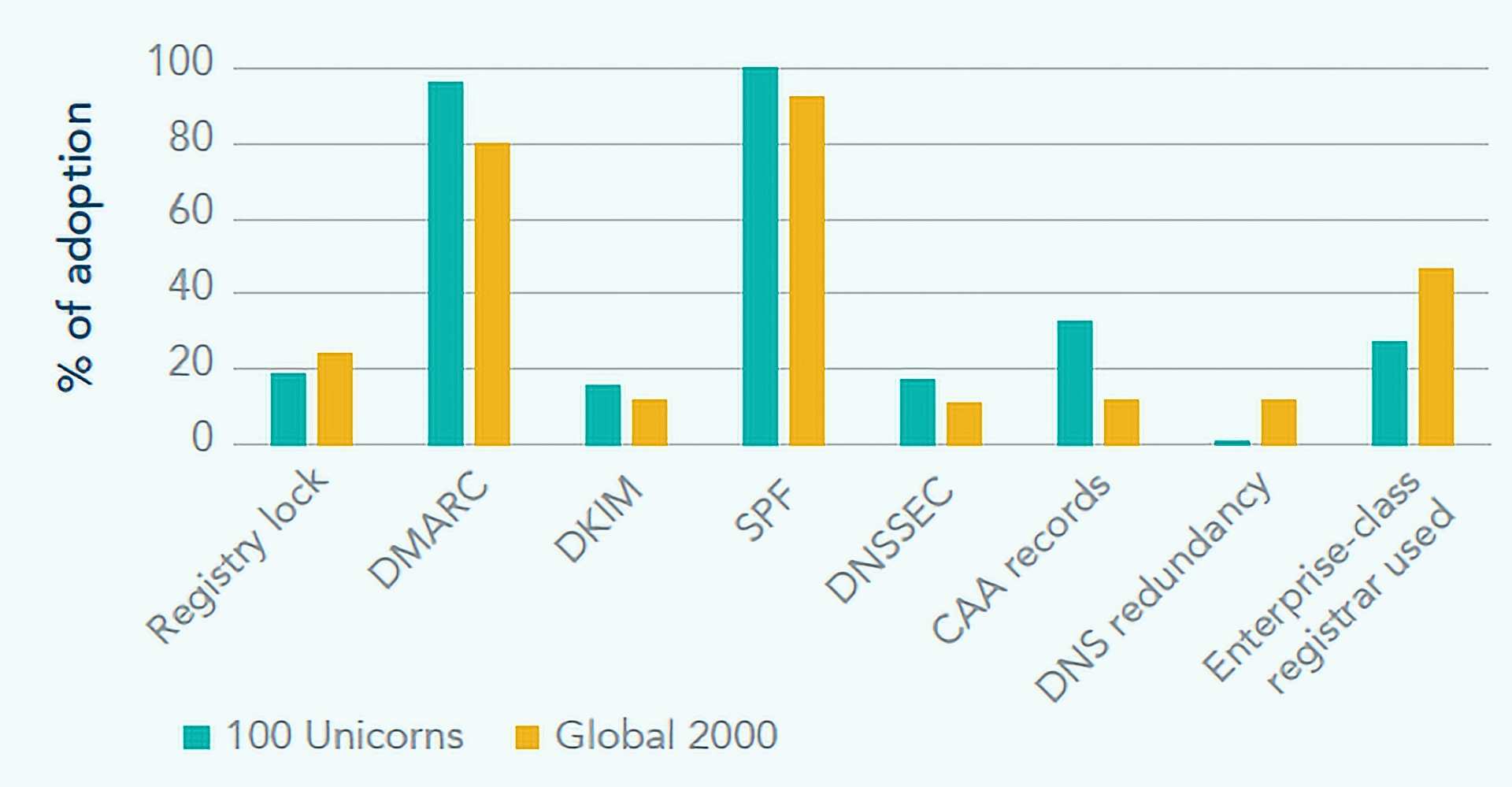
The areas where we saw higher results from Global 2000 companies were:
When taking a closer look at the unicorn companies and the areas that have greater adoption, it is clear that they mostly relate to records on the DNS. This suggests that the people managing their domain names and DNS have a greater understanding of the critical nature of these security controls. It could also reflect where the company is on its journey to becoming a more established global organization, where decision-making and the complexities of being a global organization make rolling out items such as DMARC more challenging.
What does bode well for Global 2000 companies is that many of these unicorn companies will be part of their supply chain, offering technologies to make their business more efficient.
Over the last year, we have seen an increase in cyberattacks against large organizations, particularly in Europe, where many have focused on the supply chain rather than the organization itself. A recent report by Thales found that there has been a 600% increase in cyberattacks in the Aerospace industry.
Where we saw Global 2000 companies stronger in their domain security is in features and benefits outside of DNS records. Many of the adoptions are strongly related to Global 2000 companies using enterprise-class domain registrars, which is 19% higher than that of unicorns.
When using an enterprise-class registrar, you are more likely to be offered services such as registry lock that are not offered in consumer-grade registrars. This can play an important role in preventing attacks such as DNS and domain hijacking. With all the security components, none are silver bullets, but they offer layers of protection.
Additionally, CSC observes that Global 2000 companies have more mature brand protection strategies, such as domain monitoring, which is available through enterprise-class registrars. As the unicorns mature with time, it is likely that their poorer domain security posture related to online brand monitoring and enforcement, and domain management practices will improve when they start using enterprise-class registrars.
The other area where we saw a large difference is in DNS redundancy. With almost 90% of unicorns using a single infrastructure cloud provider, this still poses risks. The strongest DNS security a company can implement is a dual DNS infrastructure. Simplistically put, if one of those infrastructures is attacked, traffic can be rerouted to the secondary infrastructure. The importance of areas such as DNS redundancy has increased with the introduction of government directives like NIS2 in the European Union, which require critical infrastructure industries to have these measures in place.
Overall, unicorns did have more domain security measures in place than Global 2000 companies. However, ensuring that their supply chain is more fully secure with enterprise-class registrars or DNS redundancy may be the journey these companies take as they grow into more mature global companies.
In our latest 2026 Domain Security Report, CSC’s specialists uncover the latest trends in domain security among the top and fastest-rising companies of the world and shed light on how companies can strengthen domain management practices and mature brand protection strategies.
Sponsored byDNIB.com

Sponsored byIPv4.Global

Sponsored byRadix

Sponsored byCSC

Sponsored byVerisign

Sponsored byVerisign

Sponsored byWhoisXML API


A World-Renowned Source for Internet Developments. Serving Since 2002.
I think the article is right to separate basic DNS-record hygiene from deeper domain-security maturity.
DMARC, SPF, DNSSEC, and CAA are important controls, but they do not by themselves prove that an organization has strong domain governance, registrar security, DNS redundancy, monitoring, or incident response.
Basic DNS hygiene is necessary, but it is not the same as mature domain-security infrastructure.