
Welcome:
Login
|
Sign Up
|
About CircleID
Follow:
|
|



|
||
|
||
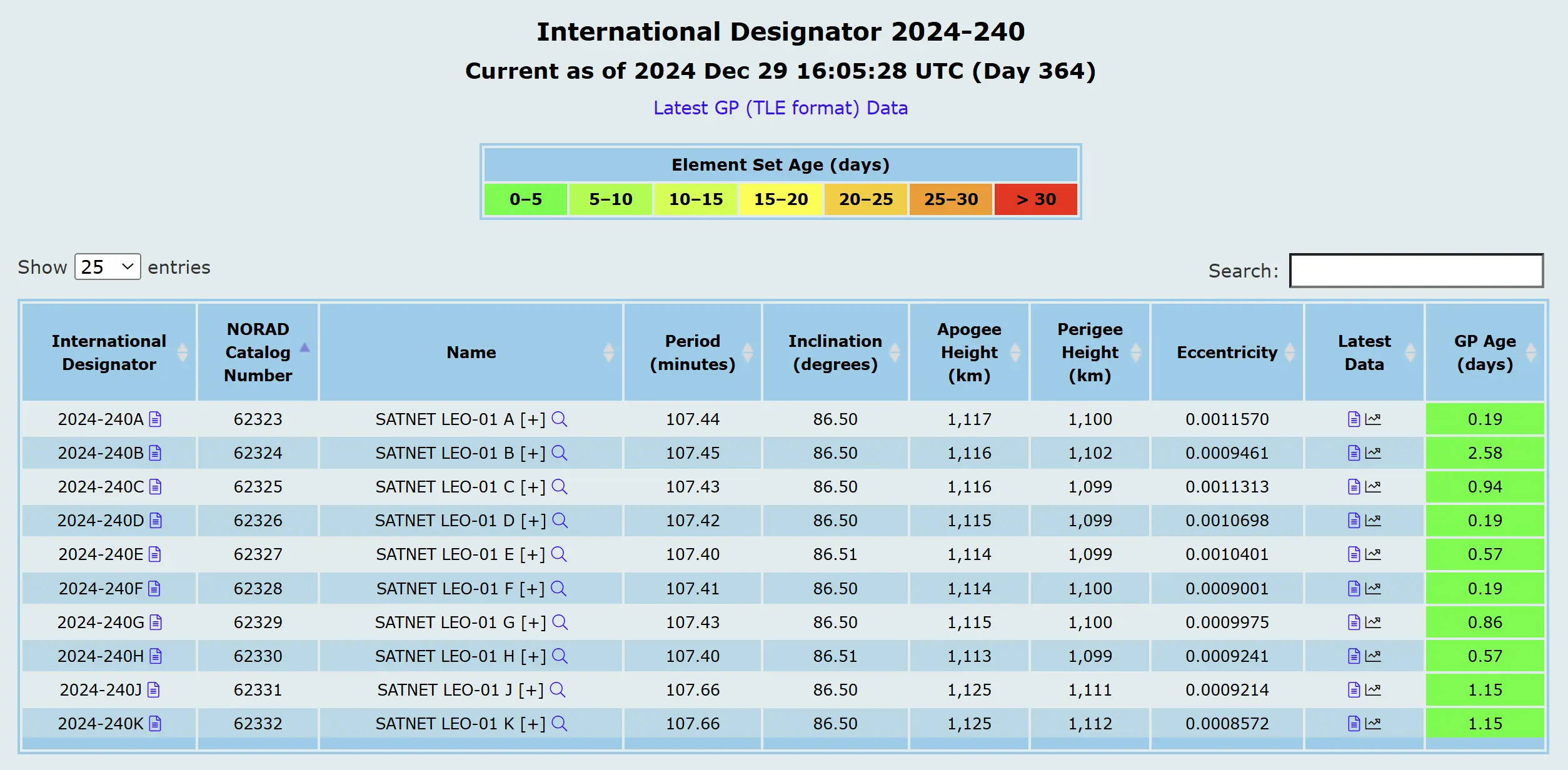
In April 2020, The Chinese State Council’s executive meeting declared information technology, including satellite Internet, an important part of the “new technology” and in October, China applied for Guowang, a 12,992-satellite Internet service constellation. Subsequently, a few Guowang test satellites were launched, and two other large Chinese constellations were announced, and one, Thousand Sails, already has 54 satellites in orbit. (Thousand Sails launches have had problems with debris and orbit raising, which attests to the immaturity of the Chinese space industry). Finally, Guowang has launched its first production satellites.
As shown above, ten satellites were launched into orbits about 1,100 kilometers above the Earth, with an inclination of 86.5 degrees. The satellites were launched on a Long March 5B rocket which can carry 23,000 Kg to low-Earth orbit (LEO) and they were stacked in a manner that optimized “the use of vertical and radial space within the payload fairing.” If the rocket was fully loaded, they would be quite large—over 2,000 kg each.
For comparison, Starlink’s current V2-mini satellites are 750-800 kg, and the V3 satellites, which will not begin launching until SpaceX’s Starship rockets are in service, are expected to be around 1,900 kg.
Thousand Sail’s satellites are smaller than either. They recently launched 18 satellites using a Long March 6A rocket which can carry 4,000 kg to sun-synchronous orbit (SSO). I could not find a mass to LEO for the Long March 6A, so I asked four AI services to estimate what a rocket capable of launching 4,000 kg to SSO would be able to launch to LEO. The average estimate was 5,700 kg total or only 317 kg per satellite.
| Service | Capacity | Per sat |
|---|---|---|
| ChatGPT | 7,000 | 389 |
| Gemini | 6,000 | 333 |
| Perplexity | 5,000 | 278 |
| Claude | 4,800 | 267 |
| Average | 5,700 | 317 |
Assuming capability is a function of mass, Guowang satellites will be significantly more powerful than Thousand Sails or Starlink’s current satellites. I don’t know what those functional differences will be—greater capacity, faster data rates, more power, improved inter-satellite capability, connectivity to 6G devices, etc. For speculation on the features of Starlink’s forthcoming V3 satellites see slide 62 in this presentation and this article).
The Guowang constellation will also orbit at a relatively high altitude. The first ten are at 1,100 km and over half the planned constellation will be roughly the same altitude. Similarly, Thousand Sails’ initial 1.296 satellites are orbiting at 1,160 km. While Starlink initially applied to have some 1,100 km satellites, they later lowered their planned orbits. Guowang’s relatively high altitude will help compensate for a lack of ground stations.
In an earlier post, I asked whether Guowang could manufacture and launch satellites fast enough to meet Its ITU commitment of launching 10% of the constellation within two years after the bring-into-use (BIU) date 50% by year 5 and all by year 7. Now that production satellites are in orbit and working, I assume the BIU clock has started or will start soon. Given the mass and orbit altitudes of the satellites and Chinese satellite manufacturing and launch capability, they will have a difficult time meeting the ITU deadlines despite new rockets, but in our politically divided world, some nations may ignore those deadlines or Guowang might simply reapply. (It’s even conceivable that Starlink could launch some Guowang satellites since Elon Musk has to please the Chinese government to protect Tesla’s sales and manufacturing in China).
Guowang is late, but the government is committed, and the satellites may be comparable to Starlink’s V3 satellites. If they can launch the constellation, there will still be a market in serving BRICS and other politically-allied or neutral nations as well as sensitive government and military organizations that are increasingly concerned with Elon Musk’s political ties and mercurial nature. The large mass of their satellites may also result in features that increase their appeal in some applications like backhaul from remote locations that are not reached by fiber. It will be interesting to see what happens when Guowang ITU deadlines expire.
Update Mar 8, 2025:
GuoWang has launched another batch of satellites on a Long March 8A rocket. Space Force cataloged nine objects in orbit, suggesting eight payloads in 862 by 870-kilometer orbits inclined by 50.0 degrees. While I could not find any definitive data online, Grok estimates that a Long March 8A could likely launch 7,200 kg to that orbit, which would imply about 800 kg per satellite, around the mass of the current V2 Starlink satellites and more than double the mass of the Thousand Sails satellites.
Update May 5, 2025:
Guowang has launched another batch of satellites on a high-capacity Long March 5B rocket, implying that these are the larger GW2 satellites.
| Date | Rocket | Satellites |
|---|---|---|
| 12/16/2024 | LM 5B | 10 |
| 2/11/2025 | LM 8A | 9? |
| 4/28/2025 | LM 5B | 10? |
Update Jun 18, 2025:
Five more Guowang satellites were launched on a Long March 6, with a capacity to orbit of 8,500 kg, implying a very large mass or a lot of empty space.
Update Jul 14, 2025:
In a speech on June 6, Yuan Jungan, chief designer of internet satellites, said more than 400 Guwowang satellites will be deployed to form the network by 2027, and “China plans to deploy more than 20,000 satellites, expand more industry-enabled application scenarios, and actively explore the international cooperation market” by 2035.
Sources vary, but there are at least 10 full BRICS members and 10 BRICS Partner Countries, and others have attended international meetings. China is pursuing international cooperation while the US seeks to cut it.
H/T Twitter @insomniacai163
Update Aug 3, 2025:
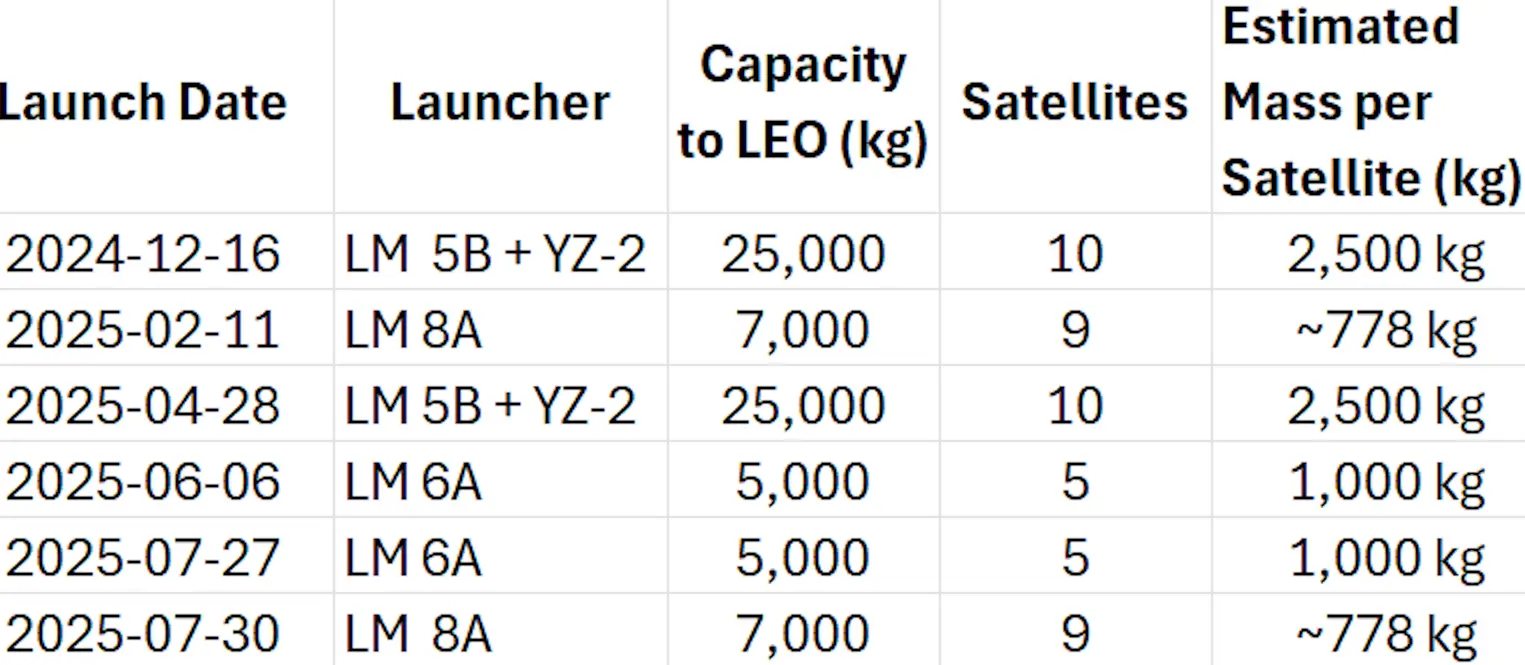
China launched two more batches of Guowang satellites in three days, bringing the total number in orbit to 48. The cadence has sped up, and the goal of 400 satellites by 2027 appears to be feasible.
Note that the Long March 5B had a Yuanzheng-2 orbit-transfer stage enabling it to carry satellites to precise orbits. (The mass of the Yuanzheng-2 rocket and its fuel would have reduced the overall carrying capacity somewhat.)
ChatGPT reports that the orbit altitudes range from 1,067 to 1,149 km. If correct, that would put them in the high-altitude GW-2 sub-constellation even though their masses, and therefore capabilities, vary considerably.
Update Aug 13, 2025:
China launched yet another batch of satellites on a Long March 5B rocket with a Yuanzheng-2 upper stage, indicating that these are probably large satellites, although, as far as I know, no details have been released.
I have also revised the estimated mass per satellite shown above based on the average of five ChatGPT queries that take the upper stage mass and fuel into account. The new estimate is 16,600 kg, and you can see the ChatGPT “reasoning” and conclusions here.
Regardless of this reduced estimate, they are definitely larger than the satellites launched on less powerful rockets and must have more capacity or other features and function as a “backbone” in some sense.
Update Aug 26, 2025:
China has launched another batch of Guowang satellites. This was the ninth Guowang launch this year but the sixth in the last 30 days. It was the third flight of the Long March 8A, bringing the total number of satellites in orbit to 81.
I wonder why the cadence has suddenly picked up. Might the Chinese have decided that, given launch and manufacturing resources, they would not be able to meet ITU deadlines for all of their constellations, so they are focusing on Guowang, which can be seen as most critical for the government?
Update Sep 27, 2025:
A batch of five GuoWang satellites was launched on a Long March 6A rocket. This, their eleventh launch, brings them up to 86 satellites in orbit, nearly as many as Qianfan, which has 90, but has slowed its launch cadence in order to correct problems with previous launches. These are the smaller GuoWang satellites, and they are in the GW-2 sub-constellation, which orbits at a relatively high 1,150 km. The satellites probably have electric propulsion systems since they would be the most efficient means of deorbiting them at 1,100 km at the end of their operational lives.
Sponsored byVerisign

Sponsored byVerisign

Sponsored byIPv4.Global

Sponsored byCSC

Sponsored byRadix

Sponsored byDNIB.com

Sponsored byWhoisXML API


A World-Renowned Source for Internet Developments. Serving Since 2002.