
Welcome:
Login
|
Sign Up
|
About CircleID
Follow:
|
|


|
||
|
||
Tightening inventory, resilient demand, and growing buyer competition suggest the IPv4 transfer market has moved beyond its spring lows and entered a firmer pricing environment.
The IPv4 transfer market entered the second half of 2026 on firmer footing, with pricing beginning to recover after several quarters of gradual declines, as reported by IPv4.Global’s June 2026 market report. Recent market activity suggests that the correction phase which characterized much of late 2025 and early 2026 has largely run its course. Although transaction volumes have moderated modestly, tightening available inventory and increasingly competitive buyer behavior are supporting a renewed upward trend in pricing across most block sizes.
This shift reflects a market that continues to demonstrate resilience despite broader macroeconomic uncertainty. Organizations expanding cloud infrastructure, AI workloads, broadband networks, and enterprise connectivity remain active participants in the transfer market, while the finite supply of IPv4 addresses continues to underpin long-term value. Earlier reports throughout the year pointed to a gradual stabilization as prices softened without a corresponding deterioration in underlying demand. June’s activity now provides further evidence that this stabilization is translating into measurable pricing strength.
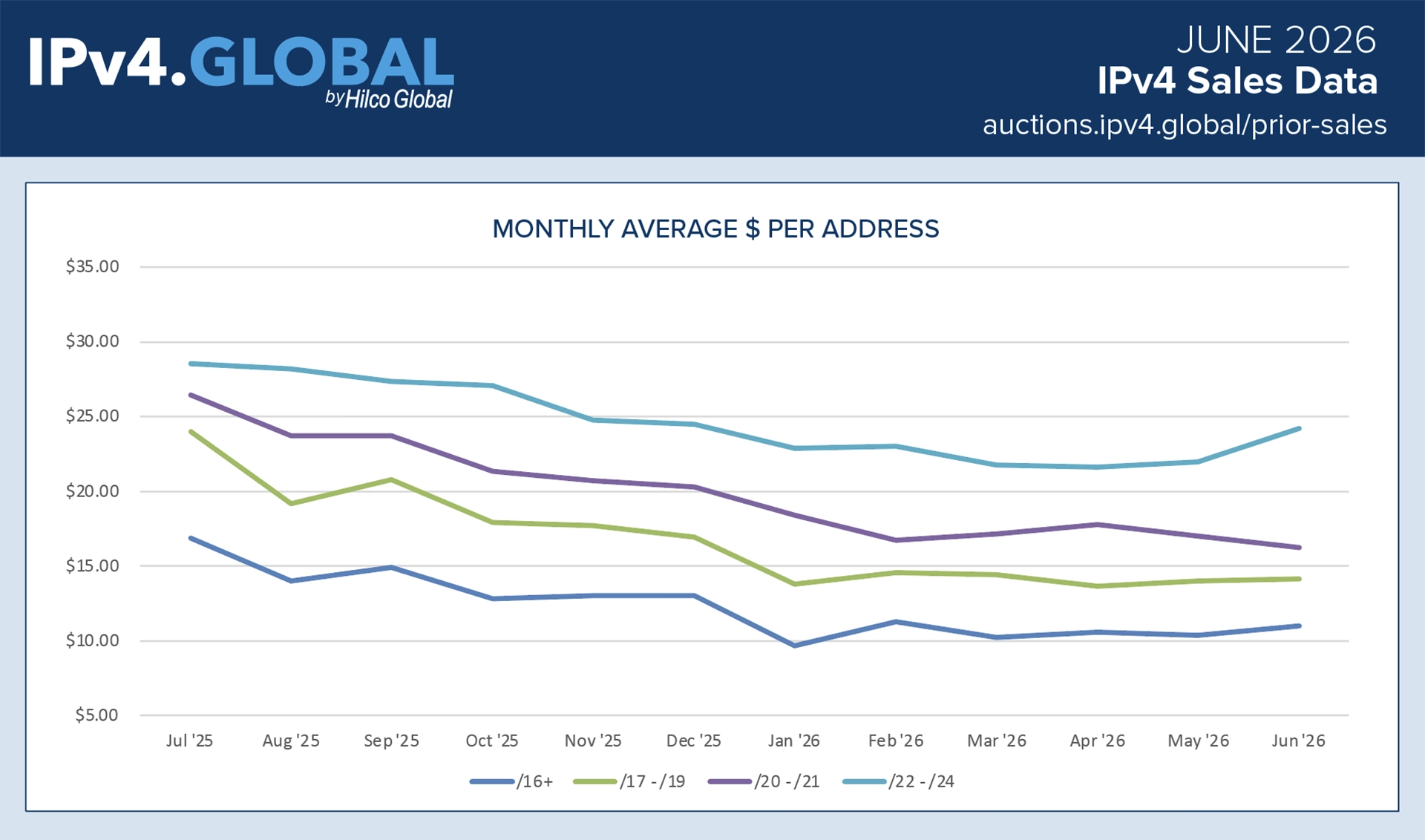
The accompanying pricing data illustrates this transition. Following a steady decline from mid-2025 through the first quarter of 2026, average prices across nearly every prefix category have either stabilized or begun to recover. Larger address blocks (/22–/24), which historically command the highest per-address valuations due to their operational flexibility and scarcity, recorded the clearest rebound during June after several months of relatively flat pricing. Mid-sized blocks (/20–/21) have likewise found support, while smaller allocations (/17–/19 and /16+) have generally stabilized after reaching their lows earlier in the year. The result is a market displaying broader pricing consistency rather than isolated strength in individual segments.
The chart also highlights an important structural characteristic of today’s market. Although values remain below the peaks observed in mid-2025, the rate of decline has slowed considerably and, in several categories, reversed altogether. Such behavior is typical of markets transitioning from price discovery toward equilibrium, particularly when supply becomes increasingly constrained. Rather than being driven by speculative buying, current pricing appears supported by practical acquisition needs and disciplined purchasing activity.
Inventory dynamics are becoming an increasingly important driver of market conditions. Available address space has tightened as many holders remain selective about bringing assets to market, while buyers continue to compete for a smaller pool of available inventory. This combination is producing firmer negotiations and reducing opportunities to acquire addresses at the discounted levels seen during the spring. For buyers, the window to secure inventory at first-quarter pricing may already be closing. For sellers, current conditions present a more constructive environment, with improving price realization supported by sustained demand rather than short-term volatility.
Looking ahead, the market appears positioned for continued firmness, provided current supply trends persist. Transaction volume remains an important indicator to monitor, as sustained price appreciation will require continued participation across a broad base of buyers. Nevertheless, the underlying fundamentals remain intact: IPv4 addresses continue to represent a finite operational resource, demand remains durable despite ongoing IPv6 deployment, and tightening inventory is once again exerting upward pressure on pricing.
IPv4.Global will continue to monitor pricing consistency, transaction activity, and inventory availability closely. Current indicators suggest the market has moved beyond its spring lows and entered a more balanced phase, one in which disciplined supply and persistent demand are supporting a healthier pricing environment for participants across the IPv4 ecosystem.
Sponsored byIPv4.Global

Sponsored byRadix

Sponsored byVerisign

Sponsored byDNIB.com

Sponsored byCSC

Sponsored byVerisign

Sponsored byWhoisXML API


A World-Renowned Source for Internet Developments. Serving Since 2002.