
Welcome:
Login
|
Sign Up
|
About CircleID
Follow:
|
|



|
||
|
||
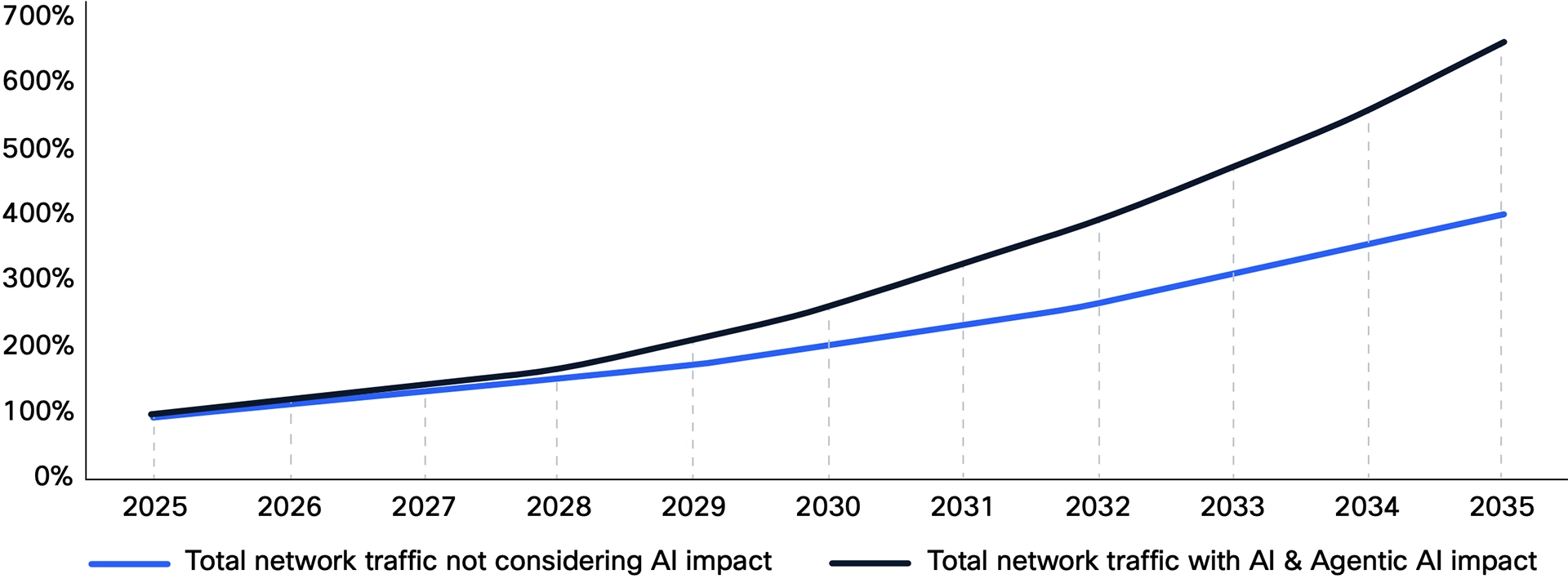
Cisco recently published a report that looks at the impact of AI traffic on networks. It’s an interesting paper because Cisco found that AI traffic does not operate the same as most other web traffic.
While the volume of AI traffic is small today, Cisco predicts that we’ll have to make changes to the web over time to accommodate growing AI traffic volumes. Cisco predicts that by 2035, one-fourth of all web traffic will be AI agents and AI models in data centers.
Cisco notes that we’ve spent decades optimizing a web that delivers burst traffic, like video. When a video is viewed from the web, the data stream doesn’t have to be delivered evenly in real time. Instead, all that is needed is for the transmission of the video to reach the viewer before they are ready to watch it. Anyone who has watched a video can see that the stream is always working to stay ahead of what you are watching.
AI traffic is very different. Cisco uses the term AI inference traffic to refer to the real-time transfer of AI traffic between AI models operating in data centers and users. AI inference traffic is delivered at what Cisco calls software speed, meaning the receiving end is ready to digest and use the data as it is delivered, quite different from streamed video that is only trying to stay ahead of a viewer.
The difference between AI traffic and normal web traffic is significant. The typical burst of AI traffic lasts twice as long as a typical burst of video data. While individual bursts of video data are smaller, the flow rate for video, which means the actual delivery time, lasts ten times longer than AI traffic, since video bursts are spread over time in multiple small bursts.
AI traffic is also two-way and requires a good upstream connection. In fact, Cisco found that 9% of AI traffic requires more upstream traffic than downstream traffic. Cisco believes the need for network upload speeds will increase as AI agents mature.
Current network latency is not a bottleneck for AI traffic, but Cisco says latency will become a problem as the volume of AI traffic increases. This will require a major rework of the web architecture when latency becomes an issue.
Cisco found that tasks performed by AI generate 450% more traffic than the same task performed in a more traditional way. In Cisco’s vocabulary, AI agents act as power users and use a lot of network resources.
The bottom line is that AI traffic differs from current web traffic and will not only increase network traffic volumes but also change the shape, symmetry, and required priority of traffic.
There have already been discussions of creating a private web to connect between AI data centers. But that would only solve part of the problem, because AI traffic is eventually delivered to users throughout the web. AI traffic is going to create an interesting new set of challenges for network engineers, something that nobody envisioned just a few years ago.
Sponsored byIPv4.Global

Sponsored byRadix

Sponsored byCSC

Sponsored byVerisign

Sponsored byDNIB.com

Sponsored byVerisign

Sponsored byWhoisXML API


A World-Renowned Source for Internet Developments. Serving Since 2002.