
Welcome:
Login
|
Sign Up
|
About CircleID
Follow:
|
|


|
||
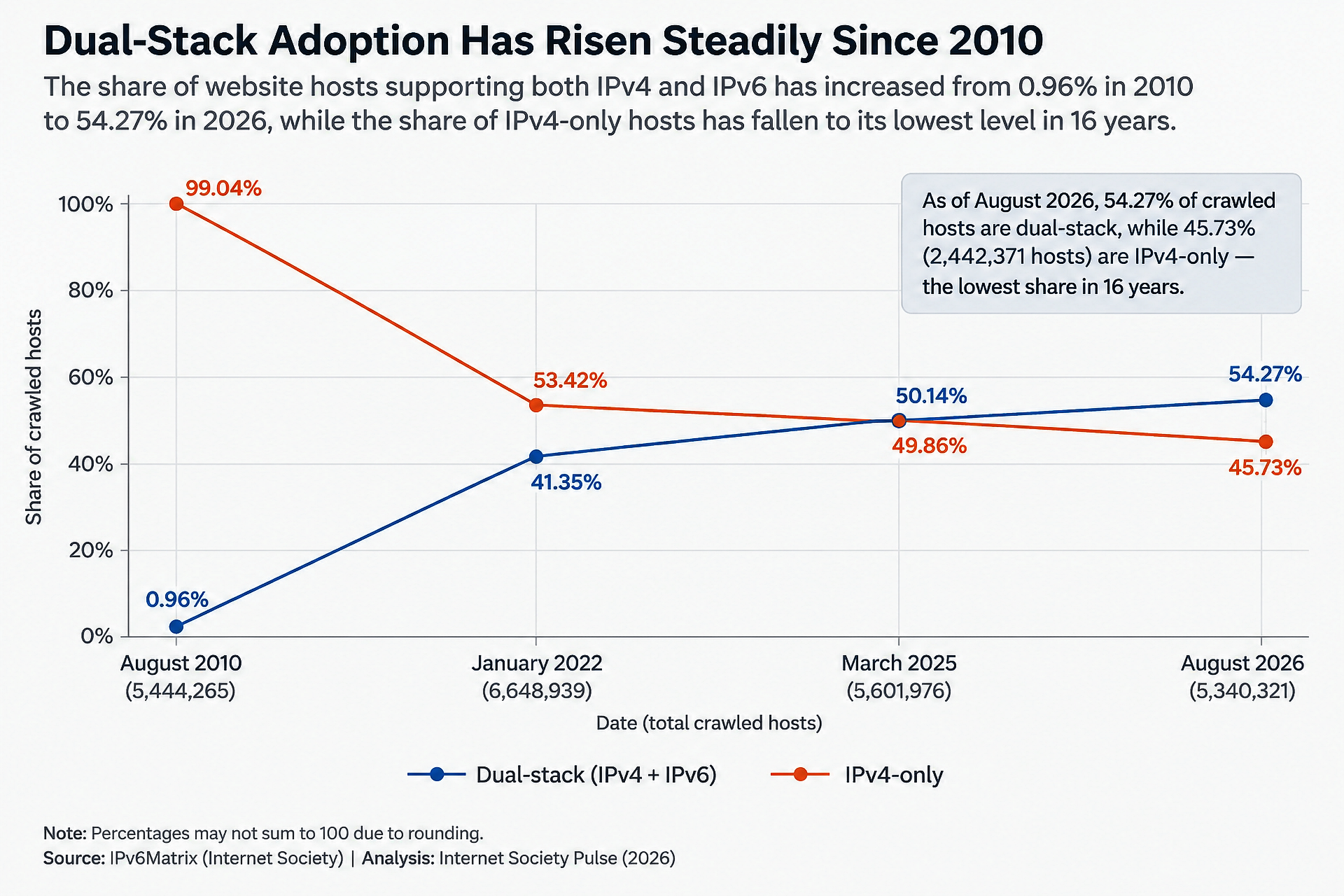
More than half of the website hosts measured by the IPv6Matrix project now support both IPv4 and IPv6, but the latest data indicate that much of the increase comes from a relatively small group of hosting, cloud, CDN, DNS and email providers rather than independent deployments across the Internet.
An Internet Society Pulse analysis published September 22 reports that 54.27% of 5,340,321 hosts in the project’s August crawl were dual-stack, up from 50.14% in March 2025 and 41.35% in January 2022. Another 45.73%, or 2.44 million hosts, remained IPv4-only.
Provider defaults account for a substantial part of the measured progress. The underlying Internet Society UK Chapter analysis says major hosting platforms and CDNs, including Cloudflare, Fastly, Akamai and Google Cloud, can give customers IPv6-capable web infrastructure without the domain owner making a separate deployment decision. It characterizes the broader trend as primarily provider-led.
That distinction complicates the global adoption figure. IPv6 availability at a domain can reflect the capabilities of a shared infrastructure provider rather than the IPv6 readiness of the organization operating the site. Current provider-level breakdowns are also limited: the UK Chapter says ASN-level figures for the latest crawl are not available through the summary API endpoints used for its analysis and would require the raw crawl output.
IPv6 coverage also varies sharply by service. Measurements of roughly one million high-ranking domains from March found IPv6 on at least one nameserver for 64.71% of domains, compared with 30.06% for web services and 32.85% for mail. Mail recorded the largest increase from January 2022, gaining 12.92 percentage points.
The researchers attribute much of the mail increase to migration toward Google Workspace and Microsoft 365. The concentration is not new: the analysis cites 2022 measurements in which 45.32% of MX records pointed to Google, while 36.3% of domains had at least one MX record pointing to Google or Outlook. The newer summary data do not provide an equivalent current provider-level measurement, preventing a direct comparison of how those shares have changed.
Country comparisons remain a gap in the current dataset. Although the project has previously visualized leading IPv6 domains by country, the Internet Society UK Chapter says an upcoming crawler and server update is intended to provide better ccTLD and per-country analysis. The present results therefore support comparisons among services and infrastructure providers more strongly than conclusions about differences between countries.
The measurements reinforce a distinction between the breadth and depth of the IPv6 transition: dual-stack availability continues to rise, while the infrastructure supplying that availability remains concentrated enough that a single global percentage can obscure who is actually doing the deployment.
Sponsored byCSC

Sponsored byRadix

Sponsored byVerisign

Sponsored byIPv4.Global

Sponsored byVerisign

Sponsored byDNIB.com

Sponsored byWhoisXML API


A World-Renowned Source for Internet Developments. Serving Since 2002.