
Welcome:
Login
|
Sign Up
|
About CircleID
Follow:
|
|


|
||
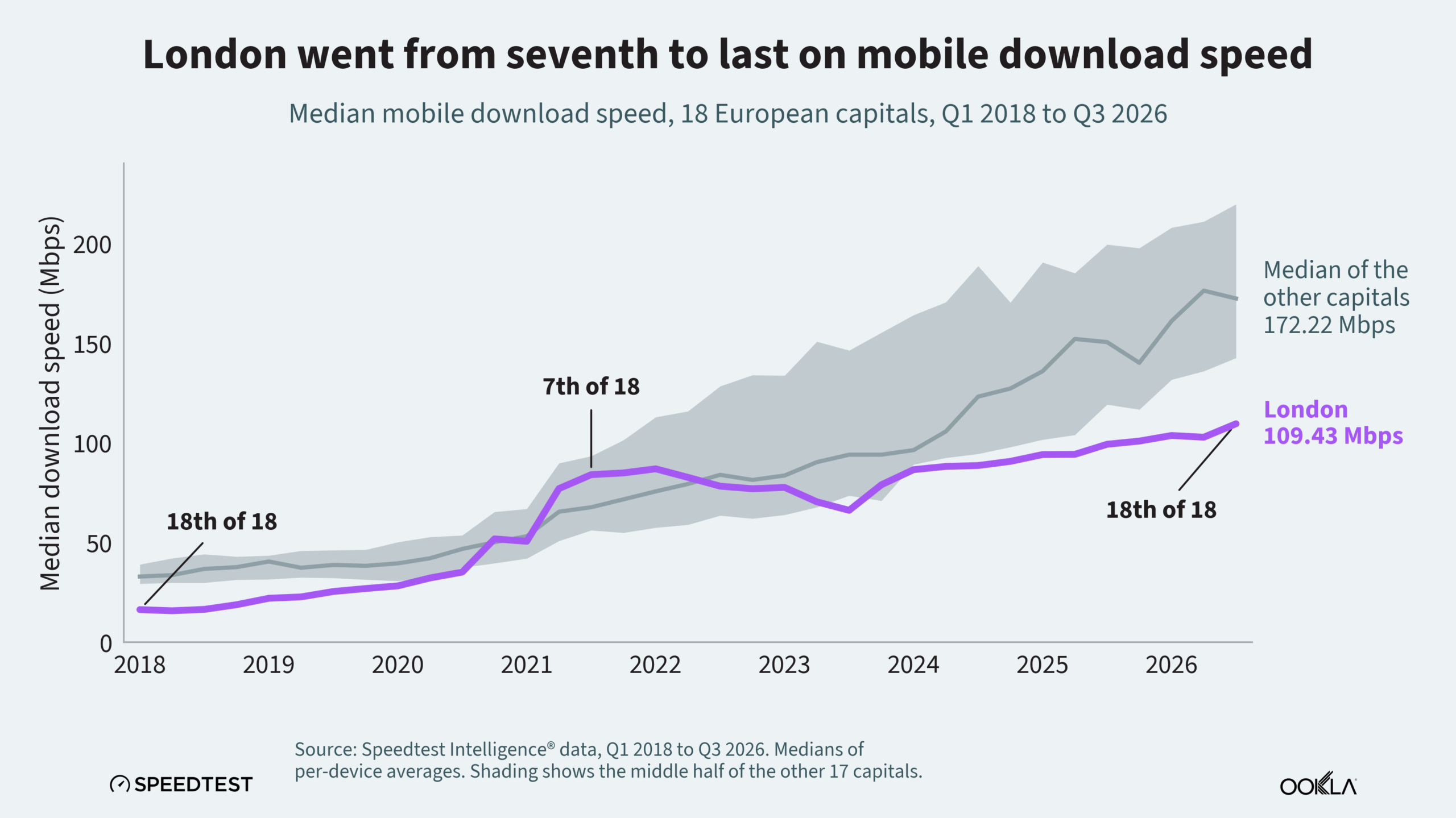
London has fallen to last place among 18 European capitals for mobile download speeds, according to new benchmarking data from Ookla. The findings show that growing network demand, congestion and obstacles to infrastructure deployment are undermining mobile Internet performance despite widespread 5G availability.
London’s median mobile download speed reached 109.43 Mbps in the third quarter of 2026, compared with 332 Mbps in Stockholm, the fastest capital surveyed. The median across the other 17 capitals was 172.22 Mbps, according to the Ookla findings. London also recorded the slowest median upload speed, at 11.40 Mbps, and the highest loaded latency among the worst-performing 10% of samples, reaching 2,204 milliseconds.
5G adoption has outpaced network capacity. London ranked seventh among the surveyed capitals for median download speed in 2021, following its early introduction of 5G. Yet median 5G download speeds declined from approximately 200 Mbps in the second quarter of 2021 to 133 Mbps in the third quarter of 2026, even as the proportion of tests conducted over 5G nearly doubled to 80%. Paris, by comparison, has maintained median 5G speeds above 225 Mbps since mid-2021.
Weekday congestion exposes capacity constraints. In central London’s City of London and Westminster districts, median download speeds fell to 80.07 Mbps around 1 p.m. on weekdays, approximately 27% below comparable weekend performance. Loaded latency simultaneously increased by 26%, indicating that networks struggle to maintain responsiveness when demand intensifies. Such conditions can affect video conferencing, interactive applications and other Internet services sensitive to delay.
Infrastructure deployment presents another challenge. Applications for new street-level mobile masts have declined by more than four-fifths since 2022, while nearly three-quarters of applications decided since 2019 were refused, according to Ookla’s analysis. Restrictions affecting protected urban areas, difficulties securing rooftop sites and the removal of equipment during property redevelopment further complicate network expansion. These constraints can limit operators’ ability to add capacity where demand is concentrated.
Network performance also varies substantially between operators. EE experienced the smallest weekday lunchtime slowdown in central London, at 15%, while Three UK recorded the highest citywide median download speed, at 113.27 Mbps. O2 exhibited substantially higher loaded latency than competing networks, including during quieter overnight periods, suggesting that traffic management and buffering behavior may contribute alongside congestion.
The findings coincide with a new initiative by London’s municipal government. Mayor Sadiq Khan’s administration has published a mobile connectivity evidence report and framework, developed with support from Ookla, identifying performance gaps and outlining ten measures borough authorities can take to facilitate infrastructure investment. The initiative introduces assessments covering download and upload speeds, signal strength and latency rather than relying exclusively on coverage indicators.
Ookla’s measurements draw on crowdsourced Speedtest data rather than a comprehensive census of mobile subscribers. Differences in testing behavior, devices and network conditions can influence the results. Nevertheless, the sustained deterioration in London’s relative ranking, combined with measurable weekday congestion, provides evidence that expanding nominal 5G coverage alone does not guarantee corresponding improvements in mobile Internet performance.
Sponsored byDNIB.com

Sponsored byIPv4.Global

Sponsored byRadix

Sponsored byVerisign

Sponsored byWhoisXML API

Sponsored byVerisign

Sponsored byCSC


A World-Renowned Source for Internet Developments. Serving Since 2002.