
Welcome:
Login
|
Sign Up
|
About CircleID
Follow:
|
|



|
||
|
||
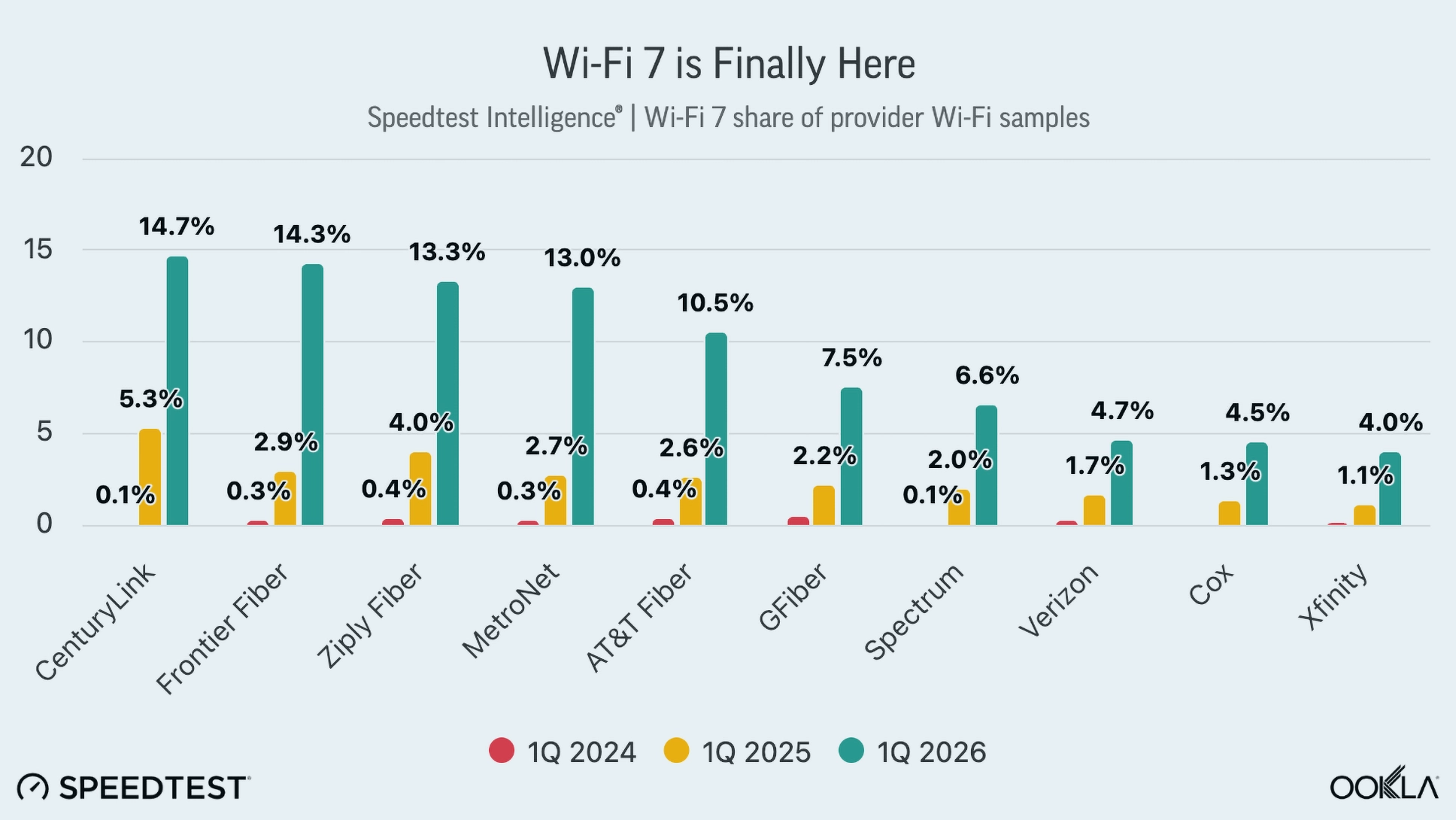
Ookla recently published a research article that documents the implementation of Wi-Fi 7 in the U.S. and around the world. Wi-Fi 7 routers were introduced to the market in early 2024, and Ookla reports that deployment has already reached 7.2% in the country. That’s a big uptake in a year and a half, considering that broadband customers hang on to Wi-Fi routers unless changing service providers.
It’s not surprising that Wi-Fi is being adopted. Wi-Fi 7 brings a big improvement over Wi-Fi 6 and earlier generations of Wi-Fi. Wi-Fi 7 can theoretically reach much faster speeds, and in practice delivers faster speeds and performance inside the customer premises. Some of the specific benefits include wider data channels inside the home, particularly for customers who have devices that can use 6 GHz spectrum, which is 1,200 MHz of bandwidth between 5.925 GHz and 7.125 GHz. Wi-Fi 7 has better data throughput to devices by the use of 4K-QAM, has better performance from preamble puncturing that can bypass interference, and has faster speeds for specific applications due to multi-link operations that let the router combine multiple frequency bands when needed. Wi-Fi 7 has also doubled the number of simultaneous devices that can be connected from eight to sixteen.
As might be expected, the growing Wi-Fi 7 adoption is mostly coming from ISPs. Charter is currently the biggest user of Wi-Fi 7 in the world. In the U.S., the new technology is being deployed by other large ISPs like Comcast, Frontier, and CenturyLink. It’s likely that the upgrades to Wi-Fi 7 will continue. For years, ISPs have been frustrated by a large percentage of customer complaints about broadband that are actually due to poor customer-provided Wi-Fi modems.
Interestingly, the U.S. is leading the world in Wi-Fi 7 adoption. Part of the reason for this is that China is not stressing the use of Wi-Fi 7 inside the country since the nation has decided to use 6 GHz spectrum for cellular traffic instead of for public Wi-Fi.
The impact of the Wi-Fi 7 routers is dramatic. Ookla cites speed test statistics for Comcast that show that upload speeds have more than doubled for some customers strictly due to the installation of a new Wi-Fi 7 modem.
Wi-Fi technology isn’t sitting still. The first prototypes of Wi-Fi 8 modems should be produced later this year, with commercial production is about two years. Wi-Fi 8 adds even more features that will help the customer experience. The most interesting new feature is Dynamic Sub-band Operations (DSO) that will allow the Wi-Fi router to assign tiny bandwidth channels instead of a full channel when connecting to devices that don’t need much bandwidth. Wi-Fi 8 also has the ability to coordinate with neighboring Wi-Fi routers to cut down on interference. There will be a new technology called Distributed Resource Units and ELR that will improve the upload path to cut down on upload stutters from devices like security cameras and smartphones.
There is even more improvement coming with Wi-Fi 9. The official specifications should be released in early 2027, with commercial adoption likely coming in the early to mid-2030s.
Sponsored byIPv4.Global

Sponsored byCSC

Sponsored byDNIB.com

Sponsored byVerisign

Sponsored byRadix

Sponsored byVerisign

Sponsored byWhoisXML API


A World-Renowned Source for Internet Developments. Serving Since 2002.