
Welcome:
Login
|
Sign Up
|
About CircleID
Follow:
|
|



|
||
|
||
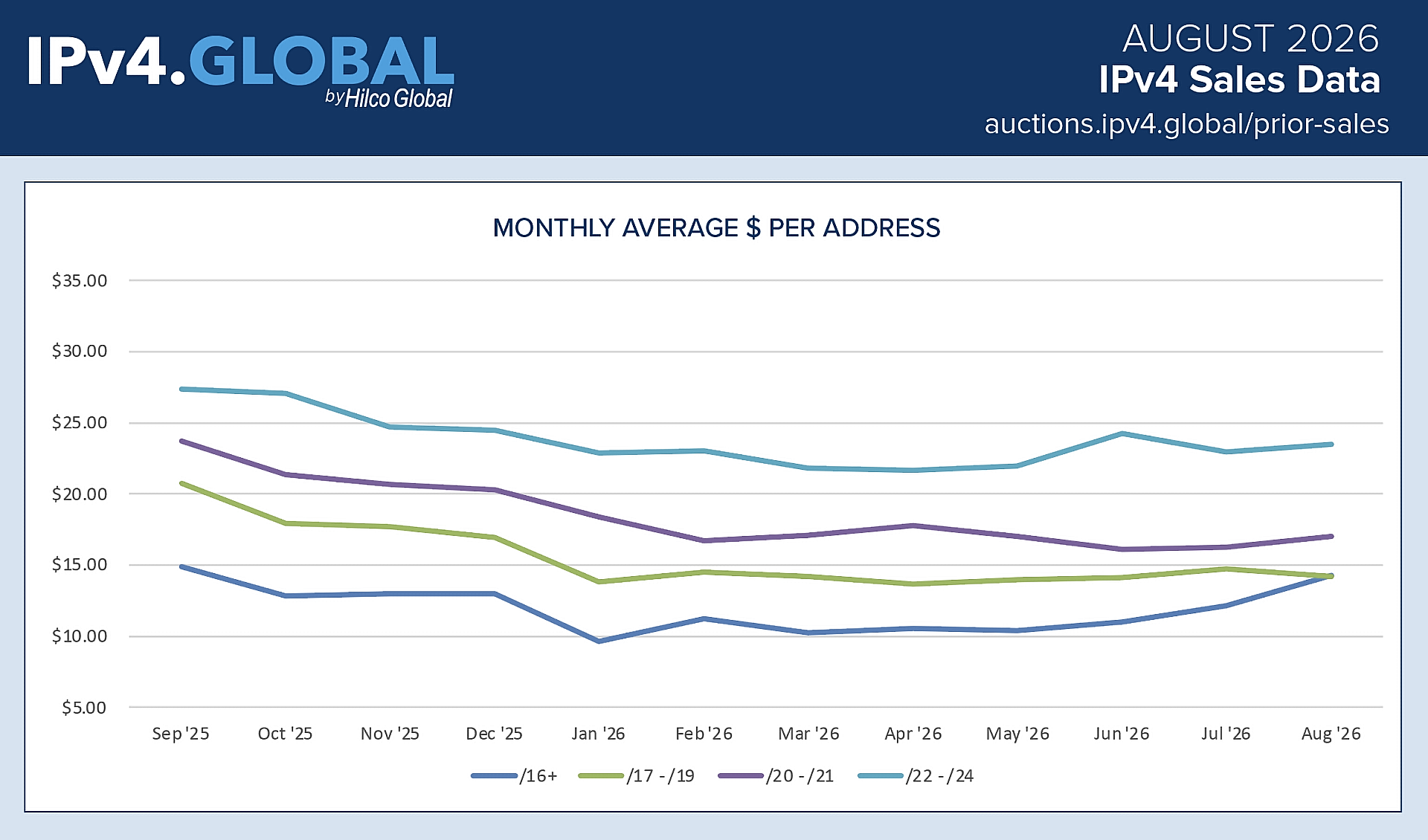
This market report draws on IPv4.Global’s August 2026 market data and analysis, examining recent pricing, transaction activity, supply conditions, and the outlook for IPv4.
The IPv4 transfer market strengthened further in August, extending a recovery that has developed steadily since the spring. Average prices continued to move higher, transaction activity remained healthy, and larger address blocks again recorded the clearest pricing momentum. The combination points to a market increasingly shaped by constrained supply rather than a sudden acceleration in demand.
The progression over recent months is significant. In May, the market was best characterized by stabilization: prices remained below earlier peaks, but declines were slowing, transaction volumes were healthy, and larger blocks had begun to firm. By June, pricing across most block sizes was either stabilizing or recovering as available inventory tightened. July extended that movement, with average prices rising across most categories and larger allocations maintaining their leadership.
August adds another month to that recovery. IPv4.Global’s latest transaction data shows average pricing remaining firm while buyers continued to transact despite higher valuations. Larger, desirable allocations were particularly constrained, strengthening sellers’ negotiating position and increasing competition among buyers seeking contiguous address space.
The accompanying pricing graph illustrates the change in market direction particularly clearly. After broad declines from mid-to-late 2025 into early 2026, the curves began flattening during the spring before turning upward over the summer. The recovery has not been uniform: larger-block categories have moved more decisively, while smaller and mid-sized allocations have generally experienced more measured improvement. The result is a widening differentiation by block size rather than a market in which all IPv4 assets move together.
Supply is becoming the central variable. Earlier in the year, durable demand coexisted with enough available inventory to keep buyers patient and pricing subdued. More recently, fewer suitable blocks have been coming to market, particularly in categories where buyers have specific requirements for size, registration history, geography, routing characteristics, or deployment readiness. That shift means acquisition certainty can increasingly matter alongside headline price.
Demand, meanwhile, appears resilient rather than speculative. Organizations continue to require IPv4 resources for network expansion, cloud infrastructure, customer growth and other operational needs even as IPv6 deployment advances. The persistence of transaction activity as prices rise is therefore an important market signal: the current recovery is being supported by actual address requirements rather than price momentum alone.
The near-term outlook remains constructive, but increasingly supply-dependent. If transaction activity holds near current levels while larger-block inventory remains constrained, further gradual price appreciation through the remainder of 2026 would be consistent with the pattern established since spring. A substantial increase in addresses offered for sale could moderate those gains, particularly in smaller and mid-sized categories.
For buyers with defined future requirements, the market is becoming less forgiving of indefinite delay. For sellers, particularly holders of larger allocations, conditions are more favorable than they were during the correction phase. The key question entering the fall is no longer simply whether IPv4 pricing has found a floor, but how far a supply-constrained recovery can progress while underlying demand remains intact.
Sponsored byIPv4.Global

Sponsored byDNIB.com

Sponsored byWhoisXML API

Sponsored byCSC

Sponsored byVerisign

Sponsored byRadix

Sponsored byVerisign


A World-Renowned Source for Internet Developments. Serving Since 2002.