
Welcome:
Login
|
Sign Up
|
About CircleID
Follow:
|
|


|
||
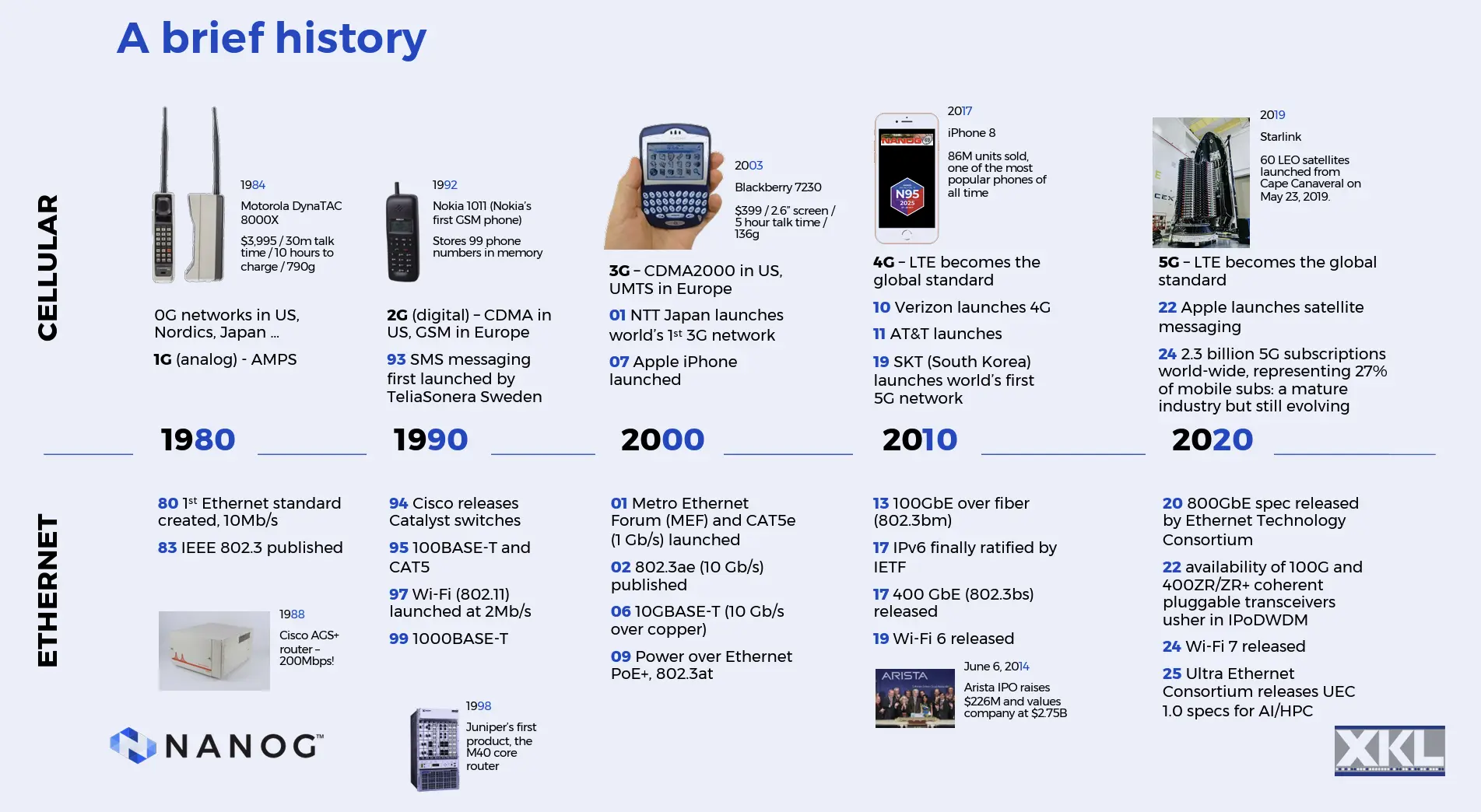
At the 95th meeting of the North American Network Operators’ Group (NANOG), held in Arlington, Texas in October 2025, industry insiders gathered to dissect the shifting dynamics of global internet infrastructure. Geoff Huston, Chief Scientist at the Asia Pacific Network Information Centre (APNIC), offered a detailed account of key sessions that covered everything from mobile data saturation to the quantum computing threat to encryption.
Mobile slowdown: A standout presentation by Len Bosack of XKL traced the evolution of communication technologies over the past 45 years. While 5G has achieved market dominance with over 2.3 billion subscribers, its growth rate has slowed significantly—from over 90% in 2018 to just 19% in 2025—suggesting signs of market saturation. Meanwhile, WiFi 7 and upcoming WiFi 8 upgrades continue to push performance boundaries, albeit in more limited domains. Fibre remains the power-efficiency leader, with deployment costs dropping and performance climbing steadily, while Hybrid Fibre Coax (HFC) networks approach technological end-of-life.
Spectrum limitations: Bosack noted the uncertain economics of 6G’s reliance on millimetre-wave spectrum, given its poor penetrative properties and costly infrastructure needs. As signal propagation at higher frequencies becomes more constrained, physical cabling—though expensive—retains advantages in capacity and reliability.
Routing risks: Routing security also featured prominently. Bryton Herdes of Cloudflare delved into BGP route leaks, a persistent vulnerability rooted in misconfigurations rather than flaws in the protocol itself. Tools like “Peerlock-lite” and the “Only to Customer” (OTC) attribute in BGP offer localized safeguards, but the broader question remains whether global routing policies should be visible and enforceable—or handled entirely within local domains.
Trading latency: From speed to subatomic physics, Jeremy Fillibean of Jump Trading addressed the demands of high-frequency financial traders. Innovations such as hollow-core fibre, which boosts light propagation speed by 50% over conventional fibre, are being explored to shave microseconds off trans-Atlantic trading routes. Precision time protocols like IEEE 1588 are also being adopted to synchronize trading systems down to nanoseconds.
Hardware counterfeits: Another threat looms not from latency, but from subterfuge. Researchers from Purdue University showcased methods for detecting counterfeit microchips in networking equipment using advanced spectroscopic and imaging techniques. As nation-states and criminal actors exploit supply chains, ensuring hardware authenticity has become paramount.
Space shielding: Looking to the cosmos, other researchers explored radiation shielding for electronics in space—a growing concern as data transmission expands beyond Earth. A composite of tungsten and boron shows promise in protecting space-grade microelectronics while maintaining thermal efficiency.
Quantum threat: Finally, the quantum future cast its long shadow. William Nelson warned that quantum computing—while still nascent—could eventually undermine current encryption standards. Shor’s algorithm, which can theoretically crack RSA encryption, may require thousands of entangled logical qubits, a threshold not yet reached. Still, Huston echoed the cautious consensus: if long-term secrecy matters, post-quantum cryptography should be adopted today.
Despite past criticisms that NANOG was veering into commercial territory, Huston concluded that this year’s event offered a robust and technical programme worthy of its reputation as a premier forum for network operations professionals.
Sponsored byIPv4.Global

Sponsored byCSC

Sponsored byVerisign

Sponsored byRadix

Sponsored byWhoisXML API

Sponsored byDNIB.com

Sponsored byVerisign


A World-Renowned Source for Internet Developments. Serving Since 2002.