
Welcome:
Login
|
Sign Up
|
About CircleID
Follow:
|
|



|
||
|
||
Replacement strings help, but they are only one tool. Contention, string similarity, GAC objections, and information asymmetry all pose distinct risks. Applicants who map the full battlefield before they apply will survive. Those who do not will pay the price.
The 2026 New gTLD round is open. Applications are being prepared. But most applicants are making a fundamental error: they are treating this as a domain registration.
It is not.
Whether you are applying for a .BRAND, a geographic string, or a community TLD, you are claiming digital territory. That comes with strategic, political, and procedural risks that most applicants do not see coming.
The 2012 round was a learning experience for many. The 2026 round is different. The stakes are higher. The scrutiny is greater. And the procedural architecture of ICANN’s accountability mechanisms has been tested, and found wanting, in ways that should give every applicant pause.
This article maps the full risk landscape and offers a framework for survival.
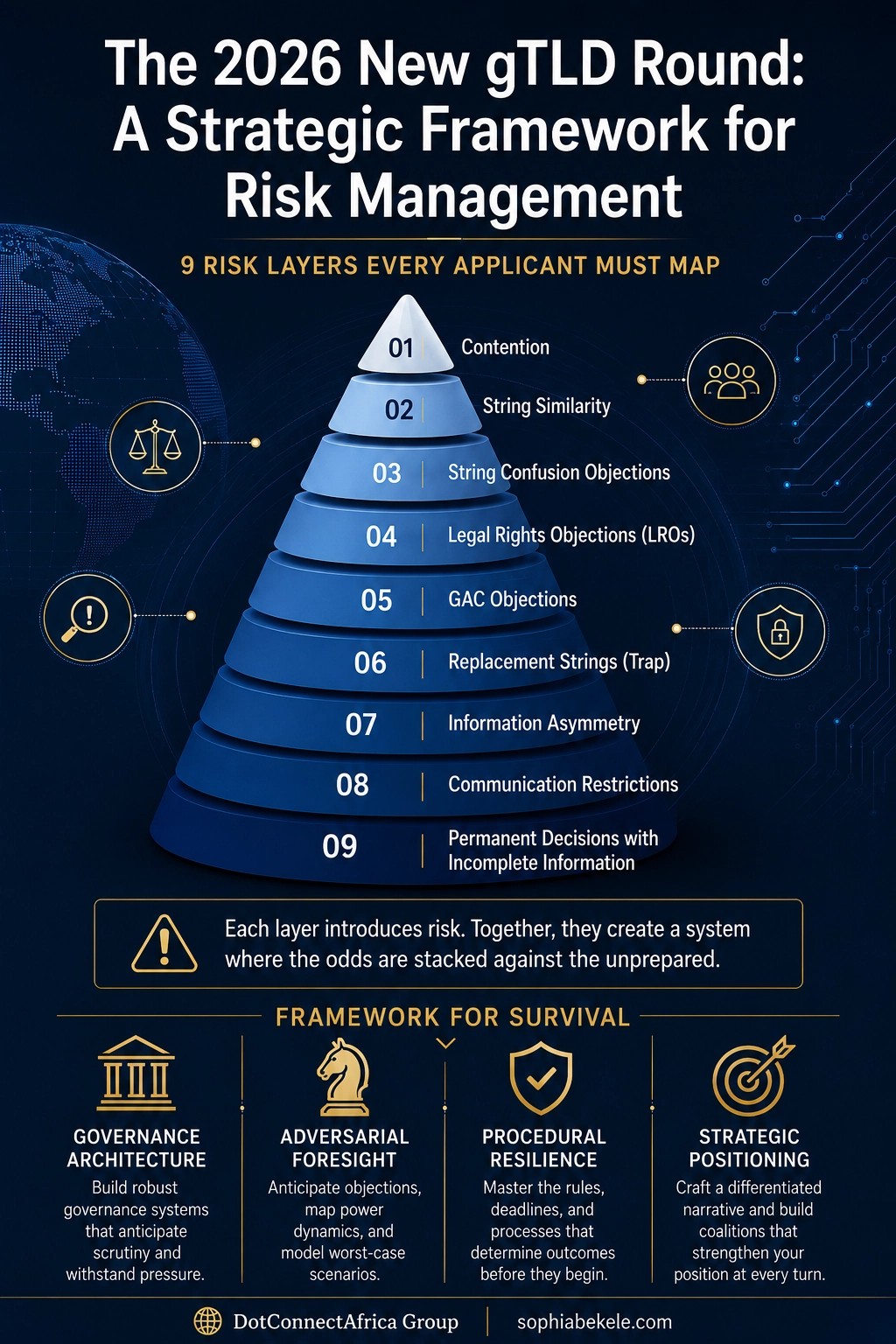
Contention is the single greatest threat to any gTLD application. It occurs when two or more applicants apply for the same or similar strings. In the 2012 round, over 200 applications were placed in contention sets. Many were resolved through auctions, private agreements, or withdrawals, but not before significant cost and delay.
Contention is not just about identical strings. It includes:
The problem is that applicants often discover they are in contention only after filing, when it is too late to change course. The application fee is non-refundable. The costs are sunk. And the outcome is uncertain.
What applicants need to do: Pre-application intelligence. Map the field. Identify potential contenders before you file. This is not always possible, but the applicants who do it well will have a significant advantage.
ICANN’s string similarity evaluation is one of the most opaque processes in the gTLD program. The guidelines are published, but the application of those guidelines is subjective. What looks like a safe string today may be deemed confusingly similar tomorrow.
The 2026 String Similarity Guidelines risk entrenching the mistakes of the past. They rely on automated tools and algorithmic assessments that are not transparent. Applicants have no meaningful right of appeal. If your string is deemed confusingly similar, you are in contention, whether you agree or not.
What applicants need to do: Understand the guidelines. Test your string against known benchmarks. And be prepared for the possibility that your string will be challenged, even if you believe it is safe.
String confusion objections can be filed by any party who believes that a proposed gTLD is confusingly similar to an existing TLD or another application. These objections are often used as a weapon by competitors who want to block a string they cannot secure themselves.
Even if you win the objection, the cost and delay can be fatal to your application timeline. The objection process is lengthy, expensive, and unpredictable.
What applicants need to do: Anticipate objections. Build a case in advance. And be prepared to defend your string, not just on technical grounds, but on strategic and political grounds as well.
Legal rights objections can be filed by trademark holders who believe that a proposed gTLD infringes on their rights. This is a particular risk for .BRAND applicants who choose a string that matches their brand, but it also affects community and geographic applicants who may inadvertently conflict with existing trademarks.
The LRO process is separate from the string similarity evaluation. It is possible to pass one and fail the other. And the cost of defending an LRO can be significant.
What applicants need to do: Conduct a thorough trademark search before applying. Identify potential objectors. And build a legal defense strategy before you file.
Governmental Advisory Committee (GAC) objections are among the most unpredictable risks in the gTLD process. Governments can object to a string for reasons that have nothing to do with its technical merits. In the 2012 round, GAC objections were raised against strings as diverse as .amazon, .patagonia, and .africa.
These objections are often political. They can be driven by national interests, regional rivalries, or diplomatic considerations. And they are difficult to challenge.
What applicants need to do: Understand the GAC landscape. Identify potential government objectors before you file. And develop a political engagement strategy to address concerns before they become objections.
The replacement string mechanism is one of the most misunderstood features of the gTLD program. Applicants who face contention or objections may be offered the option to apply for a replacement string. But this is not a safety net. It is a trap.
Once you choose a replacement string, you are locked in. You cannot go back to your original string. The replacement string may face its own objections. And the process is opaque, with limited transparency and no right of appeal.
In practice, replacement strings are rarely a viable solution. They are a last resort that leaves applicants worse off than if they had never applied.
What applicants need to do: Do not rely on replacement strings. Choose your string carefully the first time. And be prepared to defend it.
One of the most significant risks in the gTLD process is information asymmetry. Applicants do not know what other applicants are doing. They do not know who else is applying for similar strings. They are flying blind.
This creates a strategic disadvantage for applicants who are not connected to the ICANN community. They may be unaware of potential contenders, objections, or political risks until it is too late.
What applicants need to do: Build intelligence. Engage with the ICANN community. And develop a network of advisors who can provide early warning of potential risks.
During the gTLD process, applicants are subject to strict communication restrictions. They cannot discuss their applications publicly. They cannot lobby ICANN staff. They cannot engage in certain types of advocacy.
This creates additional risk for applicants who do not understand the boundaries. A single misstep can result in disqualification or sanctions.
What applicants need to do: Understand the rules. Train your team. And ensure that all communications are compliant with ICANN’s guidelines.
Perhaps the greatest risk of all is that the 2026 round requires applicants to make permanent decisions with incomplete information. Once you file, you cannot go back. The costs are sunk. The risks are real.
You are choosing a string that will define your digital presence for decades. You are committing to a process that will cost hundreds of thousands of dollars. And you are doing it without knowing the full landscape of competitors, objectors, and political risks.
What applicants need to do: Accept that you will never have complete information. Build a strategy that anticipates the unknown. And be prepared to adapt, even if that means walking away.
The 2026 round is not for the unprepared. Replacement strings help, but they are only one tool. Contention, string similarity, GAC objections, and information asymmetry all pose distinct risks.
A successful application requires more than technical readiness. It requires:
Applicants who map the full battlefield before they apply will survive. Those who do not will pay the price.
For a deeper governance review, visit the DotBrand Sovereignty Audit page.
Sponsored byRadix

Sponsored byIPv4.Global

Sponsored byVerisign

Sponsored byCSC

Sponsored byWhoisXML API

Sponsored byVerisign

Sponsored byDNIB.com


A World-Renowned Source for Internet Developments. Serving Since 2002.