
Welcome:
Login
|
Sign Up
|
About CircleID
Follow:
|
|

|
||
|
||
WhoisXML API is proud to announce the launch of the TLD RDAP Monitor, an intuitive dashboard that constantly monitors the range of adoption of the Registration Data Access Protocol (RDAP) across 1,440 top-level domains (TLDs).
The TLD RDAP Monitor answers a critical need within the domain data ecosystem. As the industry transitions to RDAP, TLD registries have implemented the new protocol with varying degrees of progress, with some slower than others. This lack of uniformity can lead to data retrieval errors and application failures for those who rely on domain data access for their products and services.
The tool provides much-needed answers to consumers of domain data, such as cybersecurity professionals, anti-abuse teams, and cyber solutions developers, helping them understand the correct query protocols for each TLD to ensure applications and services run smoothly. The dashboard also tracks the operational health of the monitored TLDs’ RDAP and WHOIS servers, adding more context to domain intelligence.
The TLD RDAP Monitor is powered by an advanced scanning operation that runs every 48 hours. Using a list of all TLDs from the Internet Assigned Numbers Authority (IANA), our system identifies and categorizes each TLD based on its protocol support. This process allows us to pinpoint:
The TLD RDAP Monitor dashboard was carefully designed to be easy to use and navigate. It has the following features, which we’ll discuss in greater detail below.
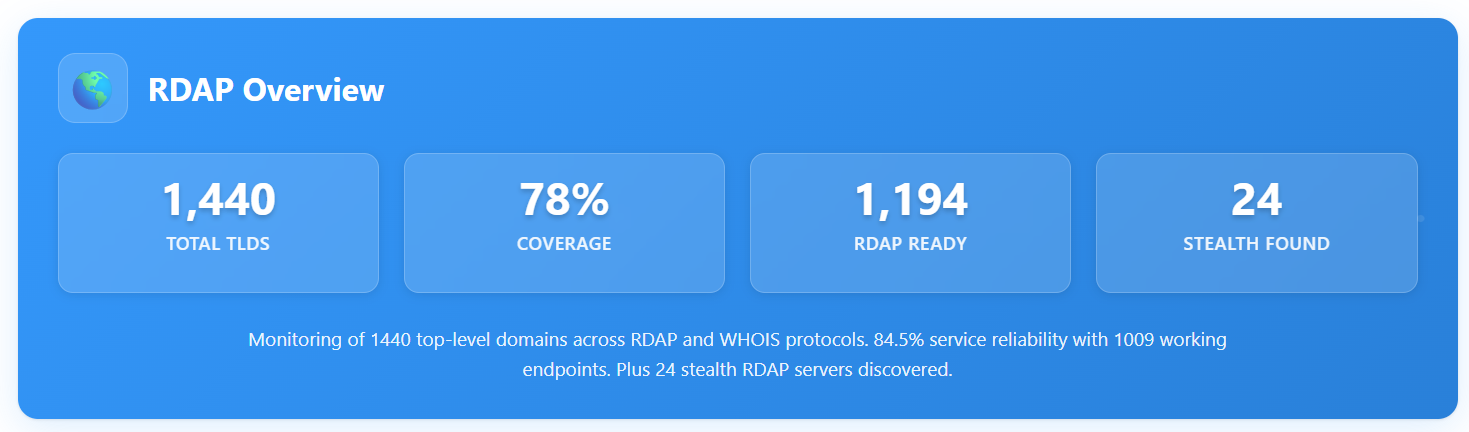
When you open the monitor, you will immediately see the total number of RDAP-ready TLDs against the total number of TLDs it monitors. The overview also displays the number of stealth RDAP servers found, as well as the service reliability percentage of the RDAP endpoints.
This dashboard provides a quick, color-coded view of the operational health of both RDAP and WHOIS servers across the board. As of this writing, 100% of the WHOIS servers worked while only 84.5% of the RDAP servers were working. The overall service reliability ranked at 78%.
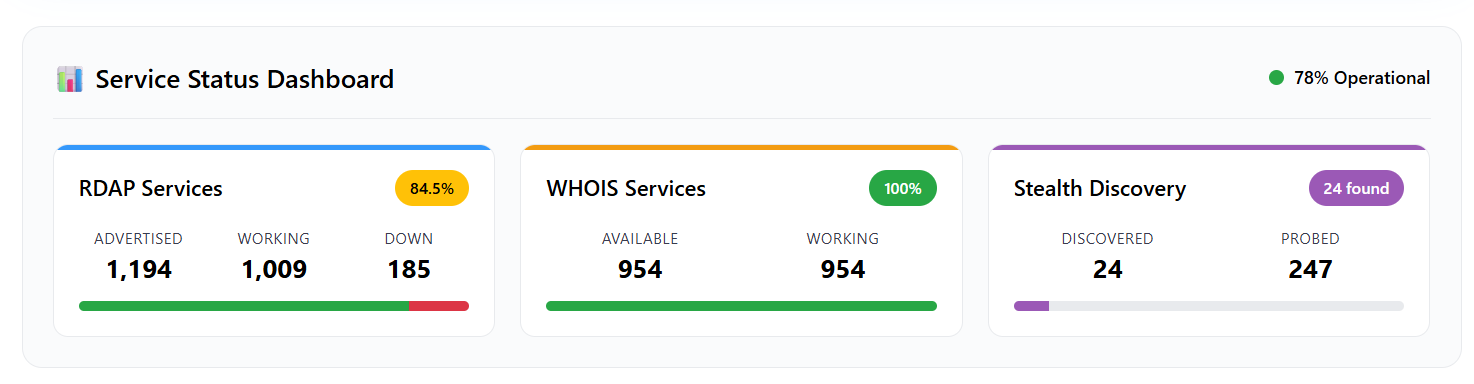
The data in this dashboard offers a clear picture of the current state of the domain data ecosystem.
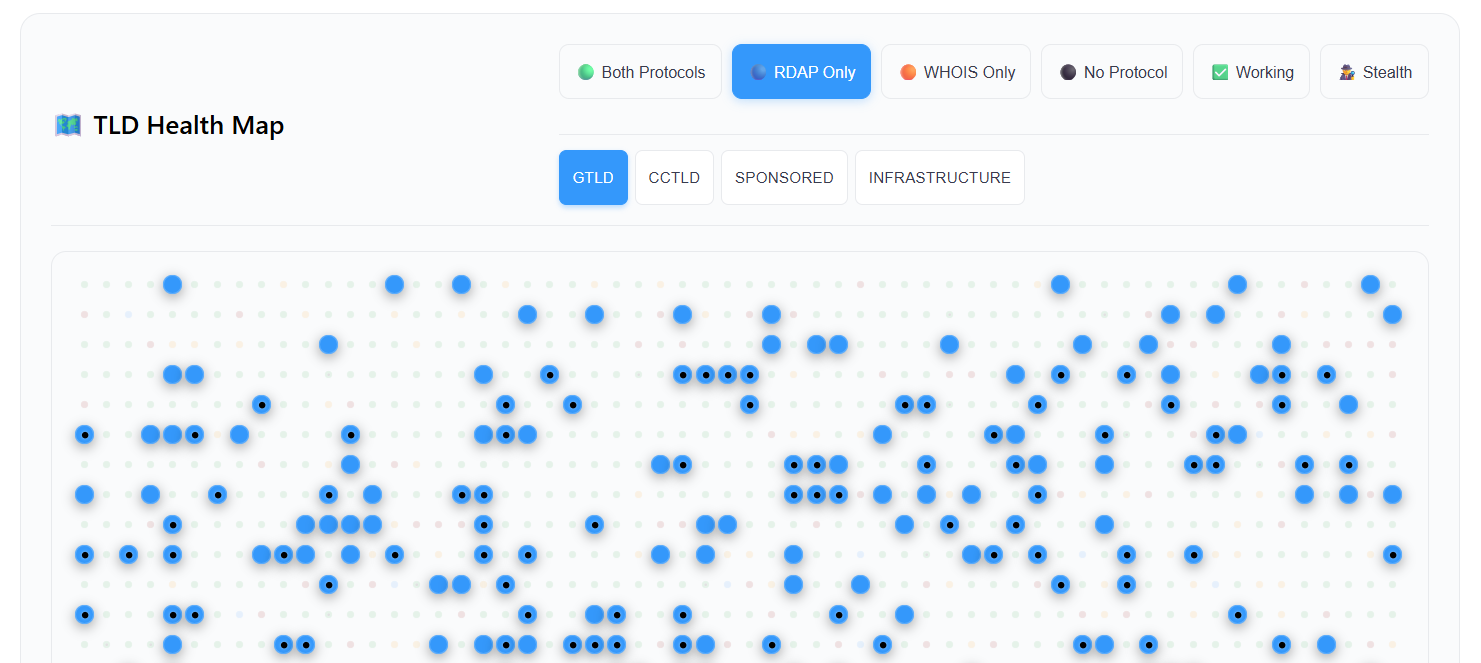
Our interactive map helps users visualize the overall RDAP deployment for the 1,400+ TLDs being monitored. Users can change the view to see TLDs that support RDAP only, WHOIS only, or both. They can also switch to “No Protocol” to see the TLDs that do not have RDAP or WHOIS servers.
The map also allows for a granular view of stealth RDAP servers and can be filtered by TLD type (gTLD, ccTLD, sponsored TLD, and infrastructure TLD).
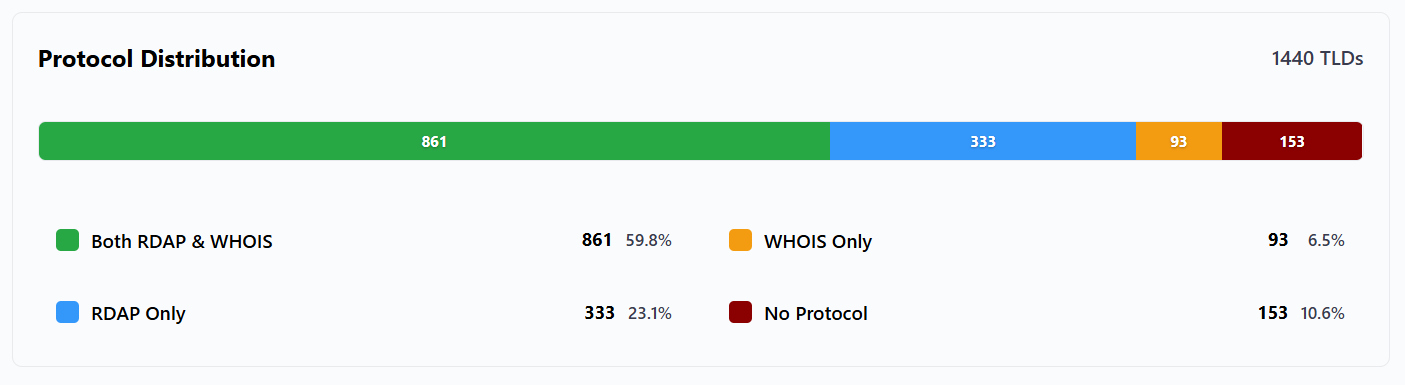
This feature provides a statistical breakdown of the TLD distribution by protocol support and shows exactly how many TLDs currently support RDAP, WHOIS, both, or neither.
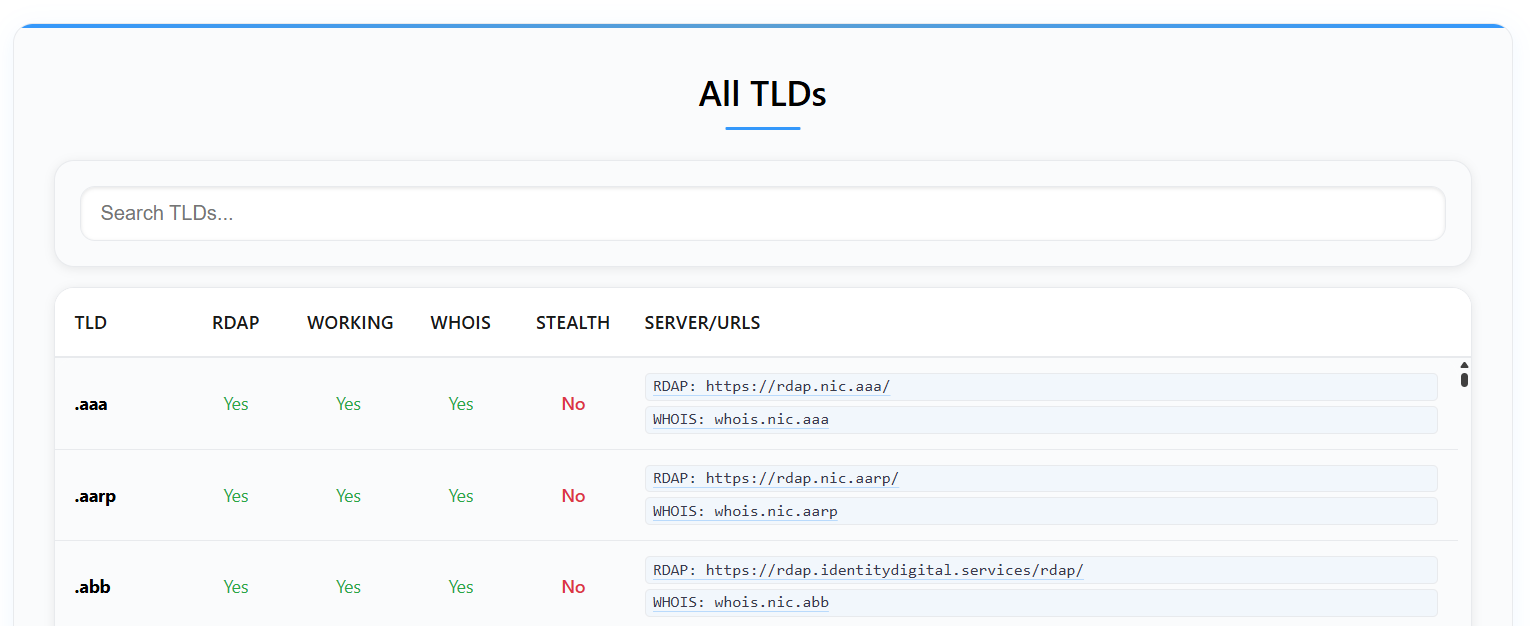
Users can search for a specific TLD to get an immediate snapshot of its protocol support, server status, and the URLs for both its RDAP and WHOIS servers. This eliminates the need to manually search for this information, saving users time.
The TLD RDAP Monitor is available for free public access at https://rdap.wxapros.com/. For those who need to integrate this data into their own systems, the dashboard’s data can be easily downloaded in JSON or CSV format.
Furthermore, for a more programmatic approach, all the data from the monitor can be accessed via our RESTful API endpoints.
Our TLD RDAP Monitor eliminates the guesswork for consumers of domain information who may be concerned about the availability of domain registration data, notably amid the recent and major change in the industry that culminated in the expected shutdown of WHOIS port 43.
We invite all cybersecurity professionals, application developers, and brand protection teams to explore the TLD RDAP Monitor and leverage its powerful insights.
Sponsored byWhoisXML API

Sponsored byRadix

Sponsored byVerisign

Sponsored byDNIB.com

Sponsored byVerisign

Sponsored byCSC

Sponsored byIPv4.Global


A World-Renowned Source for Internet Developments. Serving Since 2002.