
Welcome:
Login
|
Sign Up
|
About CircleID
Follow:
|
|
|

Rod Beckstrom announced today that he will be ending his work at the the Internet Corporation of Assigned Names and Numbers (ICANN) by July of next year. Beckstrom, a former U.S. cybersecurity chief, was elected as the President and CEO of ICANN in Jun of 2009 following Paul Twomey who had been serving the position since March 2003. more
Paul Budde writes: According to the Office of National Statistics in the UK, 85% of the population are regular internet users. With advances in internet technology, individuals and businesses are becoming increasingly more reliant on having instant access to high speed broadband. Statistics show that 69% of UK internet users would be put off from purchasing a home if it did not have a high speed internet connection. more
New research indicates cyberattacks increasingly plague businesses and government organizations, resulting in significant financial impact, despite widespread awareness. Conducted by the Ponemon Institute, the Second Annual Cost of Cyber Crime Study revealed that the median annualized cost of cybercrime incurred by a benchmark sample of organizations was $5.9 million per year, with a range of $1.5 million to $36.5 million each year per organization. This represents an increase of 56 percent from the median cost reported in the inaugural study published in July 2010. more
Google has accused Microsoft, Oracle, Apple and other companies for waging an organized campaign against Android through "bogus patents". Google's Senior Vice President and Chief Legal Officer, David Drummond, in a blog post yesterday wrote: "I have worked in the tech sector for over two decades. Microsoft and Apple have always been at each other's throats, so when they get into bed together you have to start wondering what's going on. Here is what's happening..." more
In a letter to Mr. Rod Beckstrom, President, Internet Corporation for Assigned Names and Numbers (ICANN), the Association of National Advertisers (ANA) has expressed major flaws in ICANN's program for introducing new generic Top-Level Domains. A program which ANA warns would allow as many as 1,000 new Top-Level Domains in the first year and the same cap every year thereafter. more
The U.S. Department of Transportation (USDOT), Research and Innovative Technology Administration (RITA) and Volpe National Transportation Systems Center (Volpe Center), today released a Request for Information (RFI) seeking to obtain informed views on the "perceived needs, prevailing practices, and lessons learned concerning the cybersecurity and safety of safety-critical electronic control systems used in various modes of transportation and other industry sectors."
more
Internet's oldest domain name registrar, Network Solutions, today announced that it has agreed to be acquired by Web.com. Network Solutions was founded in 1979 and pioneered the domain name registration business. In addition to domain name registration, the company also offers services such as web site design and hosting, e-commerce solutions, online security products, SSL certificates, and search engine marketing and optimization. According to Network Solutions, the company manages over 7 million domains, 3 million email boxes and more than 400,000 web sites. more
Joly MacFie writes to report: "iBreakfast is presenting About the 'Domain' Conference: The Era of New TLDs, this Wednesday Aug 3 2011 at Herrick, Feinstein LLC in NYC. Wendy Seltzer, Esther Dyson, and Annalisa Roger, representatives of dotgay, .berlin, .xxx, plus major registries are among the participants who will discuss how the Internet will be impacted by the coming new TLD rollout." more
Kevin Murphy reporting in DomainIncite: "Thousands of companies that use the pseudo-top-level-domain .gb.com have gone offline due to a legal fight between the registry and its founder. CentralNIC sells third-level gb.com domains as a 'Great Britain' alternative to .co.uk. A Google search reveals a great many small businesses use the extension for their web sites. They're all out of luck today."
more
In its second quarter 2011 earnings call, Verisign announced that Mark McLaughlin has submitted his resignation to become the CEO of a private company. His last day with the company will be August 25, 2011. Mark concluded his board service at the regularly scheduled board of directors meeting on July 27, 2011 and resigned as president and chief executive officer effective August 1, 2011. Jim Bidzos, Verisign's founder and previous CEO, will become the president and chief executive officer effective August 1, 2011. more
Cybercrime losses may be erroneously overestimated as most information available on cybercrime losses are derived from surveys, argue two researchers in a recent paper titled, "Sex, Lies and Cybercrime Surveys". Dinei Florencio and Cormac Herley from Microsoft Research examine some of the difficulties of forming an accurate cybercrime estimate by survey. more
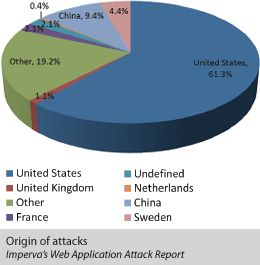 Web applications, on average, experience twenty seven attacks per hour, or roughly one attack every two minutes, according to the newly released Imperva Web Application Attack Report. Report also notes that when websites came under automated attack they received up to 25,000 attacks in one hour, or 7 attacks every second. more
The Malaysian government is poised to fully adopt the Internet Protocol version 6 or IPv6 by the end of next year and may emerge as the first government in the world to achieve full IPv6 compliance, Deputy Information Communication and Culture Minister Datuk Joseph Salang said. According to the report several government agencies have already adopted IPv6 and several others are in the process of shifting from IPv4. more
The United States and India signed a Memorandum of Understanding (MOU) today to promote closer cooperation and the timely exchange of information between the organizations of their respective governments responsible for cybersecurity, according to U.S. Department of Homeland Security. "The MOU was signed in New Delhi by Jane Holl Lute, Deputy Secretary for the U.S. Department of Homeland Security (DHS) and R. Chandrashekhar, Secretary, India Department of Information Technology." more
ICM Registry announced this week it has struck a deal with McAfee for a free malware scan for every .XXX domain. The deal would include McAfee's "trustmark" and date stamp, ICM said. Every .XXX domain will be scanned for vulnerabilities such as SQL injection, browser exploits and phishing sites, reputational analysis and malware, Stuart Lawley, CEO of ICM Registry, said in a statement. more
Sponsored byIPv4.Global

Sponsored byRadix

Sponsored byVerisign

Sponsored byWhoisXML API

Sponsored byVerisign

Sponsored byDNIB.com

Sponsored byCSC

A World-Renowned Source for Internet Developments. Serving Since 2002.