
Welcome:
Login
|
Sign Up
|
About CircleID
Follow:
|
|



|
||
|
||
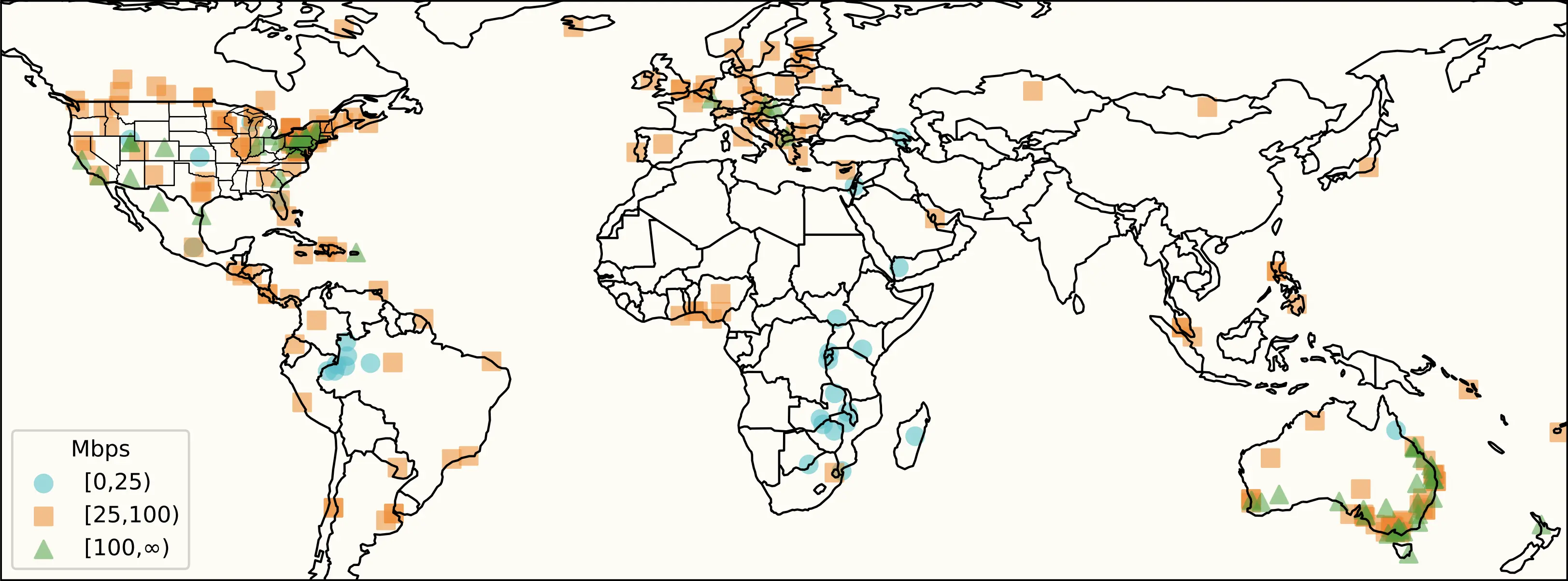
The Internet Society published a blog by Isabel Suizo of Carnegie Mellon University that looks at Starlink’s impact on digital equity.
The blog made three interesting points about Starlink. First, Starlink is not meeting the regulatory performance goals in the U.S., the EU, and Australia. The blog cites speed tests from M-Labs showing that only 24.7% of U.S. tests, 13.6% of EU tests, and 42.2% of Australian tests exceeded 100 Mbps. That speed requirement to qualify as broadband came from the BEAD grants in the US, the Connecting Europe Broadband Fund (CEBF) in the EU, and the Statutory Infrastructure Provider (SIP) regime in Australia.
The analysis noted that Starlink comes closer to meeting the regulatory goals when judged solely by peak speed at a given location, rather than average speeds over time. This is a major finding that has not been widely discussed before. It means that Starlink speeds vary for a customer and that Starlink does not deliver a reliable speed of at least 100 Mbps. The blog contrasts this with fiber, where average and maximum speeds are similar, meaning fiber delivers a reliably steady speed.
The second finding of the report is that there is little difference in Starlink broadband throughput between the top 10% and bottom 10% of households ranked by household incomes. That means, at least at the global level, that Starlink delivers the same broadband to everybody.
However, that’s not entirely true since Starlink does offer priority service to businesses and users like ships in the ocean. These priority customers pay extra to guarantee good broadband. It has also not been widely discussed that Starlink restricts broadband speeds for customers who exceed its 1 terabyte data cap in a month.
The paper concludes that LEO networks have the potential to improve broadband performance for remote, underserved users. That is not surprising, as it aligns with the stated goals for both Starlink and Kuiper. These companies have touted since they began that they can bring broadband to the underserved and unserved around the world.
Overall, this analysis adds to the evidence of how Starlink works in practice. The biggest revelation from the research is that speeds to a given customer vary, and that speeds are sometimes solid and sometimes aren’t.
The research shows that, at least for now, Starlink is largely delivering the same broadband to everyone, with the caveat that some customers are willing to pay more for higher priority. Only time will tell if priority for pay becomes a regular feature of LEO broadband. Finally, Starlink appears to be meeting its stated goal of bringing broadband to areas beyond the reach of landline networks.
Sponsored byIPv4.Global

Sponsored byRadix

Sponsored byCSC

Sponsored byVerisign

Sponsored byDNIB.com

Sponsored byVerisign

Sponsored byWhoisXML API


A World-Renowned Source for Internet Developments. Serving Since 2002.