Home / Blogs

SES Pursues Multi-Orbit Satellite Internet via Strategic Partnerships

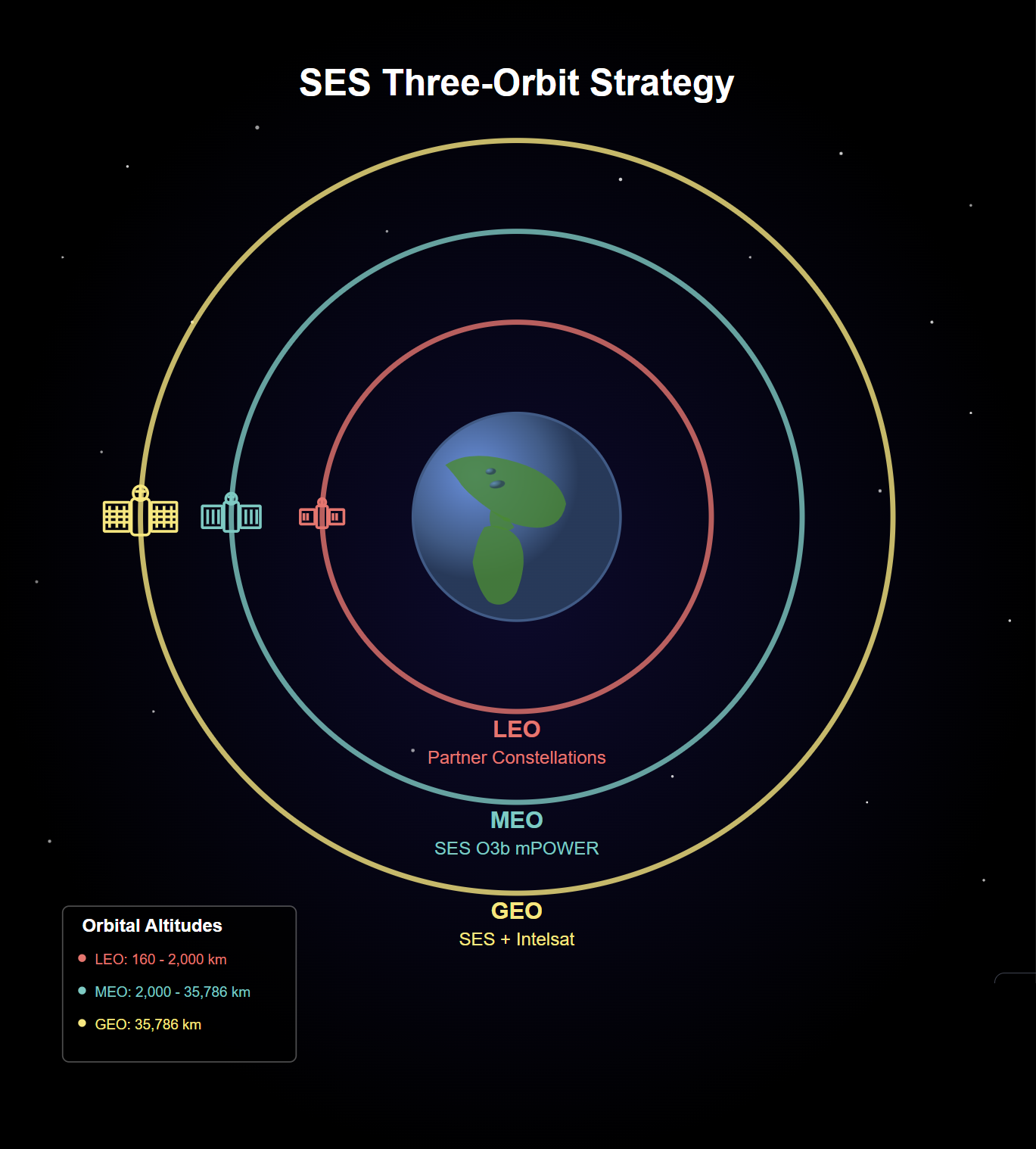
SES’s unique three-orbit offering.

In 2021, OneWeb CEO Neil Masterson said, “Interoperability with GEO satellites must happen—it’s common sense… Customers don’t care whether it’s a LEO satellite or a GEO satellite—all they want is connectivity,” and ten months later, OneWeb and Intelsat signed the first multi-orbit broadband agreement. SES, which was already a LEO-MEO operator in 2021, is now pursuing a three-orbit strategy, but they are not planning to launch a LEO constellation, but will blend multiple partners’ constellations into a unified three-orbit offering.

  • SES’s first multi-orbit partnership was Cruise mPOWERED + Starlink, providing a managed blend of SES MEO and Starlink LEO service for maritime operators, and we can expect similar bundled services in aviation and enterprise markets.
  • SES and Lynk Global plan to provide direct-to-device (D2D) connectivity through Lynk’s “cell towers in space” and SES’s MEO backhaul and terrestrial infrastructure. (SES operates the largest fiber network among satellite providers, with global reach through 150 owned and partner teleports and 50 points of presence.) Might SES also offer AST SpaceMobile D2D service?
  • SES recently completed its acquisition of GEO operator Intelsat, giving it 120 LEO and MEO satellites, but it also inherited Intelsat’s commitment to buy $250 million worth of LEO capacity from OneWeb over six years, giving it access to an operating LEO constellation.
  • SES and OndWeb’s parent company Eutelsat are both members of the SpaceRISE consortium that is building the Iris^2 multi-orbit network.
  • Amazon’s Project Kuiper is ramping up launch campaigns and seeking distribution partners, and SES’s global ground infrastructure and government contracts make selective Kuiper integration plausible, especially for defense and enterprise deals. Project Kuiper expects to offer service in the US and four other countries by the end of March and approximately 26 countries by the end ot next year.
  • Telesat’s LEO constellation Lightspeed targets enterprise and government—markets SES knows well. If Lightspeed reaches orbit at scale, SES could combine its MEO and GEO coverage with Telesat’s polar-friendly LEO. Telesat also offers GEO connectivity, but instead of offering multi-orbit service, they will sell Lightspeed to other GEO providers. For example, they have an agreement to provide LEO service to Viasat.

These early and potential LEO partners are all US or European companies, and SES is in Luxembourg, which is now a member of NATO, but it was neutral before World War II and is relatively liberal. While it is inconceivable today, might SES collaborate with a Chinese LEO constellation one day? Perhaps starting with geo-fenced service in China or Belt and Road initiative nations.

This move makes SES unique. They will offer three-orbit service without the cost and delay of a new LEO constellation, and will be able to select the best LEO provider for a given application. They also plan to gradually grow their MEO constellation, adding a satellite every year.

That being said, they are facing stiff competition from Starlink today, and Amazon’s Project Kuiper will be in service soon. They will be competing with their partners in some cases and sharing profits with them in all cases. It also remains to be seen how smoothly they can technically and operationally integrate heterogeneous LEO partners at a competitive cost. Stay tuned.

NORDVPN DISCOUNT - CircleID x NordVPN
Get NordVPN  [74% +3 extra months, from $2.99/month]
By Larry Press, Professor of Information Systems at California State University

He has been on the faculties of the University of Lund, Sweden and the University of Southern California, and worked for IBM and the System Development Corporation. Larry maintains a blog on Internet applications and implications at cis471.blogspot.com and follows Cuban Internet development at laredcubana.blogspot.com.

Visit Page

Filed Under

Comments

Huh? Karl Auerbach  –  Sep 23, 2025 2:09 PM

The article says “Customers don’t care whether it’s a LEO satellite or a GEO satellite”.

Huh?

People and applications certainly do care about a latency of a few tens of milliseconds versus on the order of half a second or more.

Ask any gamer or person who uses zoom or VoIP.  Or better, listen to the flash traders who are using straight line microwave links because the speed of the photons on fiber optics is too slow.

Larry Press  –  Sep 23, 2025 4:35 PM

That’s not me talking, it’s a quote. To be fair to him, I guess he was thinking of a system that could automatically “do the right thing” depending on the nature of the application and data or at least let the user choose constellations manually.

Comment Title:

  Notify me of follow-up comments

We encourage you to post comments and engage in discussions that advance this post through relevant opinion, anecdotes, links and data. If you see a comment that you believe is irrelevant or inappropriate, you can report it using the link at the end of each comment. Views expressed in the comments do not represent those of CircleID. For more information on our comment policy, see Codes of Conduct.

CircleID Newsletter The Weekly Wrap

More and more professionals are choosing to publish critical posts on CircleID from all corners of the Internet industry. If you find it hard to keep up daily, consider subscribing to our weekly digest. We will provide you a convenient summary report once a week sent directly to your inbox. It's a quick and easy read.

Related

Topics

Brand Protection

Sponsored byCSC

DNS Security

Sponsored byWhoisXML API

Cybersecurity

Sponsored byVerisign

New TLDs

Sponsored byRadix

Domain Names

Sponsored byVerisign

DNS

Sponsored byDNIB.com

IPv4 Markets

Sponsored byIPv4.Global