
Welcome:
Login
|
Sign Up
|
About CircleID
Follow:
|
|
|

 Registrars have the opportunity to fundamentally change the landscape of the Internet's security infrastructure by working to close the DNSSEC functionality gap. Virtually everything every Internet user does on the Internet depends on the DNS. DNSSEC is not just about protecting the DNS, it is about building a secure infrastructure foundation upon which new and innovative services and applications can be built to benefit us all. Registrars are the linchpins to advancing the deployment of DNSSEC. more
 The first Sunrise Period for trademark owners under ICANN's new gTLD program has begun. The gTLD is the Arabic IDN '????, or "dot-Shabaka". The term roughly means "web" in Arabic and eligibility for registrations is unrestricted. The Dot-Shabaka Registry has made it clear for months that they wanted to be the first TLD to launch this year. more
 I just finished reading Richard Clarke and Robert Knake's book Cyberwar. Though the book has flaws, some of them serious, the authors make some important points. They deserve to be taken seriously. I should note that I disagree with some of my friends about whether or not "cyberwar" is a real concept. Earlier, I speculated that perhaps it might be a useful way to conduct disinformation operations, but it need not be so limited. more
 Last week I published a blog looking back on the year that was 2015 and reflecting on some of the challenges and achievements for new TLDs. Turning our gaze forward, I think 2016 is shaping up to be the biggest and best year that we've enjoyed to date and will surpass many expectations as we continue the push towards mainstream adoption of these wonderful, innovative digital assets. more
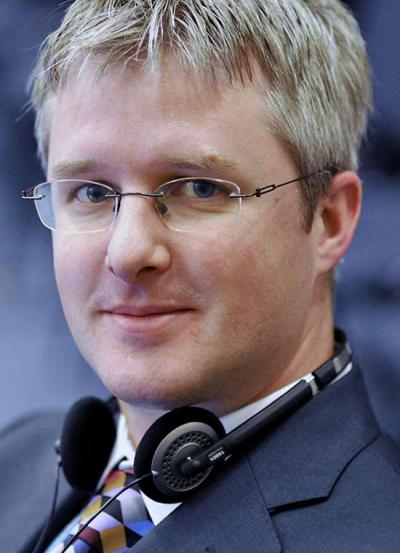 The number of applications this year for the seven positions within ICANN has been so low that the NomCom has gone to the trouble of printing up pamphlets, holding a public meeting at Marrakech and extending the deadline by a fortnight. At the two public Board sessions in Marrakech the grand hall that was provided was virtually empty, sparking some debate as to why. Susan Crawford ventured that it was because ICANN was failing to connect with people; Vint Cerf suggested that ICANN was so successful at doing its job that people didn't feel the need to attend. Mouhamet Diop pointed out that we were in a French-speaking Arabic country and no one was going to sit through four hours of discussion if they didn't understand a word of it... more
 The 78th UN General Assembly (UNGA) addressed the issue of cybersecurity again at one of its last meetings in December 2023. It included the adoption of four resolutions on the Open-Ended Working Group (OEWG), a "Program of Action" (POA), and autonomous weapon systems. The texts of the four draft resolutions were negotiated in UNGA's 1st committee, responsible for international security issues, in October and November 2023. more
Allen Grogan, ICANN's Chief Contract Compliance Officer, has written a blog post today concerning a formal letter it has received asking the agency to halt the rollout of .SUCKS, a new gTLD operated by Vox Populi Registry Inc. As it stands, a ruling against Vox Populi by ICANN could result in federal prosecution or other legal action, according to ICANN officials. more
 Bandwidth is the basic foundation for Internet traffic as a connector to everything important in our lives. Whether it is basic bandwidth for connecting to family and friends, or a super fast highway for global reach and competitiveness in the business world, bandwidth constitutes the speed at which we connect as a global presence within the expanding sphere of Internet communication. ... To understand why bandwidth is important to all Americans, including personal and business uses, we must understand the different types Internet traffic. more
 Months ago, while watching a Saturday Night Live skit about non-fungible tokens (NFT) featuring a parody of Janet Yellen speaking to a high school economics class, I realized what an NFT is and how they work. What they represent, how they are minted, and how their value is exchanged became clear while watching Pete Davidson in a boy wonder unitard rap about the latest crypto-phenomena. It was only later that I realized that NFTs have plenty of practical applications. more
New data released today indicates that trust has eroded among criminal interactions, causing a switch to ecommerce platforms and communication using Discord, which both increase user anonymization. more
 Let's take a second to look back some 50 years to the world of 1972 and the technology and telecommunications environment at that time. The world of 1972 was one populated by a relatively small collection of massive (and eye-wateringly expensive) mainframe computers that were tended by a set of computer operators working around the clock and directed by specialized programmers, trained in the obscure symbol set used by the job control systems on these computers. more
 The new Clearwire could be game-changing, but the rules of the game may not be quite as Clearwire presents them. I have been wondering since last July whether something significant would happen in the Google/Sprint world. The deal announcement earlier this weekseems to be that key development... In a nutshell, Sprint will contribute its substantial spectrum licenses in the 2.5 GHz range and its WiMAX-related assets and intellectual property. Google, Intel, Comcast, Time Warner Cable, and Bright House Networks will invest a total of $3.2 billion. more
There are still a number of countries who have Queen Elizabeth as their titular head of state. My country, Australia, is one of those countries. It's difficult to understand what exactly her role is these days in the context of Australian governmental matters, and I suspect even in the United Kingdom many folk share my constitutional uncertainty... In the United Kingdom every year the Queen reads a speech prepared by the government of the day, which details the legislative measures that are being proposed by the government for the coming year. Earlier this month the Queen's speech included the following statement in her speech. more
 Humanity continues to find itself at a crossroads. Ahead of us lies an uncertain future filled with predictions of imminent doom and ominous prospects along with the wonders of science and technology. Behind us lies a century marked paradoxically by both devastating global conflicts and unparalleled global collaboration. As societies continue to globalize, we are increasingly becoming more connected - to the point where it is difficult, if not impossible, to divorce ourselves from the interconnectivity in contemporary systems of commerce, economics, politics, and culture. more
 Recently, I had time to reflect on various matters after the alternator in my vehicle decided that the middle of a mountain pass was the appropriate time and place to go to that great big pick-and-pull scrapyard in the sky while leaving me stranded with no cell signal on the side of the road in the middle of nowhere. Until that point, I had been seriously considering applying to ICANN's Nominating Committee for one of the three open seats on ICANN's Board of Directors. more
A World-Renowned Source for Internet Developments. Serving Since 2002.